The Strategic Week (no. 4, Friday 15 January 2016) – the week in governance, planning, infrastructure and transport

Welcome to the first edition of The Strategic Week for 2016 – and apologies for the delay in this edition which was meant to appear last week. This edition also covers the period since the appearance of TSW 3 on 18 December and as with that edition there is extended coverage of the NSW Local Government reform process.

Governance

Federal Minister for Cities resigns after only three months

The Federal Minister for Cities and the Built Environment Jamie Briggs resigned on 29 December following a late-night incident during an official overseas visit in November involving a female public servant in a Hong Kong bar. Mr Briggs, who was appointed to the new portfolio only at the end of September, will be replaced by the Minister for the Environment Greg Hunt.

 NSW council merger proposals delegated amid divided responses to reforms

A group of delegates has been appointed to examine and report on the NSW Government’s recently-announced council merger proposals. The Minister for Local Government referred the merger proposals to the CEO of the Office of Local Government for “examination and report under the Local Government Act”. The CEO in turn has passed these activities on to the 18 appointed delegates who will conduct inquiries, receive submissions and prepare reports on the proposals based on the factors outlined in the Act, with submissions being received until 28 February 2016. The reports will be considered by both the Minister and the NSW Local Government Boundaries Commission.

The process is described on the NSW Council Boundary Review website which also lists the names of the delegates and describes the council merger proposals they will each be assessing. While there is a strong record of experience in senior management positions in local and state government in the delegates’ CVs, only three women have been appointed.

NSW Council Merger Maps

Criticism of the proposals has continued to intensify despite the summer holiday break, with opposition coming not just from the affected councils. According to an ABC news report 500 Kiama residents attended a recent meeting to protest against the proposed merger of their council with Shoalhaven council, calling on the local state member to introduce a private members bill to exempt Kiama from his own government’s policy.

Professor Graham Sansom who chaired the Independent Local Government Review Panel which initiated the reform process has also been highly critical, claiming that the government’s announcement “fails the test of carefully structured strategic reform”, according to media reports.

“It looks like a bit of a grab bag of some changes that are close to what we suggested and make a lot of sense and other changes which I find extremely hard to understand what on earth they are meant to achieve other than presumably some political objective,” Prof. Sansom said. “The reforms are part of a pattern which tells me that local government in NSW is seen as less and less relevant on the big picture issues …They are a crab-like step sideways, they are not a step forward.”

Opposition Leader Luke Foley quoted Prof. Sansom in an opinion piece which also strongly attacked the proposals. Mr Foley was particularly critical of the proposals to split Warringah Council to merge it with Manly and Pittwater Councils and to also split off sections of Parramatta to form a new council to the south.

“Instead of outcomes underpinned by expert analysis, advice and research, what we have is the greatest act of boundary rigging in Australian politics since Joh Bjelke-Petersen’s Queensland gerrymander in the 1970s,” Mr Foley concluded.

The proposals have however received support in some quarters, although with some qualifications. The Urban Taskforce stated that “Reducing Sydney’s 43 councils to 25 will drive reform that will improve performance while still keeping a local identity for councils”, though it expressed concerns that the proposed mergers “do not align with some of the Planning District boundaries as defined in the Metropolitan Strategy”, citing the proposed The Hills and Hawkesbury Councils merger as an example that would result in a cross-boundary council.

While criticising aspects of the proposals including the timing of the announcement just before Christmas, a Sydney Morning Herald editorial also expressed support. “It is not the sort of festive gift many communities will welcome, but they should, because in the long run, they and the state will benefit,”, the paper noted.

It described the government’s record in selling the reforms as “patchy”, noting that its public commitment has “ebbed and flowed” and that changing the IPART criteria for describing what made councils fit for the future had “eroded confidence”. The SMH however praised the decision to use a reconstituted Boundaries Commission process rather than the option of “doing deals with the Upper House crossbenchers to enforce mergers”.

The Herald concludes that while Mr Baird still has “significant political capital on which to draw” though if he gets the final decisions “wrong”, the “backlash will be fierce”. The paper states however that if in the end the merger proposals succeed, “that will be a victory for efficiency and effective government”.

NSW local government reform – the long view

A useful perspective on the long history of local government reform proposals in NSW is provided by Bligh Grant in the Australian Centre of Excellence for Local Government* (ACELG) blog, The Town Crier. Grant notes that reform proposals are “nothing new” and date back to at least 1898, with five attempts between then and 1948. This follows an earlier article by Grant describing the current processes. In the second article Grant notes that “all of these processes represent two fundamental trajectories for reform, namely proposed amalgamation – particularly for Sydney metropolitan councils – and the move toward metropolitan-wide governance”. He concludes:

“… it is not merely the twin policy goals – amalgamation and metro-wide governance – that are immediately similar in the ‘eternal return’ of Sydney’s metropolitan reform. On the contrary: It is the sites of conflict over both these issues – the seeking of advice from specialist commissions (in 1913 a Royal Commission; in 2012-13 the ILGRP, for example); and in particular the power-plays between the two houses of the NSW Parliament, through which we are reminded of the relationships between local governments and the Legislature, that are strikingly similar.”

* The author of The Strategic Week is an ACELG Associate.

Greater Sydney Commission Chair gets a seat – or two – at infrastructure table

Both the Chair of the Greater Sydney Commission (GSC), Ms Lucy Turnbull, and its CEO Sarah Hill will attend key meetings of the powerful infrastructure committee of NSW cabinet when it discusses issues related to Sydney. As a media report notes, the addition of the GSC Chair and CEO to the committee “shows just how influential the commission will be in shaping of the city’s future”.

Planning

Noise issue dominates Western Sydney airport debate as consultation period closes

The 60-day community consultation period for the draft Western Sydney Airport Plan and draft Environmental Impact Statement closed on 18 December 2015. According to the Deputy Prime Minister and Minister for Infrastructure and regional Development Warren Truss over 4,500 submissions were received and nearly 1,500 people attended 16 public information sessions.

The Minister’s media release seemed to suggest that construction of the airport was a fait accompli, stating that while the government would “take the community’s feedback on board” as it finalised the EIS and was “committed to continuing to consult with the community as this transformational project develops, with the first flights set to land around 2025”.

The main issue of concern regarding the proposed airport continues to be aircraft noise. One media report claimed that a federal government proposal for stricter noise controls near Sydney’s second airport could “expose it to a wave of compensation claims”. The noise exclusion zone would increase from 50 to 400 square kilometres and would include growth areas and established suburbs.

The Mayor of Blacktown, Stephen Bali who has been campaigning for compensation for residents in the flight path said the document “completely demolishes Truss’ argument that noise will be a non-issue”. In another report Urban Taskforce CEO Chris Johnson CEO claimed “at least 10,000 proposed new homes could be stopped if the new standard is adopted.”

Record NSW building numbers claimed but trending downwards

NSW Planning Minister Rob Stokes has announced that there were nearly 66,500 housing approvals in the year to November 2015, the highest result on record. NSW also had the highest annual growth in approvals of all mainland states. The Minister also announced that a record $34 billion worth of construction was approved in the 2014/15 financial year. This represented over 90,000 approvals, a seven per cent increase on the previous year’s figures of 84,000 approvals worth $29 billion.

A closer analysis of the figures reveals a mixed picture, however. The November Australian Bureau of Statistics (ABS) release of building approvals information indicates that the trend estimate for total dwellings approved in NSW fell by 2.8% and has fallen for the past five months. The estimate for the number of approvals of private dwelling houses decreased by 0.5% and has also fallen for the past five months. The Sydney Morning Herald claimed that the overall figures also revealed that 75% “more people are building on their blocks of land, as subdivisions or granny flats, than five years ago”.

Land values increase, especially in Western Sydney

Figures released by NSW Valuer General Simon Gilkes indicate NSW land values totalled over $1.34 trillion in 2014/15, a 19.6% increase on last year’s $1.12 trillion total.  “Land values in Sydney’s West underwent a boom in the last financial year far exceeding the rest of the greater metropolitan area”, Mr Gilkes said, with the local government areas of Parramatta, Blacktown and Holroyd recording the strongest growth.

Blacktown topped the state, with 47% growth in the value of residential land, followed by Holroyd (38%) and Parramatta (35.9%). Two other Western Sydney council areas, Fairfield and Auburn, were also in the top nine LGAs with growth over 30%.

Auckland Mayor identifies cities as the “first responders” to climate change

In an opinion piece for the New Zealand Herald Auckland Mayor Len Brown has indicated his determination to tackle the challenge of climate change “head on”.

“Cities will be the first responders because they know what is at stake. City action could make up a third of the shortfall between the Paris Agreement’s ambitions and current country commitments – that’s 3.7 gigatons of urban greenhouse gas emissions by 2030,” Mr Brown said.

Along with its recently-announced membership of the C40 Cities Climate Change Group Mr Brown identified Auckland’s consolidated governance as a factor in this process.

“As a united Auckland, we have an unprecedented opportunity to respond rapidly and strategically to affect the kinds of changes needed to ensure this city’s future” he said.

Mr Brown also noted that the council has set a target of reducing greenhouse gas emissions by 40% by 2040 (relative to 1990 levels) and that $20 billion will be invested over 10 years to create a modern, efficient and sustainable multi-modal public transport system which was already attracting growth in patronage of around 10% annually.

“As part of the C40 network, we can engage with cities facing similar challenges, enhancing Auckland’s ability to benefit from their expertise, tools and programmes,” Mr Brown concluded.

Infrastructure

Federal Opposition seeks probe into infrastructure spending – and criticises transport projects “propaganda”

The federal opposition has written to the Australian National Office of Audit requesting a review of “the Turnbull Government’s entire infrastructure program amid a 20 per cent decline in infrastructure investment and the collapse of two of its major road projects,” according to a media release from the Shadow Minister for Infrastructure and Transport, Citues and Tourism Anthony Albanese.

The media release also accused Infrastructure Minister Warren Truss of wanting to “raid his own infrastructure budget for $18 million which he plans to squander on advertisements about his own performance”

The Shadow Minister also claims that public infrastructure investment “plunged 20%” between the September quarter of 2013 and the June quarter of 2015 and that two projects, Melbourne’s East-West Link and the Perth Freight Link have “collapsed” while the budget for Sydney’s Westconnex toll road “has blown out from $10 billion to $16.8 billion”.

“The government has cut funding for public transport projects and re-allocated it to new toll road projects which it did not subject to cost-benefit analysis to determine whether they represented value for money,” Mr Albanese said.

Transport: Sydney Metro

Metro tunnelling completed ahead of time

The tunnelling for Sydney’s Metro Northwest has been completed with the last of the four tunnelling machines breaking through to connect with the future Cherrybrook station.

The NSW Premier Mike Baird, Minister for Transport and Infrastructure Andrew Constance and local MPs witnessed the historic breakthrough, which completed the second of two 15 kilometre tunnels.

“Today everyone can be proud at what’s been achieved, with this long-promised critical public transport project taking shape before our eyes,” the Premier said in a media statement, later declaring at the site that the project was “ahead of time and under budget”.

How much will the metro really contribute to Sydney’s peak hour train capacity?

SMH report Jacob Saulwick has questioned the NSW Premier’s claim that the when completed the Sydney Metro will boost the capacity of Sydney’s rail network by 60%. In a recent article Saulwick admits that it was probably “a failure of the media” that he and other journalists did not fully scrutinise this claim at the time it was first made by Mr Baird, partly because the need for an additional line had been “well established for decades” and also because the state government was “making impressive construction progress” on its rail projects.

Since then Saulwick has been attempting to use FOI requests for material that would support the 60% claim. An initial requests for the 2014-15 period revealed none, while a request covering earlier years produced only one document which provides little detail to support the claim. As a result Saulwick states that he has “oscillated between a couple of attitudes” towards the Premier’s commitment and the metro project generally – on the one hand a new line is being built which will greatly increase capacity, on the other the need to justify $10 billion in public spending especially when two existing lines will be “cannibalised” for the project.

“I don’t have a problem with companies running transport services. But the problem is when transport services are structured in a way to make it easier for companies to build and run them, at the expense of what is best for people who need to use them”, Saulwick says, noting that the metro will join the Bankstown line, the least busy of Sydney’s main rail lines.

He concludes by noting the Transport for NSW had subsequently provided some information, claiming that the new metro will add 60 services to the 120 entering Sydney in the morning peak hour. Saulwick suggests that this does not take into account the 16 services already running in this period on the Bankstown Line, “so the 60 ‘new’ services would really be only 44 – and that’s less than a 40 per cent increase.”

A separate comment piece will be published shortly on this issue.

Transport: Light Rail

Passionate protests fail to save trees from the chop for the light rail

Protestors chained themselves to trees in a desperate attempt to save them from being chopped down to enable construction of Sydney’s light rail line along the edge of Centennial Park. The line was originally planned to run along the south side of Alison Road next to the racecourse but was subsequently shifted to the north side next to the park. The affected trees, some up to 100 years old, were described as “having irreplaceable heritage and environmental value”.

The protest was to no avail however, with most of the trees cut down over a weekend after police told the protestors to leave as they were trespassing. Transport for NSW rejected claims by Randwick Council that it had not been consulted regarding the altered plans, stating that the alignment was changed “after further consultation was carried out with the community and stakeholders” and that the constructing the line on the south side of Addison Road was “unfeasible”. Between two and eight trees will be planted to replace each tree removed.

Gold Coast Light Rail on the up and expanding, as fare increase deferred

Gold Coast Light Rail patronage has increased by 640,000 trips or nearly 52% to a total of 1.88 million fares during the July to September quarter of 2015, compared to 1.24 million trips in the same period in 2014, according to the latest figures from the latest TransLink Tracker report on public transport patronage in Queensland.

While there were increases across all modes of 3.1% in trip numbers to 47.09 million, the new light rail line made the largest contribution of any mode to the 1.42 million extra trips made. The Queensland Minster for Transport Stirling Hinchcliffe claimed in a media release that the Labor government’s decision to reinstate TransLink Tracker was “about restoring accountability and transparency in our public transport network” after the quarterly statisitcal report was scrapped by the previous LNP government.

“It’s fantastic to see that after three years of stagnating under the former government’s watch, patronage on our public transport network is growing and is up by 3.1 per cent,” he said. The Minister conceded however that “affordability remains the weakest performing category”, stating that the Government had appointed a taskforce to review Translink fares. He also announced a fare freeze would be imposed until July 2016 while the review is underway.

In a separate statement Mr Hinchcliffe announced that the three companies short-listed to construct the 7.3 kilometre second stage of the light rail had all submitted detailed bids. GoldLinQ Chairman John Witheriff said the team would now evaluate the detailed proposals with the announcement of the successful tenderer due to be made by April. The project which will link the current northern terminus at Gold Coast University Hospital to the Helensvale rail station and bus interchange is due to be completed in late 2017 or early 2018, in time for the 2018 Commonwealth Games to be held on the Gold Coast.

Light rail to Auckland Airport “a bad idea”

An editorial in the New Zealand Herald has criticised suggestions that light rail could be an alternative to heavy rail for the proposed link from Auckland’s CBD to the city’s airport at Mangere, describing the proposal as “a bad idea”.

The paper’s comments came after the airport’s managing company requested a decision on the mode be made by the middle of the year so that a station can be incorporated into its plans for a new domestic terminal.

“The ability to greet or farewell travellers at Britomart [the city’s current rail terminal] may be more convenient than driving all the way to Mangere for many Aucklanders. For that very reason a rail connection to the airport should be a high priority for the Auckland Council, as it was until, inexplicably, Mayor Len Brown postponed it to the 2020s in his planning.”, the NZ Herald states.

Auckland Transport (AT) is considering both light and heavy rail options, claiming that a heavy rail link would cost around NZ$2.2 billion and provide travel times between the current rail terminal and the airport of 39 minutes while light rail would cost less than half at $1 billion but take five minutes longer (44) minutes to complete the trip. The NZ Herald acknowledges that light is better than the “rattling old trams of distant memory”, but still doubts the travel time estimates because of the impacts of traffic congestion. It concludes that “the airport company envisages an underground station in the new domestic terminal. That sounds perfect. AT should forget about trams and get real trains in there.”

Transport: Rail

Brisbane’s Moreton Bay line “switched on” ahead of mid-year opening

joint statement by the Queensland Deputy Premier and Minister for Infrastructure, Local Government and Planning and Minister for Trade and Investment Jackie Trad and the Minister for Transport and the Commonwealth Games Stirling Hinchliffe has celebrated the switching on of power for the overhead wiring on the new Moreton Bay line north of Brisbane.

Moreton Bay rail link map (source: Queensland Government website)

Moreton Bay rail link map (source: Queensland Government website)

The six-station 14km link was jointly funded by the Australian Government ($583 million), the Queensland Government ($300 million) and Moreton Bay Regional Council ($105 million). It runs from Lawnton to Kippa-Ring with a grade separated rail connection to the Caboolture line and is due to open in the middle of the year.

“Once opened, the rail line will revolutionise public transport in the Moreton Bay Region, delivering more than 650 train services between Kippa-Ring and Brisbane each week,” Mr Hincliffe said.

Auckland City Rail Link to be funded two years early

Media reports suggest that the New Zealand Prime Minister John Key will provide financial assistance to Auckland’s City Rail Link (CRL) two years earlier than expected. The foreshadowed decision is set to be announced on 27 January and follows lobbying by Auckland Council in the wake of soaring public transport patronage particularly on the city’s rail network (as reported in TSW no. 3).

In 2013 the government committed to joint funding for the project but said it would provide its share of the funds in 2020. It indicated however that it would consider an earlier start if rail patronage and employment growth in the city centre reached set targets. Preliminary works have already commenced on the line which will complete a loop under the CBD from the current terminus at Britomart to Mt Eden station, with two new stations to be built under the city centre.

“Sky train” suggested to beat Melbourne’s level crossings

Rebuilding the Dandenong rail corridor in Melbourne’s southeast as viaduct has been proposed as an alternative by a bidder for the project to upgrade the line, rebuild four stations and remove nine level crossings, according to media reports.

The proposal for the city’s busiest rail line has been attacked by the Shadow Planning Minister David Davis. “The complete structure of the elevated rail, including poles and overhead wires, will be around three to four storeys high, making it a visual eyesore in suburban areas,” Mr Davis is quoted as saying.

However Ian Woodcock, an urban design lecturer at RMIT, said that an elevated rail line could be a less intrusive way to remove the level crossings than the current method of digging a long trench. Elevated rail lines already exist in some corridors in Melbourne.

Melbourne public transport goes 24 hours while Bendigo gets extra services

Victorian Minister for Public Transport Jacinta Allen has praised the work of public transport operators after the first weekend of Night Network, claiming that almost 10,000 Victorians used the all night services. Night Network is a year-long trial to evaluate the demand for all night public transport at weekends and the impact it has on businesses and residents. During the trial data will be gathered on patronage, network performance data, and public and business feedback.

“Initial myki touch on data from the first weekend has shown three times as many people used Night Network compared to NightRider services – but we want to see even more Victorians taking advantage of this great new service,” Ms Allen said.

In a separate release Ms Allen also released details of the additional services to serve Bendigo. These include an addiitonal morning and evening service between the inland city and Melbourne and more trains will stop at the nearby towns of Epsom, Eaglehawk and Kangaroo Flat. These services will form the first stage of the Bendigo Metro Rail project, which aims to establish a commuter rail service for the city, and are supported by additional bus services.

Transport: Fares and Funding

More support for value capture approaches to fund public transport…

The Committee for Sydney has released a report on how value capture could be used to contribute to public transport funding. While it is focused on Sydney, the the Committee claims the report “also provides lessons for Australian State and Federal governments on how to deliver better transport infrastructure”. The issues paper  notes that Public Transport in Australia does not fund itself, with (for example) only 25% of the operational costs of Sydney Trains covered by income and the remainder by general revenue. The report claims this gap needs “to be reduced to make it more viable and attractive to Treasury and Government”.

Lincoln Leong, the CEO of MTR which currently runs the Melbourne Metro rail network and will be the operator of the Sydney Metro Northwest line, is seeking to build and run additional lines in Australia using its version of the value capture model, according to a recent report. “The company funds the construction and maintenance of its rail lines by developing and managing high rise apartment blocks, malls and offices around or on top of train stations and depots,” the article states.

One area of criticism is that the MTR’s Hong Kong developments are very large and dense by Australian standards, which is acknowledged by Mr Leong.  “The issue for Hong Kong is we have a relatively large population packed into a relatively small area and therefore inevitably one of the options for us would be to go up, but that need not be the case in other cities and that really is dictated by the city planning,” Mr Leong said.

… but what are the real consequences of privatisation?

While the value capture mechanisms mentioned above can be used by public transport operators, the MTR model provides an example of their use by the private sector. An opinion piece in the Guardian has provided a critique of the privatisation of public transport particularly in NSW – and also of the MTR value capture approach.

In a strongly-worded article, Greens NSW MP and spokesperson on multiculturalism and transport Mehreen Faruqi claims that the “outsourcing and privatising of government services is at the heart of the neoliberal agenda; it’s a test of economic conservatism and ‘management’ to put as many publicly operated services into private hands as possible.”

“…public transport privatisation is the unexamined trajectory of Baird’s overall multi-billion dollar infrastructure strategy – taking our essential transport services out of public hands and into the control of private companies,” she states.

Ms Farudi also singles out value capture for criticism, claiming “big business” also benefits from the resulting “massive overdevelopment” around stations. In addition she argues that “carving up” the rail network “is a way of breaking down an organised and unionised workforce” and is also critical of the privatisation experience in Victoria.

“Melbourne trains are run by MTR, which is often exemplified for running the supremely efficient Hong Kong Metro. This is the company the government has brought on to run metro trains in Sydney. But MTR is owned by the government of Hong Kong, and when MTR ventured into the world of private contracting for running Melbourne’s public transport the successes of Hong Kong could not be replicated.

“The vague myths about private operators reducing costs and increasing efficiency are just that – myths”, she states.

Most NSW paper tickets phased out – and the possible end of cheaper Opal travel

The sale of most NSW public transport paper tickets including pensioner excursion tickets, bus and ferry TravelTen tickets and rail MyMulti weekly tickets ended on 1 January 2016. The only remaining paper tickets are adult and concession single and return tickets and some pensioner country and international student tickets.

No paper tickets graphic

Meanwhile the NSW Independent Pricing and Regulatory Tribunal (IPART) has released the More efficient, more integrated Opal fares draft report. In a media release accompanying the report the IPART Chair Dr Peter Boxall said the proposals “are designed to deliver a fairer structure of fares, while ensuring fares continue to cover approximately 20% of around the $6 billion1 cost of providing public transport”.

Dr Boxall stated that the proposed changes would mean that over 60% of passengers would pay less next year and that over the next 3 years, the average annual increases before inflation would range from 1.8% for rail passengers, to 3.3% for bus and light rail passengers, and 3.5% for ferries.”

The review also proposes ending the multiple flag falls which still apply under Opal for mode changes on a single trip.

“The package we’re proposing would make public transport fares more integrated by calculating fares for multi-mode journeys in the same way as for single-mode journeys, so customers could switch modes without being penalised”, Dr Boxall said.

There would also be a bigger discount for off-peak rail travel – but longer distance journeys would become relatively more expensive. What has been described as the “Opal loophole” – the practice of some passengers who take short, unnecessary trips early in the week in order to qualify for free trips on their actual much longer commute would also be ended.

“We are also proposing to reduce the number of free trips enjoyed by some, so more passengers can access lower fares without further increasing the burden on taxpayers,” Dr Boxall said.

Submissions on the draft report will be accepted until 5 February 2016, with the intention that new fares would come into effect on 1 July 2016
Posted in Airport, Environment, Growth, Infrastructure, Local Government, Planning, Public Transport, The Strategic Week, Transport, Western Sydney | Tagged , , , , , , , , , , , , , | 4 Comments

What happened in StrategicMatters in 2015?

DSCN3567-copyIt is certainly a busy time for those involved in strategic planning, infrastructure and urban governance. The number of plans released, infrastructure proposals made, public transport projects commenced and governance reforms announced in Sydney along with other major cities in Australia and New Zealand seems almost countless and the interest in these has certainly contributed to making 2015 by far the busiest year for StrategicMatters since the blog commenced. I would like to thank all the people who have visited and especially those who provided feedback on specific posts.

In this final post for 2015 and with only few days of the year left to go I thought I would discuss the future of StrategicMatters and provide a brief overview of the blog for 2015. I’ve also added an index of all the blog posts in alphabetical order.

2015 statistical snapshot

First to the statistics. Looking back over 2015 there were 23 posts which received 2,248 visits and 4,290 views (as at 27 December). The three most viewed items posted in 2015 (apart from the Home Page) were:

  1. Greater Macarthur Land Release – many questions but few answers  (this is also the most viewed post since the commencement of this blog in this form in 2012)
  2. A tale of three light rail lines (and two to come) – part 3: performance, expansion and concluding comments
  3. Sydney Metro: where to, south (and north) of the Harbour?

Key issues and events in 2015

The articles that received the most interest reflect the extent to which discussion of public transport issues dominated the blog. This is partly the result of the number of transport-related projects that were either commenced or announced in Sydney and elsewhere, but also reflects a personal area of interest of mine (it also seems to be an area that interests Malcolm Turnbull, with the new Prime Minister announcing that funding contributions to public transport infrastructure projects are back on the Federal Government’s table).

There were also a number of important planning announcements but they too seemed to have been driven to a large extent by plans to provide new transport infrastructure; the plans for revitalisation around the recently-announced Waterloo metro station and along the planned Parramatta light rail corridor are significant examples. One major planning announcement was significant however not because of a commitment to public transport but rather a lack of it, with plans for the proposed airport at Badgerys Creek to open without a rail link in place attracting significant criticism. This has been surpassed by the strong opposition to the airport from residents in areas affected by the flight paths, in particular the lower Blue Mountains.

In infrastructure the biggest story was the NSW Government’s success in leasing the state’s electricity assets, a policy which it took the state election in March. Whatever one’s standpoint is on this divisive issue the government’s victory in the election and its subsequent passage through parliament has provided it with a significant war-chest of which a substantial proportion will go to the Sydney Metro’s planned harbour crossing.

If infrastructure was significant at the beginning of the year and transport and planning dominant through most of the middle part of 2015, governance emerged at the end to provide the potential for another major political contest for the Baird government. The announcement that NSW councils will be reduced in number by mergers from 152 to 112 was welcomed by some but seen by others as being a cynical exercise both in relation to the release of the proposal just before Christmas but also because of the nature of many of the mergers. As a result the proposal has been strongly opposed by councils who are likely to gear up their campaign throughout 2016.

The future of StrategicMatters

The range of issues and events affecting the future development of Sydney led to the launch the trial in early December of a new service on the StrategicMatters blog – The Strategic Week (TSW), a short summary of the some of each week’s key developments not only in transport but governance, planning and infrastructure as well. TSW concentrates mainly on Sydney issues but will also look at important activities elsewhere, especially when they are relevant to Sydney.

ASs I stated in the first edition of TSW, my intention is not only to take a weekly snapshot of the main events across these key strategic policy areas but also to provide a sense of how they relate to each other and how they are – or are not – working together. TSW provides a quick summary of each event or story along with relevant links, especially to the original media statements and reports where these are available. Commentary (identified as such) will be added from time to time to some and I will also continue to research and publish more detailed articles on the blog on a monthly basis.

TSW will reappear in early January and is likely to change further over time as I fine-tune the format. I intend to trial TSW for the first half of 2016 and then review its future; I certainly don’t think I’m going to run out of source material!

An index for StrategicMatters posts in 2015 is provided below. I wish all StrategicMatters and TSW readers all the best for 2016.

Index of posts in 2015

Posted in Index | Leave a comment

The Strategic Week (no. 3, Friday 18 December 2015) – the week in governance, planning, infrastructure and transport

Introduction

Because of today’s announcement of the NSW local government mergers this edition of “The Strategic Week” is being released a day later than usual and the lead item on the mergers is also longer than normal. There is also a comment on the mergers at the end of the post.

Also, because of the Christmas and New Year holidays this will be the last edition of TSW for 2015. The next edition will appear on Thursday 7 January and will cover major stories from now until then, though in the interim there will be some posts on specific issues. Please have a happy and safe break.

Governance

NSW Councils mergers finally announced, with some major surprises

The NSW Premier Mike Baird has just publicly announced the government’s plans to merge councils which will see Greater Sydney councils reduced from 43 to 25 and regional and rural councils from 109 to 87. This means that the number of councils statewide will be reduced by 40, from 152 to 122.

The Premier and the Minister for Local Government Paul Toole made the announcement after briefing NSW mayors. Their joint media release states that 35 new councils will be created as a result of the mergers – 15 in Greater Sydney and 20 in the rest of the state – and that no Sydney Council will be larger in population than Blacktown (335,000) “or have fewer than 150,000 ratepayers”. It also claims that there will be “significant financial benefits” to NSW as a result of the mergers of around $2 billion.

“Through the Stronger Communities Fund, every new council that is established will be provided with up to $15 million to invest in community infrastructure,” Mr Baird said.

“Each new council will receive funding of up to $10 million to ensure ratepayers do not bear the upfront costs of merging.”

Mr Toole said under the proposal there will be no change to merged council’s existing rate paths for four years.

“This package provides ratepayers with certainty,” Mr Toole said.

While the Minister for Local Government has foreshadowed changes to the existing legislation, the merger proposals will be finalised and referred to the Chief Executive of the Office of Local Government for assessment under existing legislation. The Chief Executive will appoint qualified delegates who will conduct a public consultation process, after which the final proposals will be referred to the Boundaries Commission for comment.

Although the government’s decision to force some form of amalgamation was widely anticipated, the specific merger proposals have produced some surprises especially when compared to the Independent Local Government Review Panel’s (ILGRP) Revitalising Local Government report released in 2013. The most notable example is Warringah Shire, which will split with the northern section to be merged with Pittwater Council and the southern section to be merged with Manly and Mosman Councils.

The merger proposals in relation to Parramatta and surrounding councils are particularly complex; all of Parramatta, Auburn and Holroyd and the southern extremities of the Hills and Hornsby Councils will be merged to form two new councils. One will incorporate those parts of the current Parramatta Council north of the M4 motorway as well as Sydney Olympic Park (currently in Auburn) and extend north to the M7 motorway taking parts of the Hills and Hornsby, while the other will incorporate Holroyd and the remaining sections of Auburn and Parramatta south of the M4.

Sydney Metropolitan Area: proposed council mergers

Sydney Metropolitan Area: proposed council mergers

The only parts of the metropolitan area unaffected by the mergers are broadly speaking in the outer south and southwest – Blue Mountains, Penrith, Blacktown, Fairfield, Liverpool and Sutherland Councils and those further south – as well as the City of Sydney. In rural NSW several mergers are proposed for councils in the mid north, central west, the southeast and southwest but significant areas such as the far north coast, lower Hunter and far west are not affected.

Regional/rural NSW: proposed council mergers

Regional/rural NSW: proposed council mergers

Media reports of the early responses to the proposals suggest that many of the affected councils will maintain their long-held opposition to amlgamation – but will be joined by representatives from some councils which previously supported the concept but are opposed to their councils being split as part of the merger process. According to ABC News, this includes Warringah Council mayor Michael Regan who is quoted as saying he felt “dismayed” and “betrayed” by reports that his council would be split to merge with Pittwater and Manly councils.

Fact sheets outlining the proposals can be downloaded here and a web page outlining the mergers in more detail can be accessed here. This website will also be used to provide more information about the merger review process when this becomes available in January 2016.

There is a comment about the proposed mergers at the end of this post.

 First CEO for Greater Sydney Commission

Ms Sarah Hill, currently an Adjunct Professor at the University of Technology and Director of a planning advisory service has been appointed as the inaugural Chief Executive of the Greater Sydney Commission. Ms Hill was a founding member of the planning team for the London Olympic and Paralympic games and was subsequently appointed as a lead consultant for the London Olympic Delivery Authority on planning, design and environmental matters. She is an immediate Past President of the Planning Institute of Australia (NSW)

Planning Minister Rob Stokes said “it is great news for Sydneysiders that the Greater Sydney Commission will be run by someone with Ms Hill’s experience.

“Sarah’s skill in urban planning and property economics has gained her international recognition for her work.”

Councils foot the bill – NSW Government accused of increasing cost shifting

The Local Government NSW Cost Shifting Survey, which is conducted every two years by Local Government NSW, has identified some $670 million in costs passed on to councils by the Federal  and NSW Governments in the 2013/14 financial year.

“Cost shifting” involves one sphere of government shifting responsibilities to another sphere without providing sufficient funding to support the shift. The report has found the cost-shifting burden borne by NSW councils has increased by $88 million since the last survey, which covered the 2011/12 financial year.

The bulk of cost shifting is mainly from state to local government. “One of the greatest ironies is that we’re able to quantify this figure on the same day that the NSW Government is off arguing against federal-state cost-shifting at the Council of Australian Governments (COAG),” LGNSW President Keith Rhoades said.

New report explores local government international relationships

Disclaimer: the writer of this blog is one of the co-authors of this report.

Sister Cities report coverA new report, Sister Cities and International Alliances, has been published by the Australian Centre of Excellence for Local Government (ACELG). The report provides an overview of Australian local government international and sister city relationships. It includes a literature review, a quantitative Australian-wide survey, case studies, and guided discussions with stakeholders. The report describes Australian local government engagement in international relationships, assesses their value to Australian councils and communities, and attempts to provide practical guidance for councils interested in establishing or expanding such relationships.

Planning

Fight against airport at Badgerys Creek heats up

The potential impacts of the Western Sydney Airport at Badgery’s Creek on the Greater Blue Mountains World Heritage Area (GBMWHA) have been “seriously overlooked with potentially disastrous consequences on its World Heritage values and the regional economy of the Blue Mountains”, according to a submission by Blue Mountains City Council. Council’s submission also states that the Australian Government has not taken into account current international trends in the management of aircraft noise in national parks when proposing to operate a 24 hour flight path over the Greater Blue Mountains World Heritage Area.

Mayor of the Blue Mountains, Cr Mark Greenhill said, “The City of the Blue Mountains is a special place of unsurpassed natural values which the draft EIS has failed to take into consideration.” Subsequently a council meeting unanimously resolved to express its opposition to the airport and to call on the Federal Government to reject the “inadequate” draft EIS.

Blue Mountains Council wins concessions on new LEP

Blue Mountains City Council has welcomed the news that the NSW Government is in the final stage of approving a new Blue Mountains Local Environment Plan (LEP). The final approval of the Draft LEP2013 is awaiting the Ministers’ sign off and gazettal, anticipated to occur by the end of the year. The new LEP will conform to the Government’s standard template, but also incorporate many provisions specific to the Blue Mountains that respond to local issues and values which have not been previously adopted by the Government.

Blue Mountains Mayor, Cr Mark Greenhill, said, “This will be a great outcome for our City on the back of strong advocacy by the Council and community over many years.” The Mayor noted that the new LEP “will support the fundamental aspects of our current LEP, including the preservation of the character of our villages, and the protection of water quality and significant vegetation.”

Infrastructure

Randwick Council seeks to double solar power

Randwick City Council will collaborate with Origin Energy over 12 months to help make renewable energy and energy-saving technologies more accessible to residents. The “Randwick Go Solar” initiative is aimed at doubling the amount of solar installed by providing discount incentives for the installation of solar panels and other energy efficient appliances in homes. businesses and schools. The project will also trial battery storage technology on a Council site and a sustainable transportation option will be considered early in 2016.

Transport: Sydney Metro

Waterloo the winner, Sydney Uni the loser, in Metro station decision

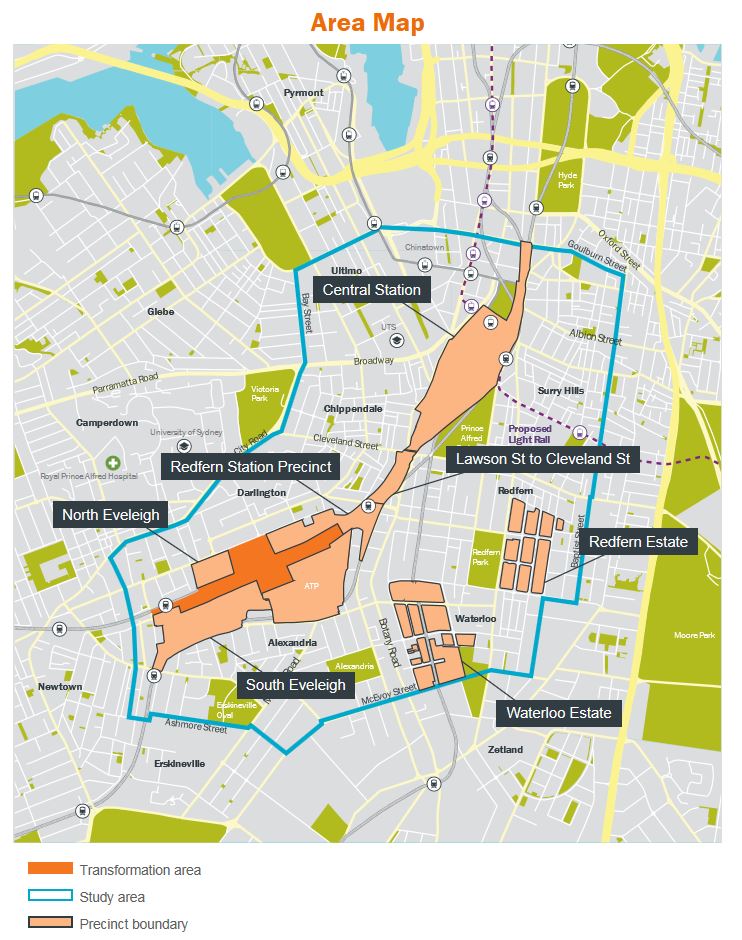
The NSW Government has announced that Waterloo has been selected over the University of Sydney as the site of the 31st railway station on Sydney Metro. Making the announcement, NSW Premier Mike Baird said “the metro station creates the opportunity to transform Waterloo and make it a better place to live for future and existing residents, many of whom are amongst the most vulnerable people in NSW.”

“Waterloo Station will help bring new jobs to the area as well as providing a direct public transport link to employment hubs at Barangaroo and Martin Place.”

The Waterloo social housing estate will be “progressively renewed to create a vibrant community with a mix of private, affordable and social housing”. There will be no loss of social housing from the current 2,000 dwellings. An additional 10,000 homes and “thousands of new jobs” will be created in the precinct over the next 15 to 20 years, with the first relocations not expected until mid-2017.

Central to Everleigh renewal map

Media reports suggest that the development will cover an area within an 800-metre radius of the station in which properties will be rezoned for high and medium density. However the government will investigate a “Special Infrastructure Contribution” to be applied to these properties for the metro and associated infrastructure, “under a similar model to the Parramatta Light Rail project.”

The decision to select Waterloo comes at the expense of the University of Sydney, which had considerably more commuters, and was made despite the presence of the Airport line. Transport Minister Andrew Constance said would have been “too costly and very disruptive” to build a station on the airport link. Transport for NSW will now linvestigate improving public transport at the university “through significant upgrades to Redfern Station and improved pedestrian connectivity”.

Council fights high-rise planned for NW Metro stations

The mayor of the Hills Shire Council, Clr Dr Michelle Byrne, has declared the NSW Government’s plans for adding 10,000 dwellings at the Showground metro station currently under construction as “unacceptable”.

“Council was blindsided on a number of issues. We thought the Showground would accommodate roughly 3500 dwellings – but the controls exhibited allow for more than 10,000 dwellings,” the mayor said. “This is above and beyond what the infrastructure around the Showground can cope with.”

Transport: Light Rail

NSW government light rail value capture model questioned

An opinion piece in Government News by Julian Bajkowski has questioned both the nature and level of the value capture model the NSW government is adopting in relation to a number of new projects including the Parramatta light rail. The government has indicated that it wants to “share in the value uplift that will occur along the corridor,” through a “Special Infrastructure Contribution” (SIC) with the levy expected to be set at “around $200 per square metre of gross floor area of new residential developments subject to consultation.”

Urban Taskforce CEO Chris Johnson is quoted as saying “the government needs to be aware it [the SIC] will increase the price of housing. It is going to be inflationary.

“The danger of adding a high contribution amount is that development may not be economically viable and so funds will not flow to the infrastructure. Further discussions with industry are needed to ensure that the SIC is workable.”

The article suggests there is confusion about what value capture actually means and that the NSW government is “facing escalating community hostility and demands to better explain what its wider plans for ‘value capture’ are” to communities “deeply worried that established residential communities in older inner suburbs will be bulldozed” for new apartment blocks.”

Transport: Rail

Service ramps up on the southwest rail link

Direct services to the city and the doubling of peak hour services have commenced on the South West Rail Link. The line has now become part of the T2 Inner West and South Line, with services travelling to the city via Granville and a 15-minute service rather than 30 minutes in the peak.

Minister for Transport and Infrastructure Andrew Constance said, “For the first time customers will be able to get a direct service to the city and improved access to key employment hubs including Parramatta, Liverpool and North Sydney.”

It is “anticipated” the peak 15 minute frequency will remain in place for most of the day, though some “low-demand services in the off-peak” will continue to run every 30 minutes to Glenfield and Liverpool.

New name for Newcastle Wickham Station proposed

Transport for NSW has lodged a proposal with the Geographical Names Board of NSW to change the name of Wickham station to “Newcastle Interchange”. The yet-to-be built interchange will become the major station in the Newcastle area following the truncation of the heavy rail line to Newcastle station and will provide interchanges between heavy rail, buses and the planned light rail network.

Central Coast rail bridge repair will just meet deadline

The NSW Government has awarded a tender for repairs on the Hawkesbury River rail bridge.

“We’ve secured specialist marine engineers Waterway Constructions to carry out the work,” Sydney Trains CEO Howard Collins said.

“The project is set to be complete by the end of April, but this timeline is very much dependant on weather.”

Mr Collins claimed that “two independent reports have confirmed that the bridge is safe to run trains.”

“The work involves renewing an outer layer of concrete surrounding the inner core of one of the bridge’s piers. The core remains in very good condition and carries the vast majority of the load.”

Media reports claim that the $2.6 million repair will come right at the end of the period nominated in an independent investigation in the state of the bridge ordered by Transport and Infrastructure Minister Andrew Constance.

Wynyard Walk Tunnel to get digital advertising

Wynyard Walk Tunnel users will not be able to escape advertising during their walk to and from Barangaroo. Sydney Trains has issued a Request for Proposal (RFP) “to implement, manage and sell advertising for the 7 Digital LED advertising screens within the Wynyard Walk Tunnel.”

No details regarding the size or location of the digital signs have been provided on the government tender list though further information on the RFP is available to registered tenderers.

Gold Coast rail line to be duplicated in time for Commonwealth Games

A $163 million contract has been awarded for the duplication of 8.2 km of single-track section of the Gold Coast rail line between Coomera and Helensvale stations “to significantly improve train service capacity and reliability ahead of the 2018 Commonwealth Games.”

“The Gold Coast heavy rail line is a key gateway from Brisbane to the Gold Coast region and records around 4.5 million passenger journeys per year, but is currently at capacity during peak times,” Queensland Transport Minister Stirling Hinchliffe said.

“This project will involve duplicating the only remaining section of single track on the Gold Coast rail line, and is crucial to ensuring more frequent train services can be introduced.”

The project which also involves constructing eight new rail bridges, one of which will span 860 metres, is expected to be completed by late 2017.

Perth “on airport” rail elements approved

The Australian Government has approved the on-airport elements of the Forrestfield-Airport Link rail project in Perth.

Deputy Prime Minister and Minister for Infrastructure and Regional Development Warren Truss said the airport link is consistent with development plans outlined in the Perth Airport 2014 Master Plan. The link is an extension of the existing suburban Perth line from Bayswater to Forrestfield which includes a four-kilometre section within the airport. The $2 billion project which will be fully funded by the Western Australian Government.

“Works will include twin-bored tunnels running east-west under the main runway and cross runway, and the construction of a new below ground Airport Central Station with pedestrian linkages to existing and future terminals,” Mr Truss said.

SA Government forced to close Seaford Line to replace faulty overhead wiring

Part of the Seaford line in Adelaide will be closed for much of January 2016 to replace faulty overhead wiring which was installed in 2013. The entire line will be closed for four days in late December and early January. After this period services will resume to Brighton but from 4 January until 25 January the section between Brighton and Seaford will be closed to allow the wiring to be replaced.

The original contractor Laing O’Rourke has admitted that it installed the faulty wiring which will be replaced “at no cost to the taxpayer”.

“Laing O’Rourke can confirm we were supplied a faulty batch of catenary wire by one supplier, which we are dealing with through other processes,” Director Pat Cashin  said.

“However we stand by our delivery commitments and will work quickly and collaboratively with the department to replace the wire as quickly as possible and at no additional cost.”

SA Transport Minister Stephen Mullighan said the government was “absolutely furious” to be “let down” by a supplier and that it was “incredibly disappointing” to have to close the line.

Soaring Auckland PT usage could hasten City Link funding – but intercity passengers face a long walk

Auckland public transport use has soared 8.1% to 81.2 million passengers with rail patronage increasing 22.6% to 15.1 million trips, according to Auckland Council. Mayor Len Brown said the figures confirm Auckland’s new electric trains “are a huge hit with Aucklanders” who enjoy their comfort and reliability. He also claimed that the figures suggest that the patronage target of 20 million rail trips annually which was set by the New Zealand Government as a precondition for funding of the City Rail Link (CRL) will be achieved at the end of 2016, three years ahead of schedule.

“At this rate of growth we will reach train service capacity next year, making the construction of the CRL a matter of urgent priority”, Mr Brown said.

The preparatory works for the CRL appear to have claimed an early casualty, according to NZ Herald columnist Brian Rudman. The resulting disruptions have forced KiwiRail to shift the terminus for the Wellington inter-city services out of the Britomart terminal “to a jerry-built shipping container ‘kiosk’, 1.4km away in the wastelands of the old Beach Rd shunting yards”.

“…Britomart is the focal point of an integrated transport network, with ferries, trains and buses, including the airport shuttle, all linking up at the bottom of town. It’s the closest Auckland has got to an integrated public transport system. Ejecting the one inter-city rail link we have into the boondocks is just perverse,” Mr Rudman said.

Wellington (NZ) to get new rail operator and electric buses planned – but trolley buses to go

Greater Wellington Regional Council has dumped TranzMetro in favour of French-based company Transdev Australiasia,  in association with Hyundai Rotem, as its preferred future operator for Wellington’s metro rail service.

The council will now negotiate with Transdev to finalise the 15-year contract which is intended to start in July 2016. The jobs of the current 400 TranzMetro staff will be preserved. GWRC Chair Chris Laidlaw said the decision was a significant milestone. “The rail contract is the first of all new, performance-based contracts for our train, bus and harbour ferry services. The new contracts will mean better services for customers and provide strong incentives for operators to grow patronage by making public transport easier and smarter,” Mr Laidlaw said

The regional council has also decided to move to an all-electric bus fleet – in the longer term. “We expect to progressively introduce electric buses to the region within the next five years, starting with an electric bus demonstration in the first half of 2016” Mr Laidlaw said.

“In the interim, however, we need to begin upgrading the Wellington City bus fleet. High capacity buses are a vital part of the new, simpler and more convenient network which will be rolled out in early 2018. The new network will give 75% of residents, compared to 45% at present, access within 1km to a high frequency bus route.”

The decision however conforms the demise of the city’s trolley bus fleet, the last in Australasia. “The Council has decided that an upgraded fleet should include new low emission double decker buses, ten of which will be hybrids. These will replace the older diesel buses in the fleet and the trolley buses, which are being phased out in 2017 because of their unreliability, the high cost of upgrading and maintaining the infrastructure and incompatibility with the new routes,” Mr Laidlaw said.

Albanese writes in support of HSR

Anthony Albanese, Shadow Minister for Infrastructure, Transport, Tourism and Cities, has written a strong argument in support of rail infrastructure investment in an opinion piece, “the Future is on Track“, for Huffington Post.

“The development of great railway networks is a critical part of the economic development of any nation,” Mr Albanese said. He pointed out the need to diversify in the wake of the decline in mining and to develop alternatives such as food production and processing for export.

“That’s a perfect argument for investment in more freight rail projects, such as the proposed Inland Freight project, linking Brisbane and Melbourne via an inland route that will pass through some of the nation’s most productive agricultural regions,”

Mr Albanese also argued the case for an east coast high speed rail (HSR) link. “A feasibility study completed by the former Labor Government in 2013 found that for every dollar invested in high-speed rail between Sydney and Melbourne, there would be $2.15 worth of economic benefits, Accordingly, we allocated $54 million to create an authority to progress the planning for high-speed rail and to begin to acquire the corridor before it is built out by urban sprawl,” he said.

Mr Albanese criticised the current government for failing to follow up on Labor’s previous expenditure on HSR and accused it of failing to invest in urban passenger rail. “Congestion is worsening in this country, partly because in recent years jobs growth has shifted from the outer suburbs of cities in industries like manufacturing, to the inner suburbs in industries like insurance, information technology and other services. This means many Australians live in outer suburbs of cities and spend long periods commuting on congested roads,” he said, urging the government to address the problem by addressing in urban rail – and to ‘get on with” HSR and Inland Rail.

Government scopes future of Australian Rail Track Corporation

The Federal Government has appointed Macquarie Capital as business adviser and Herbert Smith Freehills as legal adviser  for the scoping study into “options for the future management, operations and ownership of the Australian Rail Track Corporation (ARTC)”.

“As previously announced, the scoping study will also consider the implications of the Inland Rail project between Melbourne and Brisbane for the ARTC. In particular, it will consider the possible opportunity for ARTC to participate in any private sector financing, delivery and operation of the Inland Rail project,” the media release from Minister for Finance Sen. Mathias Cormann said.

“The advisers will provide independent advice and recommendations around possible future management, operation and ownership options for the Australian Rail Track Corporation and those matters related to the ARTC’s possible involvement in the Inland Rail project.”

The Government will consider the outcomes of the scoping study in the context of the 2016‑17 Budget. According to the International Rail Journal the precise value of ARTC is unclear but its fixed assets have been valued at $4.4bn, though “no firm decision is yet to be made as to whether ARTC will be sold”. There has been media comment however over the appointment of Macquarie and Herbert Smith Freehills given their involvement in Brookfield’s bid for Asciano which might result in Macquarie owning substantial rail assets.

Comment: NSW Local Government mergers – a reform of government or of governance?

The local government merger proposals just announced by the NSW Government are both more radical and yet more conservative than those proposed by the Independent Local Government Review Panel (ILGRP) – more radical in that the government seems more prepared to split existing councils such as Warringah than the Panel was, but also more conservative in that the ILGRP proposals for mega councils in the Sydney metropolitan area have largely been ignored.

As a consequence the proposed reduction in council numbers is more modest than that achieved through similar (though more dictatorial) processes in Victoria and Queensland which resulted in the number of councils in each state being more than halved. There will be 25 councils in the metropolitan area, down from 43, and a reduction in the number of rural councils from 109 to 87. In Sydney the government has announced that no council will be bigger than Blacktown in population (around 335,000) or have fewer than 150,000 ratepayers (in the Premier’s media release) or residents (merger fact sheet).

However this is interpreted it means the largest council will continue to be Blacktown (or at least Blacktown-sized) which is well below the 500,000-plus mega-councils, three at least were proposed by the ILGRP. There are a number of likely reasons for this, the most practical of which is that some of the complex mergers required by the Panel’s recommendations were seen to be just too complex. The Government also seems to think that the new councils will be large enough to achieve “$2 billion in financial benefits” (though that seems relatively modest when spread over 20 years), create communities “with common characteristics and connections” and to “reduce red tape”.

More cynically the result will be that no council and in particular the City of Sydney (which seems largely untouched by the merger proposals) will be large enough to provide an alternative power base to the state government for an aspiring politician in the way the City of Brisbane does in Queensland. Even more cynically the splitting of some council areas (most notably Warringah and Parramatta) seems designed to blunt the opposition of surrounding councils fearing a takeover by these much larger councils as much as it is to reflect emerging communities of interest.

Largely unstated but implicit in the government’s proposals is the desire to use mergers to drive an improvement in the strategic capacity of councils. While this is likely to occur to a degree it remains to be seen whether this will extend beyond the local level; the information provided to date is silent about whether and to what extent the reforms are expected to drive the strategic engagement of councils in planning and management at a regional or in the case of Sydney at a metropolitan-wide level.

Part of the problem was that the ILGRP provided limited guidance on this in its report. While the panel made detailed suggestions on the creation of Joint Organisations (JOs) in rural areas as a platform for councils to collaborate and engage in regional planning and management processes, it regarded the JO option as a last resort for the metropolitan area if its amalgamation proposals were not implemented. In the event that amalgamation proposals did occur the Panel favoured the introduction of a Council of Mayors similar to that operating in South East Queensland, though this was not discussed in any detail.

The difficulty with this is that the experience in Queensland and elsewhere suggests that such a body is only really successful if the number of participating mayors is relatively limited; 25 is likely to be too many. Consequently if there is to be any real improvement in local government engagement in strategic planning at the metropolitan level some sort of sub-regional structure based on either the existing ROC model or the emerging JO structure will be required for Sydney.

Nowhere is this discussed in today’s announcement so a key question therefore remains – regardless of whether the government’s reform goals are the right ones or whether the mergers will achieve them, should they be solely about reforming councils or also about reforming – and expanding – their role in the urban and rural governance and management process?

Disclaimer: the author wrote a discussion paper for the ILGRP on options for regional collaboration.


Posted in Governance, Growth, Infrastructure, Local Government, Planning, Public Transport, Regions, ROCs, Sydney metro area, Transport, Western Sydney | Tagged , , , , , , , , , , , , , , , , | 4 Comments

The Strategic Week (no. 2, Thursday 10 December 2015) – the week in governance, planning, infrastructure and transport

Before we begin, a thank-you to all the people who read, liked, shared and commented on the inaugural edition of The Strategic Week – and especially to those who gave me detailed and instructive feedback. Your responses are all greatly appreciated.

Governance

Government  confirms Turnbull to lead Greater Sydney Commission

The NSW Government has confirmed the appointment of Lucy Turnbull AO as Chief Commissioner of the new Greater Sydney Commission. As noted previously Ms Turnbull was the first female Lord Mayor of the City of Sydney. She also chairs the Committee for Sydney as well as BioMed Limited, an ASX- listed biomedical company.

The government also appointed three other commissioners:

  • Heather Nesbitt as Social Commissioner. Ms Nesbitt has extensive experience in social sustainability, social housing, community infrastructure planning and social impact assessment
  • Rod Simpson as Environment Commissioner. Mr Simpson is Director of the Urban Design and Master of Urbanism Programs in the Faculty of Architecture, Design and Planning at the University of Sydney and Principal of simpson+wilson whose work ranges across architecture, urban design and strategic planning.
  • Geoff Roberts as Economic Commissioner. Mr Roberts is a specialist in city strategy, governance and leadership and currently holds an Adjunct Professor position in the City Futures Research Centre at the University of NSW
  • The Commission will also comprise the heads of the Departments of Planning and Environment, Transport for NSW and NSW Treasury and six District Commissioners (who are yet to be nominated) to represent the needs of Sydney Councils.

Council amalgamations impact on Liberal vote in North Sydney by-election

Local Government NSW President Keith Rhoades has claimed that “community outrage at NSW Government moves to force council amalgamations” had helped drive down the Liberal party primary vote in the recent by-election for the Federal seat of North Sydney.

“The take-out from Saturday’s by-election is that people power works,” Cr Rhoades said. “I’m urging all communities and councils opposed to forced amalgamations to contact their local MPs, MLCs and Senators to remind them of the likely political cost that will be extracted if the Baird Government acts contrary to the wishes of residents and ratepayers.”

The incoming member for North Sydney, Mr Trent Zimmerman, also conceded the prospect of forced council amalgamations contributed to the swing against the Liberal Party in the poll. Mr Zimmerman, a former North Sydney councillor, was quoted as saying, “on amalgamations, I suspect there was some impact.”

UN climate change conference – Sydney City leads the way

Sydney’s lord mayor Clover Moore has stressed the role of cities in taking action on climate change because the 80% of emissions occur in cities and that over 50% of the world’s population – and 75% of the Australian population – live in cities. Making a keynote speech at a C40 Cities Climate Change function at the Paris climate change talks,  she noted that Sydney’s top commercial landlords had cut their carbon dioxide emissions by 45% since 2006, saving more than $30 million annually.

Sydney city leads the Better Buildings Partnership which includes the major landlords and property managers of more than half of the Sydney city centre’s commercial office floor space. The lord mayor said the group was “more than halfway to reaching their 70 per cent emissions reduction target by 2030″.

SA Government and Adelaide Council join forces for carbon neutrality and to limit global warming

Adelaide City Council’s aim to make its operations carbon neutral by 2020 and Adelaide the world’s first carbon neutral city, has been formally endorsed in the council’s Carbon Neutral Strategy 2015-2025.

Lord mayor Martin Haase noted that by “decarbonising the city’s electricity supply through sourcing green energy; taking advantage of roof-top solar photovoltaic systems; and significant energy efficiency improvements” council had reduced its energy consumption by more than 15% and  intended to “capture the full benefits of a carbon neutral operation by 2020”

Earlier in the year, the lord mayor signed the international Compact of Mayors, while the SA Premier signed the Compact of States and Regions – the first union of its type in the world. In Paris thbis week for events connected to the climate change conference, Mr Weatherill  co-chaired an international climate change assembly of global states and regions, representing 325 million people and 11 per cent of global GDP.

The Premier also signed South Australia up as the first Australian state to an international agreement to limit global warming to less than 2 degrees Celsius, noting that “while national Governments are working towards an agreement on limiting global emissions, it will be the cities and states that will need to do the heavy lifting”. The “Under2MOU” agreement was signed by eight states, regions and cities during a ceremony hosted by Governor of California Jerry Brown.

South Australia is also expected to pass its 50 per cent renewable energy target next year, a decade ahead of schedule, and is aiming to get close to 100% within two decades.

Planning

Deloitte Western Sydney blueprint highlights worsening jobs deficit, while the Premier pledges to move jobs west

Deloitte designing western sydney report coverDeloitte Access Economics has launched an ambitious plan for the “economic transformation of Western Sydney” which involved the creation of 200,000 new jobs in the region by 2020. Noting that despite the size of the region’s population and the fact that it is Australia’s third-largest economy, “issues around employment access, labour force skills and social disadvantage persist”, Deloitte worked with regional stakeholders to develop the plan, Shaping Future Cities: Designing Western Sydney.

The plan claims the most critical issue is the region’s “worsening jobs deficit”; 300,000 workers leave each morning to work while 100,000 arrive, meaning Western Sydney has a jobs deficit of 200,000. This could grow to 340,000 by 2014, while eastern Sydney’s jobs surplus could grow to more than 280,000.

Report author Theo Psychogis has also identified “five key ways policy makers are going to have their thinking disrupted” by the plan. These include:

  • “A hand up not a hand out”
  • “Increased certainty to de-risk investments”
  • “Designing policy around one global city”
  • “Putting skin in the game” i.e., recognising that business and industry have responsibility as the “primary job creators for the region”
  • “Enabling a Narrative Driven by People, Place and Purpose”.

Speaking at the launch the NSW Premier Mike Baird announced that all 1,800 Department of Education staff employed in the CBD will be shifted to offices in Parramatta. The move will commence in 2018 and be completed by mid-2020.

Mr Psychogis also stressed the importance of transport. The report’s recommendations include a proposal for the creation of a 15-minute express train service between Parramatta and Sydney.

The Deloitte plan will reviewed in more detail in a future StrategicMatters post.

Sydney Urban Living Index launched

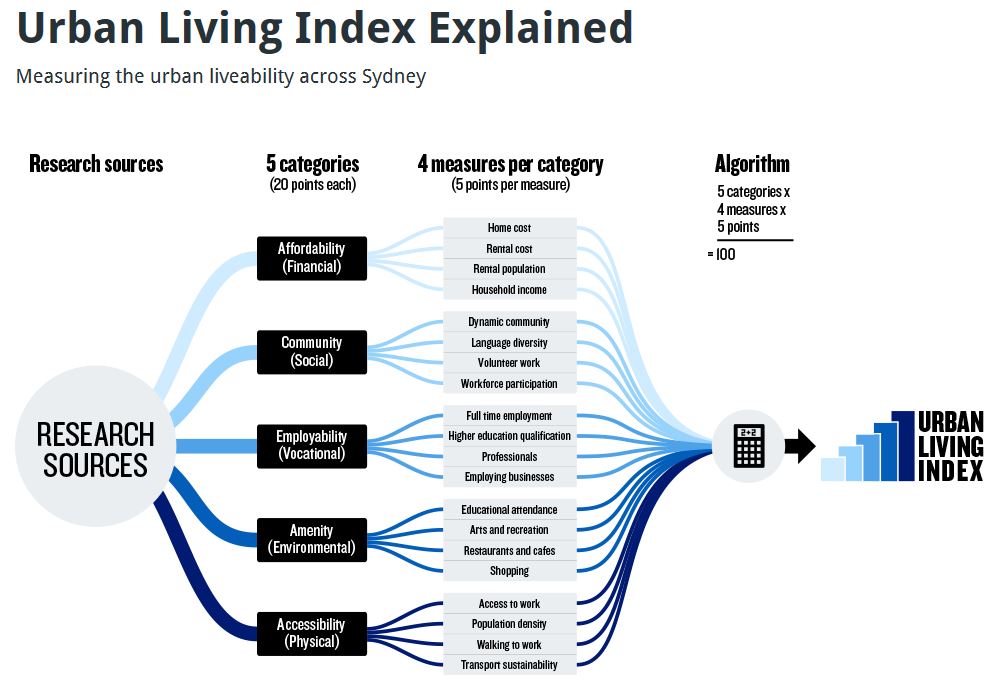
The Urban Taskforce has launched a new Sydney Urban Living Index. The Taskforce commissioned McCrindle Research to develop the index, which uses 20 measures based on ABS Census data grouped into five categories – affordability, community, employability, amenity and accessibility – to measure the livability of 228 Sydney suburbs.

Sydney Urban Living Index graphic (source: Urban Taskforce)

Sydney Urban Living Index graphic (source: Urban Taskforce)

Urban Taskforce CEO Chris Johnson noted that while the trend towards apartment living was gathering pace in Sydney this was only partly due to affordability and that “there is a cultural shift at play”. Mark McCrindle, Principal of McCrindle Research said, that the challenge the city faces “is to ensure that it responds to population growth yet maintains its world-beating lifestyle and that its liveability rises to match its increasing density”. The Index is available at http://www.urbanlivingindex.com/

Changing policies underpin Sydney’s high density urban renewal

A new paper from City Futures at the University of NSW, The changing political economy of the compact city and higher density urban renewal in Sydney, examines the policies and politics shaping redevelopment in Sydney in the 21st century.

The paper, by Dr Raymond Bunker is part of an ARC Discovery Project entitled Planning in a Market Economy: The Case of the Compact City. It traces how the emerging neoliberal political economy helped to reconfigure the powers and relationships underpinning Sydney’s development. The report notes:

“Many of the policies developed to bring a more compact form to Sydney have been opportunistic, particularly those concerned with the formulation and operation of measures to encourage higher density urban renewal. Where they have tried to be long-term or systemic they have suffered in their implementation from a lack of realism about urban conditions or a lack of consistency of political commitment. Progress has been patchy, and aspiration often compromised in outcome.”

New era for Sydney’s industrial buildings

The City of Sydney has announced that some of the city’s “last remnants” of the city’s industrial era warehouses and factories will receive a heritage listing to help preserve them and to provide guidance to owners on how to “adapt and incorporate interesting heritage elements on their properties for future use”. The listings will allow redevelopment but also protect the buildings “and their valuable contribution to the local area”.

“With few undeveloped areas of the city remaining, these buildings are being converted into sought-after residential or commercial properties. The proposed listings will ensure the heritage value of these buildings remains, while retaining the current zonings for height limits and floor-space ratios,” lord mayor Clover Moore said.

Infrastructure

Truss delivers second annual Infrastructure Statement

The Deputy Prime Minister, Warren Truss, has delivered the second Annual Ministerial Infrastructure Statement to Parliament . The Deputy Prime Minister said he was “particularly proud of the significant progress that has been made over the past twelve months delivering the critical infrastructure needed in every state and territory”.

The areas of expenditure outlined in the Infrastructure Statement relate mainly to a range of road projects, including in NSW WestConnex, the Pacific Highway upgrade and the Western Sydney Infrastructure Plan. The Statement does note however that the federal government is “working closely with NSW to determine the rail needs of the Western Sydney Airport and surrounding suburbs” and that the it has also made a commitment to contribute to stage 2 of the Gold Coast Light Rail project. It also notes that government is “progressing” the Melbourne to Brisbane Inland Rail project and will decide on funding and delivery in the 2016 budget.

Transport: Sydney Metro

Higher densities follow metro to Sydney’s northwest

The NSW Government is asking for feedback on the draft proposals for Showground, Bella Vista and Kellyville stations which have been identified as “priority precincts” on the northwest section of the Sydney metro currently under construction.

The precinct proposals support a number of features for each station. In the case of Showground station for example, a new, 5,000 to 10,000 square metre shopping centre, a range of housing types including apartment buildings up to 20 storeys near Carrington Road, the provision of employment lands, increased areas for open space, facilities and schools and the retention of Castle Hill Showground are all proposed. The draft proposals are on exhibition until 28 February 2016.

Unstraightened legacy for Sydney Metro

Around 500 people attended an industry briefing on the construction of Stage 2 of the Sydney Metro, the city and southwest section. The briefing document released provides “a general overview of the nature and scope of Sydney Metro City & Southwest and the role that industry can play in helping to deliver the Project,” and outlines an initial outline for the next stages, including procurement.

The briefing also revealed that one of the project challenges is the need to straighten out the curved platforms at 11 existing stations from Sydenham to Bankstown to cater for the single-deck driverless trains which will need to stop at precise positions to match the platform doors. This will reduce the gaps for passengers entering or exiting trains.

Sydney Metro program development director Luke Franzmann told the briefing that the platforms are “significantly curved” which “we want to test with industry”.

Transport: Light Rail

Strathfield and Carlingford – the long and the short of the Western Sydney light rail plan

The NSW Government has released its long-awaited plans for the Parramatta Light Rail Network. The plan for the 22-kilometre link was unveiled by NSW Premier Mike Baird, Transport Minister Andrew Constance and Planning Minister Rob Stokes. It comprises a line from Westmead servicing the hospital precinct then linking North Parramatta to the Parramatta CBD before heading east through Camillia to Sydney Olympic Park and then to Strathfield, A second line will branch at Camillia and run north along the current heavy rail line corridor to Carlingford.

Parramatta light rail network indicative map (Source Transport for NSW)

Parramatta light rail network indicative map (Source Transport for NSW)

Work will now begin on preparing the final business case and assessment of the preferred network. This will include planning, design and consultation with key stakeholders along the network to “develop the staging of the project, the exact light rail route and stops, and the final project cost”.

The NSW Government has set aside $1 billion for the project and “is actively looking at ways to share in the value generated along the new light rail corridor to raise additional funding”. Media reports indicate that a “special infrastructure contribution” from the private sector will be established with a levy of about $200 per square metre for new residential developments along the corridor. This funding will also be used for infrastructure, such as new schools and road upgrades as well as the light rail.

This approach attracted criticism from the Urban Taskforce as well as NSW Opposition leader Luke Foley, who noted that no one in the eastern suburbs would need to pay “an additional $20,000 per apartment for their light rail project” (the CBD and South East Light Rail currently under construction. Ryde Council mayor Jerome Laxale also criticised the decision to not to extend the northern branch of the line from Carlingford to Epping and Macquarie Park.

See Transport Sydney’s excellent summary of the history of this project and the comment at the end of this post.

Engineers provide input on Newcastle while Premier defends proposed PPP

Engineers Australia has met with the office of NSW Transport Minister Andrew Constance to provide input into Newcastle’s transport planning. The association clained that the city needs “a multi-modal, fully integrated transport system” which connects all major activity centres and which can accommodate the city’s future expansion. Engineers Australia also “sees a need to ensure future light rail stages can continue west fron the Wickham rail terminus”.

Meanwhile NSW Premier Mike Baird used a visit to Newcastle to defend the use of private-public partnerships for key projects in the region including the Hunter Street Mall redevelopment and The Store development in Newcastle west. There have also been calls for private sector investment in the city’s light rail project.

Transport: Rail

Maldon-Dombarton off-line but councils support Sydney-Canberra electrification

The future of the partially-constructed Maldon-Dombarton freight rail line is again uncertain after the NSW Government’s registration of interest (RoI) approach failed to fund a private backer, according to media reports.

The line would have offered a direct link between Port Kembla and coalfields at Lithgow and Picton as well as to Western Sydney, also removing rail freight from much of the passenger rail network. Construction commenced in 1983 but the project was abandoned in 1988. Only two groups expressed interest in completing the project but NSW Roads and Freight Minister Duncan Gay said they had not been accepted “as neither RoI met all the published evaluation criteria”.

Initially the private sector was expected to foot all the project costs, but the Minister did however hint that government funding might now be an option. Shellhabour MP Anna Watson criticised the government’s approach, saying that “seed funding” must be part of the project in future.

Meanwhile a meeting of Wingecarribee, Goulburn Mulwaree, Palering Shire and Queanbeyan Councils have agreed to support electrification of the Sydney to Canberra corridor after a meeting with the Southern Tablelands Rail Users group (STRUG). The group’s president Greg Price said that electicification combined with tilt train technology could reduce journey times and boost population growth.

Rebuild for Sydney CBD station

Access to Sydney’s CBD Museum Station entrance in Hyde Park South will be improved with the installation by Transport for NSW of lifts linking the entry, concourse and platforms, according to the City of Sydney. The project will require the demolition of the existing cafe at the rear of the station and a new open-plan cafe will be constructed by the council to replace it.

 Record PT use recorded in Adelaide

The South Australian Department of Planning, Transport and Infrastructure has reported a large increase in the number of people using public transport in Adelaide, with an extra three million trips recorded in the last financial year. The largest increase was experienced on the train network in the first full year since the electrification of the Seaford line. More than 4.45 million passengers used the line, an increase of 78%. There were increases across the other rail lines and a slight increase in use of the bus network, which carries the bulk of Adelaide Metro passengers.

The Strategic Week no. 2. Comment: the long and the short of the Western Sydney light rail plan

The NSW Government’s announcement of the Parramatta to Olympic Park route as its preferred option is no great surprise, especially as even some of its ministers were giving the game away. The decision to incorporate the link to Carlingford but not to extend this to Epping or Macquarie Park is more unexpected, but taken together the preferred routes reveal a lot about both the extent and limits of the government’s ambition.

While the concept of a light rail network within Western Sydney dates back at least to the 1970s, the decision by the previous Labor government to cancel the Parramatta to Epping section of the Parramatta to Chatswood heavy rail link led to the concept being revived, especially after the decision to incorporate the Epping to Chatswood section into the Northwest Metro.

In acknowledgment that a heavy rail link from Parramatta to Epping was an increasingly unlikely option, Parramatta Council put a lot of work into developing and reshaping the regional light rail concept. Council’s initial proposal involved an ambitious intra-regional network connecting all the major centres in the region. Out of this a feasibility study commissioned by council identified four priority corridors, all centred on Parramatta. These included routes to Castle Hill, Macquarie Park via Eastwood, Bankstown and to Sydney Olympic Park.

As well as improving access to Parramatta from surrounding suburbs and increasing connectivity with the Parramatta CBD, these routes provided the basis for orbital connections between the existing western and southwestern lines and the planned northwest rail link, thus filling in some critical missing gaps in Sydney’s public transport network. Out of these four lines, the feasibility study identified the link to Macquarie Park as the highest priority, along with the route to Castle Hill.

Parramatta City Council preferred light rail options as identified in the feasibility study (Source Parramatta City Council Feasibility Report volume 2)

Parramatta City Council preferred light rail options as identified in the feasibility study (Source: Parramatta City Council Feasibility Report volume 2)

The light rail concept attracted political support, with both major parties promising up to $1 billion for the project prior to the state election. The government also announced it would undertake its own assessment of the routes and priorities. This is where something odd happened; the route to Macquarie Park via Eastwood was suddenly transformed into a Epping via Carlingford proposal which involved taking over the current Carlingford rail line, while the Olympic Park route was shifted to terminate at Strathfield rather than Rhodes. There was little explanation for these changes and the two-volume feasibility report which explained the route choices and provided a rationale for prioritising the Macquarie Park disappeared from Council’s website.

In my view the Eastwood/Macquarie Park option is a better choice at least on paper; it links directly to the Macquarie employment area, avoids the congested Epping interchange but still provides a link to the northern line and the northwest metro currently under construction. Nonetheless the Epping option would at least have provided a link between the Northwest Metro, and the northern and western rail lines. There was however increasing support for the Olympic Park option to be selected as the first route, with the private sector and some elements within government identifying the light rail as a potential catalyst for the redevelopment of this old industrial corridor. Ironically this is the only route which does provide an orbital link, especially as it will now terminate at Strathfield rather than Rhodes.

From the government’s perspective however, the Olympic Park route obviously had one thing going for it – in using the light rail to drive redevelopment, there was also the potential to at least partly fund it through development-related value capture mechanisms. While the development sector has expressed concern that a suggested contribution of around $20,000 per apartment is too high and too inequitable (especially as eastern suburbs developments will not be required to contribute to the development of the light rail there), the ability to use value capture to raise additional funds also provided the opportunity to fund a second route, with the most obvious choice being the Epping option.

So it has come to pass – but only in part. The second branch is planned to go only as far as Carlingford and will take over the existing heavy rail corridor. This proposal appears to fall between two stools as it neither provides an orbital link from Parramatta to Epping, nor the opportunity to support redevelopment to anything like the extent potentially available in the Olympic Park corridor. It’s tempting to see the adoption of the truncated route as a repeat of what happened in Newcastle; a convenient opportunity to solve the “problem” of an existing under-utilised heavy rail link, though given the current poor patronage in this case it’s hard to see a strong economic rationale even for a conversion unless the line is eventually extended to Epping.

It is hard to make a definitive assessment at this stage as very little detail such as costings, a business case or even a decent map have been released for the project; it is therefore quite possible that it will change again before a construction contract is signed. Despite this, the tantalising gap between the end of the line at Carlingford and Epping is indicative of the government’s modest ambitions for the project. On the other hand it can be argued that the project will deliver a solid foundation for the future expansion of light rail to become a genuine Western Sydney network.

Posted in Governance, Growth, Infrastructure, Local Government, Planning, Public Transport, ROCs, Sydney metro area, Transport, Western Sydney | Tagged , , , , , , , | 5 Comments

The Strategic Week (no. 1, Thursday 3 December 2015) – the week in governance, planning, infrastructure and transport

Welcome to the first edition of “the Strategic Week”

Welcome to the first edition of a new service on the StrategicMatters blog – the Strategic Week, a short summary of the some of the week’s key developments in governance, planning, infrastructure and transport.

I’ll be concentrating mainly on Sydney but will also look at important activities in the rest of NSW as well as interstate and even overseas, especially when they are relevant to Sydney. My intention is not only to take a weekly snapshot of the main events across these key strategic policy areas but also to provide a sense of how they relate to each other and how they are – or are not – working together.

I’ll provide a quick summary of each event along with relevant links, especially to the original media statements and reports where these are available. I’ll also add commentary (identified as such) from time to time to some of these items and will also continue to research and publish more detailed articles on the blog on a monthly basis.

This first edition is a little longer than I expect future editions will be, especially as a lot has been going on recently and partly as a result I’m delving back a few more days than I expect to do normally to establish some context. I’m also fine-tuning the format, so any feedback would be greatly appreciated.

Governance

Lucy Turnbull gets the nod as Government set to announce Greater Sydney Commission appointments

Media reports claim that Former Sydney lord mayor Lucy Turnbull will be appointed by the NSW Government to chair the Greater Sydney Commission. Appointments to the commission were due to formally announced on Friday 4 December. Including the chair there will be 13 appointees to the Commission with separate commissioners for environmental, economic and social issues, six district commissioners nominated by Sydney councils and the department heads from Transport, Treasury, and Planning and Environment. Ms Turnbull who is the wife of Prime Minister Malcolm Turnbull was the first woman to be elected as lord mayor in 2003.

Planning

Western Sydney Airport EIS “does not meet the mark”

An independent review of the Western Sydney Airport Environmental Impact Statement (EIS) conducted by WSP Parsons Brinckerhoff for 11 Western Sydney councils has found that it “lacked certainty” on key issues such as aircraft noise, flight paths, traffic, transport, and the environment, according to the President of the Western Sydney Regional Organisation of Councils (WSROC), Cllr Tony Hadchiti.

WSROC Western Sydney airport EIS review report cover

WSROC Western Sydney airport EIS review report cover

The review also found that the EIS did not adequately consider the cumulative effect of projects associated with the Western Sydney Airport, as well as the impacts if the airport is built without a rail line. The review also notes that the draft EIS is explicit that the flight paths propose were designed primarily to avoid impacting the existing operations at Kingsford Smith Airport and “have not been designed to minimise environmental (and in particular noise) impacts on communities”, or the impact on smaller airports. The review further notes that “there is no visibility in the draft EIS of how these contours were arrived at, and how they compare to alternatives considered”.

Cllr Hadchiti also noted that the review confirmed “without doubt” that developing an EIS in only eight months for such a complex project “was always going to fall short of providing certainty and allaying community concerns”.

“Classic Ponzi schemes” and rental lockouts – the social costs of Sydney’s high housing prices

A new report by consultancy firm LF Economics, “Parental guidance not recommended” claims that Sydney houses now cost 12 times the annual average income, up from four times in the 1970s. According to media reports the paper also claims that baby boomer parents are at risk of being caught up in a classic “Ponzi scheme” as they over-leverage their children into mortgages they can’t afford, thus leaving their own homes at risk from default and foreclosure.

While economist Saul Eslake disagrees with the Ponzi term he believes there may be a sustained decline in house prices and that recent rises have caused “great harm” by deepening wealth inequality. Some of these costs were laid bare in the release of Australia’s first Rental Affordability Index, prepared by National Shelter, Community Sector Banking and SGS Economics and Planning.

The report revealed that NSW low income families on $500 a week would have to spend 65% of their income to rent a property under current market conditions. Ellen Witte from SGS noted that the Index shows that single income households are the worst off but even for average working households in many cities rents are unaffordable. Sydney is in a particularly critical position with almost no affordable rental income housing for low income earners east of Blacktown.

Back to the Future – NSW Government proposes terraces and villas to deal with housing crisis

NSW Planning Minister Rob Stokes has announced the government will “explore new actions to improve housing supply, affordability and diversity”, releasing a discussion paper on the fast-tracking of the delivery of medium-density options such as terraces and villas. The Minister noted that Sydney will need over 660,000 extra homes over the next 20 years. The paper prepared by SJB Planning seeks feedback from the community and other stakeholders on the “expansion of complying development to cover medium density housing development”.

Strong support for Newcastle revitalisation

Newcastle Station 1900 (from NSW State Archives)

Newcastle Station 1900 (from NSW State Archives)

UrbanGrowth NSW and Newcastle City Council have released a summary of findings from the Revitalising Newcastle community engagement program which show that people “overwhelmingly support the revitalisation of Newcastle city centre”, with over 75% of those surveyed in favour of the “Harbour Entertainment City and Harbour Play City opportunities”, according to UrbanGrowth NSW director Michael Cassel.

Mr Cassel also indicated that residents were keen to restore the city’s now disused railway station back “into its heritage state or its original state”, though a final use for the building was yet to be determined. According to media reports Newcastle Council has also backed the reduction of proposed building height limits in the city’s east end from 20 storeys to 12. This follows major opposition from local residents to the NSW Government’s original revitalisation plans.

Infrastructure

NSW Government pockets $10 billion from Transgrid privatisation

The NSW Premier Mike Baird has announced that the Government has succeeded in leasing the transmission assets of Transgrid to Australian-led consortium NSW Electricity Networks for over $10 billion. The consortium also involves investment entities from Canada, Abu Dhabi and Kuwait.

According to media reports, more than $3 billion in debt attached to Transgrid will be paid off, resulting in a net return of about $7 billion. This will be topped up by a payment of around $1 billion from the Commonwealth to the NSW Government under a national partnership agreement to encourage asset sales. The result means that when the remaining assets are leased the total proceeds will exceed the $13 billion estimated from the electricity privatisation.

Victorian councils investigate shared solar power and storage

The Australian Renewable Energy Agency (ARENA) is providing $112,400 support for Moreland Energy Foundation Limited (MEFL) to investigate a model for shared solar photovoltaic (PV) generation and energy storage capacity in the Melbourne community of Moreland. MEFL is a not-for-profit organisation established by the Moreland City Council to work with communities, partners and governments to implement sustainable energy projects.

According to ARENA CEO Ivor Frischknecht, the project will investigate how communities could pool solar energy generation and storage using a “microgrid”. The project will also look at how these microgrids can be integrated into existing power networks, which were mainly designed to facilitate power flowing in one direction, from the grid to the customer, and which can run into defficulties if too much power is fed back at the same time. Mr Frischknecht noted that adopting solar and battery storage at a community level can “decrease installation and maintenance costs by leveraging the purchasing power of multiple residences”.

Similar studies are also being undertaken by Victorian power supplier CitiPower in conjunction with four councils in Melbourne’s inner north. The three-year trial has been funded by the Australian Energy Regulator and involves the installation of battery storage in 20 houses to assess the costs and benefits of installing battery systems and how home-based energy storage will impact the wider network.

Infrastructure cost-benefit analysis “doesn’t add up”

In an opinion piece for the Sydney Morning Herald, Chris Standen, a researcher at the University of Sydney, has criticised the basis of the cost-benefit analysis process used to assess major infrastructure projects, including the WestConnex road project in Sydney. Noting that the process “was devised by highway agencies in the 1960s to justify the massive cost of urban motorways”, he claims that it puts too high a value on hypothetical travel time savings.

Noting that it is “normally assumed travellers would value saving one hour of travel time at $15 to $48, Standen claims that in the case of WestConnex this has been further inflated to $70, resulting in a benefit of $13 billion. However as daily travel times have been stable at around 80 minutes a person for decades it appears that people have used the tollway infrastructure simply to move further away from work and services which is no longer feasible.

Standen recommends that projects should be assessed before approval (which didn’t happen with WestConnex) by an independent body and that much less value should be attributed to “hypothetical time savings”. Instead changes in accessibility to economic and social opportunities should be valued along with improvements to the quality of travel time and the ability to stay connected while travelling.

Transport: Sydney Metro

Some go up and some come down – city skyline to get makeover courtesy of the Sydney Metro

Sydney Metro project director Rodd Staples has indicated in media interviews that 52 properties across Sydney will be acquired for the second stage of the Sydney Metro project. Of these, 19 buildings in the CBD, some up to 22 storeys  high and a further 17 buildings in North Sydney and Crows Nest will be demolished to make way for the construction of stations. Despite the disruption, Mr Staples has likened the construction process to “keyhole surgery” compared to the major excavations required to construct the City Circle lines in the 1920s.

Meanwhile the NSW Government has announced that a new tender process will be opened for Central Barangaroo to incorporate the addition of the additional metro station. Craig van der Laan, CEO of the Barangaroo Delivery Authority, said the location of the Metro station will “shift the epicentre of the precinct to Central Barangaroo“. The former Prime Minister Paul Keating warned that the increase in development – from 120,000 to 150,000 square metres – “could be squeezing the lemon too hard.”

Sydney Metro – winners, losers and mystery flyers

Sydney Metro Proposed Alignment (from Transport for NSW, 2015. Sydney Metro City and Southwest Project Update)

Sydney Metro Proposed Alignment (from Transport for NSW, 2015. Sydney Metro City and Southwest Project Update)

Despite the recent announcements regarding the second stage of the Sydney Metro including the conversion of the Bankstown line and the possibility of a direct extension to Liverpool, the NSW Government still has not released any more detail regarding the future of the existing rail line beyond Bankstown to Cabramatta and Lidcombe. A Fairfax Media report claims that many residents in the area are unaware that they will be losing a direct connection once the Bankstown line is integrated into the metro.

The government is also yet to decide whether the only station to be provided on the line between Central and Sydenham will be constructed at the University of Sydney or Waterloo. A flyer has been reportedly appearing in mailboxes around Waterloo and Alexandria urging residents to lobby for the Waterloo option which is supported by the government’s development agency Urban Growth NSW. Both the flyer and the website to which it is linked are anonymous which led to speculation that UrbanGrowth was involved, though this was denied. However the author was later identified as a local resident who wanted to “seize a historic transport opportunity – getting the metro line routed through Waterloo”.

Sydney Metro sets the scene for Sydenham to Bankstown corridor renewal

The NSW Government is working with Bankstown City, Canterbury City and Marrickville Councils and local communities to examine opportunities for “more homes, jobs, better public spaces, shops and cafes” within walking distance of the eleven train stations between Sydenham and Bankstown. A draft strategy has been released which includes detailed land use and infrastructure analysis for each of the station precincts and outlines the “future vision and character for each area, the number of new homes and jobs that could be delivered, and the improvements to community facilities, public spaces, the transport network and other infrastructure needed to support growth.” The submissions deadline is 31 January 2016.

Transport: Light Rail

Sydney CBD and South East Light Rail proposal modified to reduce park impact

The NSW Department of Planning and Environment has exhibited a proposal to modify the already-approved CBD and South East Light Rail line. The modifications include proposals to relocate and redesign Randwick Terminus from High Cross Park to the eastern end of High Street and reconfigure the UNSW High Street stop design from one island platform to two separate platforms on either side of the light rail tracks. The modifications are designed to improve safety at both stops and to reduce the impact on High Cross Park.

Did the NSW Roads Minister spill the beans on Western Sydney light rail route?

Western Sydney Light Rail proposed corridors (source: Western Sydney University)

Western Sydney Light Rail proposed corridors (source: Western Sydney University)

NSW Roads Minister Duncan Gay has appeared to indicate that the State Government’s preferred option for Western Sydney’s first light route will be from Parramatta to Sydney Olympic Park. The Minister was speaking at an unrelated function to announce the construction of a westbound off-ramp from the M4 Motorway at Hill Road to support the redevelopment of the Lidcombe industrial area, which would also potentially be served by the Olympic Park light rail route. Later the Minister issued a statement saying that no final decision had been made.

The Lidcombe development involves a new Carter Street precinct which will transform “a rundown industrial area into a new community”. There will be about 5,500 homes as well as space for corporate offices and light industry that could provide up to 5,500 jobs, a planned new primary school and a new foreshore reserve at Haslams Creek.

Interstate tram fleets boosted

The Victoria state government has announced a new order will be placed with manufacturer Bombardier for 20 trams, increasing its E-Class fleet to 70 vehicles. The government said the $274 million agreement will “provide certainty” for 500 jobs for the next three years at Bombardier’s Dandenong factory, which is currently completing the intial order for 50 E-Class trams. The 33m long E-Class trams have a maximum capacity of 210 passengers.

In Queensland the GoldlinQ consortium which is responsible for the Gold Coast light rail line has exercised an option to order four additional Flexity trams. The 43.5m trams can carry up to 309 passengers and will be required for the stage 2 extension to Helensvale. Unlike the Victorian Bombardier order, the Gold Coast trams will be manufactured in Bautzen in Germany and in Vienna.

Gold Coast consults on light rail southern extension while Canberra proposed route criticised

Gold Coast Light Rail southern extension option 1 (source: City of Gold Coast)

Gold Coast Light Rail southern extension option 1 (source: City of Gold Coast)

Following the approval of the stage 2 northern extension of the Gold Coast light rail to Helensvale rail station, the Gold Coast City Council has announced that public consultations will be held on extending the line to the southern Gold Coast. The consultation brochure outlines a number of ideas or route options for the proposed extension. Council is also lobbying the Federal Government for funding towards the project.

The proposed Canberra light rail route along Northbourne Avenue between Gungahlin and Civic, has been criticised by Griffith University transport expert Matthew Burke as being a “much more political decision” than those selected in Sydney and the Gold Coast. He said that the route lacked major destinations making it a “poor choice” for a first-stage route and needed to be changed or quickly extended to avoid failure.

Transport: Rail

$1.1b cost blowout for NSW intercity trains downplayed by Government

Suggested NSW Intercity train interior (source: Transport for NSW)

Suggested NSW Intercity train interior (source: Transport for NSW)

The NSW Auditor General has reported that the procurement cost for the intercity train fleet replacement program has been revised upwards from $2.8 billion to $3.9 billion. The report notes that the revised budget was approved by the expenditure review committee and includes “potential foreign exchange fluctuations, a new maintenance facility and related infrastructure costs.”

Media reports claimed however that the cost of the project to buy 520 carriages (or 65 eight-car trains) to service the Blue Mountains, Illawarra, Newcastle and Central Coast lines had blown out at least partly because the “off-the-shelf” trains the government initially planned to acquire are too long and narrow to provide services on the suburban network and will have to be modified, particularly for use in underground stations.

Camden residents win government commitment to underground rail line

Responding to pressure from the Camden community, NSW Minister for Transport and Infrastructure Andrew Constance has announced that any extension of the South West Rail link further south will be run underground at Oran Park and Harrington park to reduce the impact on local residents.

The Minister noted that while construction might not start “for some years, even decades”, the government had decided on the basis of consultations that the “final recommended corridor will include an underground alignment between Oran Park and north of Narellan”.

 National overview shows “rail on track” according to Minister, while opposition tells government to do more

The launch of Trainline 3 at AusRail 2015 demonstrates that rail is “on track for Australia’s economic and social future, according to Deputy Prime Minister and Minister for Infrastructure and Regional Development Warren Truss. Trainline 3 is a “collaborative compendium” between the Australasian Railway Association (ARA) and the Bureau of Infrastructure, Transport and Regional Economics (BITRE) which provides an overview of the Australian freight and passenger railway industry.

The Minister also indicated that the Australian Government “is committed to investing in rail projects that deliver economic benefits to Australia including freight rail, inland rail, the intermodal sector and passenger rail.” Meanwhile Shadow Minister for Infrastructure, Transport, Cities and Tourism Anthony Albanese also addressed Ausrail, urging the rail industry to “demand more” from the federal government. “I call on the government to not just ride on rail, but to fund rail,” he said. “There’s been more than a 20% decline in spending on infrastructure [during the Coalition’s current term]”.

Melbourne and Auckland CBD rail project updates

While Sydney plans the second stage of its metro project that will involve a second Harbour rail crossing and a new line under the city centre, two “neighbouring” cities are pressing ahead with major rail projects which also involve tunnelling under their CBDs.

Melbourne Metro route map (source: The Age)

Melbourne Metro route map (source: The Age)

In Melbourne the first package of works for Melbourne Metro has been announced, with “Early Works” set to commence in 2017 to prepare key sites for the start of major construction in 2018. This will involve moving and protecting utilities such as gas, sewer, water and stormwater pipes and telecommunications cables as well as the relocation of some tram tracks and other road features. Melbourne Metro will provide a new line under the CBD from Sunbury to Cranbourne-Packenham, with five new underground stations to be constructed in the CBD.

Auckland city rail link with future lines (source: Auckland Transport)

Auckland city rail link with future lines (source: Auckland Transport)

Auckland Transport is undertaking market sounding, asking construction-consulting industries for input into the development of its procurement strategy for the City Rail Link (CRL) main works. The line will extend Auckland’s passenger rail system in a loop past its current city terminus at Britomart under the CBD to connect back to the existing regional rail line at Mt Eden. Britomart will become a through station with new stations near Aotea Square and Karangahape Road, and a redeveloped station at Mount Eden. The CRL has been divided into 10 distinct packages.

Posted in Airport, Governance, Infrastructure, Planning, Public Transport, Sydney metro area, Transport, Western Sydney | Tagged , , , , , , , , , | 3 Comments

The Sydney Metro City and Southwest stations – why these locations?

The Sydney Metro has made the front pages again because of the news that 52 properties including 19 buildings in the CBD will have to be demolished to make way for the construction of stations to support stage two of the project, City and Southwest (see my last post for a summary of the project). These include some fairly recent buildings over 20 storeys, with the acquisition costs likely to run into hundreds of millions of dollars. This is an inevitable consequence of retrofitting a metro system in any large city but it is relevant to look at the station locations, why they were chosen and the implications for the Metro’s potential to increase the coverage and reach of the rail network as well as its capacity.

That the metro will significantly boost capacity is indisputable and it is also clear that it will greatly extend coverage in North Western Sydney where there is no other rail infrastructure. As I noted in a previous post however, the metro’s role in extending the reach of the heavy rail network in other sectors is a bit mixed. This is because the project involves taking over two existing heavy rail lines (Epping to Chatswood and Sydenham to Bankstown) and converting them to be integrated with the metro; this will increase train frequencies but as there will be no change in the number or location of the existing stations on these lines there will be no change in coverage.

Between these two sections will be the heart of stage two of the metro project – the 15km section that will run entirely underground from Chatswood to Sydenham via the CBD. As this will be close to existing rail lines there is inevitably going to be some overlap in the walk-up station catchments between the new and existing systems, including of course those stations which will act as interchanges where the catchments will be identical.

I’ve attempted to document the walk-up catchments of both the existing and proposed stations as detailed in the Sydney Metro Project Update. To show the catchments I have added colour-coded circles with 500m radii to each station location on a series of maps. There are several important things to bear in mind:

  • An 800m boundary, or around a 10-minute walk at average speed, is generally seen as the limit of the walk-up catchment for a railway station. It is however somewhat arbitrary choice of distance especially in major destinations where several rail lines and other public transport   services converge and there may be several options within an 800 metre limit, especially in the CBD. Because of this and also to make the maps a little easier to read I have used 500m rather than 800m catchments because most of the new stations in the section from Chatswood to Sydenham will be morning peak destinations. While an 800m radius would have filled in a few more gaps it would not have materially affected the key patterns.
  • Irrespective of the radial distance chosen, drawing a circle centred on each station is a very arbitrary way of showing these catchments. The actual catchment will be influenced by factors such as the specific location of the entrances for each station (which can be up to 100 metres apart), local street and footpath patterns, the nature of the terrain and physical barriers such as waterways and motorways, as well as the proximity of other stations and other forms of public transport. Despite these limitations this approach does provide useful insights and helps to identify gaps and overlaps between these catchments.

Sydney CBD

The first map shows the impact the metro line will have in the Sydney CBD. The existing rail station catchments are shown in yellow, the proposed stand-alone metro stations in blue and those stations which are going to be interchanges to the existing rail network and which therefore will share catchments these are shown in green. I have also mapped the locations of the existing light rail stops and those under construction, though not their catchments.

Rail catchment 1A

Given that there are already seven stations within the relatively small confines of the CBD there is significant overlapping of the current catchments and it is hardly surprising that the impact of the metro will be largely in terms of improving capacity rather than extending coverage. In addition two of the stations (Martin Place and Central) are interchanges and a third (Pitt Street) is only 150 m from Town Hall station and only slightly further away from Museum and St James stations.

This means that the Pitt St station catchment will be wholly within the combined catchment of these existing stations and in fact is almost identical to that of Town Hall station. Constructing a metro station in this location is logical in terms of the demand in the surrounding area and the consequent pressure on the existing station, which is the second-busiest in the network.  The decision not to connect the Pitt St metro station directly to Town Hall as an interchange to avoid further overcrowding is also understandable, though the resulting pedestrian pressure on the surface street network by having these two stations and a planned light rail stop within a 150 metre radius will need to be carefully managed.

The choice of Central as the primary CBD interchange between the metro line, the existing rail network and both light rail lines needs little explanation though the selection of Martin Place as the central CBD interchange is more interesting. Having ruled out Town Hall as an interchange and seeking to swing the line across the CBD to provide a northwest-southeast link, there was presumably a choice between St James station which has disused tunnels and platforms which could have been upgraded to provide cross-platform interchanges, and construction of a new station linked to Martin Place. Apart from any technical issues involved the latter was selected, presumably because it provided a more central location and has more contemporary station infrastructure. It will also provide a direct interchange for people travelling between northern and eastern Sydney.

Barangaroo will be the only new station that adds substantially to the heavy rail catchment in the CBD. This is the largest area in the CBD which is relatively isolated from the existing heavy rail network and it will not be serviced directly by the new light rail line. While Wynyard Walk will bring the southern part of the area closer to the existing station at Wynyard, the new metro station will support the northern and central part of the Barangaroo development, the new Barangaroo reserve and the growing cultural precinct in Hickson Road.

The addition of Barangaroo will complete heavy rail coverage of the main part of the CBD but there will still be some gaps around its edges.  The western side of the CBD is serviced by the existing light rail line and the CBD and South East Light Rail line under construction will provide a stop in Surry Hills to the southeast. On the eastern side however, while the station at Kings Cross covers much of Potts Point and parts of Darlinghurst, the southern section of Darlinghurst along Oxford Street and parts of Woolloomooloo are comparatively isolated from the rail network.

Chatswood to North Sydney

The following map shows the relationship between the catchments of the existing stations and those planned for the metro line between Chatswood and North Sydney. As I noted in my previous post Chatswood is the only interchange between the two systems on the lower North Shore and there are only two other stops before the metro line crosses the Harbour. This factor and the deletion of the proposed station in the Artarmon industrial area means that all the new station catchments in this sector overlap those of the existing stations in or near the major established centres and will further consolidate development in these areas.

Rail catchment 2A

The second map shows Crows Nest and Victoria Cross station catchments in more detail. While the overlap isn’t as marked as it is with the CBD stations there is still around a 50% overlap in each case. The new Crows Nest station will extend heavy rail coverage to the southeast of the existing St Leonards station and Victoria station will extend the heavy rail catchment northwards in North Sydney, relieving pressure on the existing station. There will still be a gap however in heavy rail coverage along Pacific Highway between these two stations where the existing rail line deviates from the highway.

Rail catchment 5A


Central to Sydenham

There will be only one new metro station between the planned interchanges at Central and Sydenham at either the University of Sydney or Waterloo, as the final map shows. While this reflects the fact that there are five existing stations on two lines in the area between them, this means there are still gaps which the metro won’t address, most notably the area around northern Marrickville and Enmore.

Rail catchment 6A

I’ve also attempted to show the catchments for the two station options still under consideration. The university has nominated a specific site at Maze Crescent, but while a site in the vicinity of the Botany Road Raglan Street intersection has been mentioned a specific site for Waterloo was not proposed in the metro Project Update. The catchments for both proposed locations overlap that of the existing Redfern Station; the university site is further away and would service over half the university within 500 metres and most of the remainder of the campus and Prince Alfred Hospital within 800 metres, as well as a range of other institutions. Meanwhile the Waterloo site would provide access to the Australian Technology Park but would play a more significant role in supporting residential development in this area.

Conclusion

To an extent the necessity of placing the metro broadly within the existing rail corridor between Chatswood, the CBD and Sydenham to address capacity issues means that the new stations in this section of the project inevitably are going to overlap the catchments of existing railway stations. There are however several locations where additional stations could have filled some of the remaining gaps, but the role of the metro in providing high-speed access for outer suburban areas as well as in consolidating commercial and residential growth in established centres appears to have precluded the possibility of additional stations.

Posted in Infrastructure, Planning, Public Transport, Sydney metro area | Tagged , , , | 2 Comments

Sydney Metro plans updated – but key station location still unresolved

The State Government’s release of the Sydney Metro City and Southwest Project Update has flagged some key changes with interesting implications both for transport and urban planning in Sydney, though it hasn’t resolved the key issue of which alignment and station option will be selected for the stretch between Central and Sydenham Stations.

The Update confirms that the line will extend the Sydney Metro Northwest currently under construction from its terminus at Chatswood through the city to Sydenham, from where it will run on a converted Bankstown line to Bankstown and possibly beyond. The line is due to open in 2024. The government has also released the project’s Early Community Consultation Submissions Report which details major issues raised in the first round of submissions on the project as well as the government’s response to these. Key features of the revised project include:

Project scope and tunnelling

  • The original proposal had explored the option for the line to run on the surface within the existing corridor at least part of the way between Chatswood and St Leonards stations heading underneath just near the latter, or alternatively running underground all the way from just south of Chatswood. The project update has indicated that based on consultation feedback the second option has been chosen and that therefore the line will run entirely underground for 16 km from just south of Chatswood to Sydenham.
  • The project is now divided into two components. The first is involves twin 15 kilometre tunnels from Chatswood to Sydenham via the CBD and the second the upgrade and conversion of the existing 13.5 kilometre line from Sydenham to Bankstown to be integrated with the metro.
  • Combined with the 15km of tunnel currently being bored from Epping to Bella Vista for Metro Northwest and the underground 13km Epping to Chatswood rail link also being converted for Metro Northwest, this means that the completed metro will contain 44km almost entirely in tunnels, apart from a brief section of surface running at Chatswood and open-cut stations at Bella Vista and Cherrybrook.
  • Comment: This is around two-thirds of the Sydney Metro’s total length from Cudgegong Road to Bankstown (65km); if the Chatswood Station section of the proposed line were also underground (and discounting the open cut stations), this would have made the Sydney Metro the fourth-longest fully underground metro line in the world, after Line 3 of the Guangzhou Metro (60.4km – longest branch), Line 10 of the Beijing Subway (57.1km) and Line 5 of the Seoul Subway (47.6km – longest branch). As it stands, the underground section of the line will be separated at Chatswood into 28km (to Bella Vista) and 16km (to Sydenham) sections.
Sydney Metro Proposed Alignment (from Transport for NSW, 2015. Sydney Metro City and Southwest Project Update)

Sydney Metro Proposed Alignment (from Transport for NSW, 2015. Sydney Metro City and Southwest Project Update)

Station locations – North Shore

  • Partly as a result of this and feedback from the consultation process, the station proposed for the Artarmon Industrial Area has been eliminated and the option of a new station at Crows Nest has been selected over an interchange at St Leonards station with the North Shore Line. Crows Nest station will be located on the western fringe of the Crows Nest village with entrances from the corner of Hume and Clarke Street and the corner of the Pacific Highway and Oxley Street. It will be approximately 600 metres from the existing St Leonards Station and will service this larger precinct as well as Crows Nest itself.
  • The location of Victoria Cross station at North Sydney has been confirmed in the northern section of the North Sydney CBD, with access via the eastern side of Miller Street between Berry Street and Mount Street. The station will be only 450m from the North Sydney Station and will both help relieve demand at the existing station and support the growth of the North Sydney CBD.
  • Comment: The Artarmon option had been explored as a basis for new development, so the decision to drop it means that additional development in the lower North Shore associated with the metro will be largely confined to the established areas around Chatswood, Crows Nest and North Sydney. It also means there will be only two metro stations (Crows Nest and Victoria Cross) between Chatswood and the CBD. This compares with the six stations on the existing North Shore Line. In addition there will be no interchanges with the North Shore Line between Chatswood and the city. The implications of the interchange arrangements with the existing rail network are discussed below.

Station locations – CBD

  • The location of Barangaroo Station has been confirmed. It will be the first station in the CBD, located beneath the northern end of Hickson Road in Millers Point between the new Barangaroo Reserve and the Central Barangaroo development about 700m from Wynyard Station. As well as servicing these it will improve access to the Walsh Bay arts precinct and the northern part of the CBD, relieving congestion at Wynyard Station.
  • Martin Place station will be located south of Hunter Street between Castlereagh and Elizabeth Streets and will be integrated with the existing Martin Place station to provide an interchange with the Eastern Suburbs and Illawarra Lines. It will service Sydney’s financial district, the Macquarie Street civic precinct and the Pitt Street retail zone. As well as helping to relieve Wynyard and Town Hall Stations it will provide a new cross-CBD connection to Barangaroo.
  • Pitt Street Station will be below Pitt and Castlereagh Streets, running from north of Park Street to south of the Bathurst Street, with entrances on the north side of Park Street, the south side of Bathurst Street and on the north-eastern corner of Pitt and Park Streets. It will be only about 150m from Town Hall Station, effectively just across the road from it, but will not have a direct connection to avoid overcrowding at Town Hall. The station will service the southern CBD, midtown retail precinct and Chinatown and provide an interchange with the CBD and South East Light Rail currently under construction, as well as with bus services.
  • The station at Central will be within the existing Central Station precinct below intercity rail service platforms 13, 14 and 15 and provide integration with the existing suburban, intercity and country rail lines and bus services, as well as both the current light rail line and the one under construction. The project update indicates that entry will be via the existing main northern concourse at Central Station only and makes no mention of an entry or an interchange at the southern end.
  • Comments: The metro will parallel the North Shore Line as it runs north-south through the CBD, though it switches from the western to the eastern side of the CBD as it does so. Of the four CBD stations two are interchanges (Martin Place and Central) and one (Pitt Street) is with 150m of an existing station (Town Hall). While this approach will relieve capacity on the existing network it will provide only one station with a substantially new catchment and destination in the CBD at Barangaroo.
  • The arrangements at Central are intriguing. It is unclear if it is for technical reasons (for example, the depth of the tunnels) or practical ones that the location under Intercity platforms 13 to 15 was selected over the existing disused tunnels above the Eastern Suburbs/Illawarra platforms, but the choice of the latter on the eastern side of the station would have clearly favoured the Waterloo option over the University of Sydney as the choice for the next stop on the line (see below). The preferred location announced in the Update which is just to the west of the suburban platforms does not appear to favour one option over the other and also provides reasonable access to the Intercity platforms as well as the suburban rail network.

Station options: University of Sydney or Waterloo

  • The Project Update indicates that a choice is yet to be made regarding whether the only station to be provided between Central and Sydenham will be located at the University of Sydney or at Waterloo. The former would service the large university population as well as the RPA health precinct, Glebe Point Road and the Broadway shopping area, while the latter would support the revitalisation and development of the Waterloo precinct and Australian Technology Park as well as the expansion of the Global Economic Corridor between the CBD and Green Square.
  • The University has proposed a $1.5 billion “knowledge hub” with retail, offices and research facilities to be integrated with the new station. Its preferred site is in Maze Crescent (parallel to City Road). Meanwhile UrbanGrowth NSW has claimed that the Waterloo option would support the replacement of 2,000 public housing units and the broader redevelopment of the area which is just south of the CBD
  • Comments: The Submissions Report noted that the majority of submissions favoured the University option for the reasons outlined above and also because of the large potential demand from students. This would support patronage of the line throughout the day and in doing so alleviate the current pressure on local bus services. The report commented briefly on the proposal put forward in a “small number of submissions” for stations in both locations (which was one of the options I proposed in my response), stating that this wasn’t feasible as the they are on “separate alignments” though it did not explain this further. It also noted that some of the submissions opposing the Waterloo option suggested that a more cost-effective alternative would to add a station to the current Airport Line but did not offer a view on the feasibility of this.
  • The Minister has indicated to the media that the choice is “a difficult decision” but hoped that it would be made by the end of the year. It will be interesting to see whether the strong case put up by the University which is based on servicing the existing strong demand in this location will win out over the advice to the government from its own agency supporting the Waterloo option as a basis for new residential development.

Erskineville, St Peters and the Sydenham to Bankstown corridor

  • The Project Update has confirmed the initial proposal to upgrade the existing Sydenham to Bankstown line and integrate it with the metro. The Submissions Report noted that a number of other lines were considered but the Bankstown line was favoured because removing this line from the existing network would provide a significant boost to rail capacity in the CBD, allowing an increase from 120 to 200 trains entering the city in peak hour. This would allow the wider network to accommodate an extra 100,000 passengers in the peak. In addition the Department of Planning and Environment will support “place-based renewal” at stations in this corridor.
  • The Project Update also discussed Erskineville and St Peters stations which are currently served only by Bankstown line trains but which will be bypassed by the metro which will be entirely underground from Central to Sydenham. The report indicates that they will continue to be serviced by trains on the existing network.
  • Comments: Along with the commitment to single-deck trains, the decision to link the metro to the Bankstown Line is one of the fundamental differences to the previous Metropolitan Rail Expansion Program (MREP). This had proposed linking the then proposed North West Rail Link to the East Hills Line to Campbelltown to provide a high-capacity limited-stop service linking the major growth centres in the southwest and northwest to the CBD, similar to the double-deck RER services in Paris or the Regionalbahn services in Berlin and other German cities.
  • As Jacob Saulwick noted in an opinion piece earlier this year however, the decision by the previous transport minister to build the metro with single-deck trains virtually ruled out this option. This is because single deck trains do not have the capacity to deal with the existing and growing demand on this line, especially as Saulwick noted that “you could not ask the majority travelling to the city from Campbelltown to stand the whole way”. It is one thing to make the majority of passengers on a brand-new service stand but quite another to force passengers on an established line who are used to seated travel to stand. The shorter and more lightly-used Bankstown Line was chosen instead.
  • The confirmation that Erskineville and St Peters stations will be serviced by other lines means that the timetables for these services will have to be revamped and travel times may be longer. It also has implications for the initial premise that the metro line would divide at Sydenham with one branch going to Bankstown and the other to Hurstville. All references to Hurstville appear to have been dropped in the project plans.

Services beyond Bankstown and the proposed extension to Liverpool

  • The revised plan reiterates that suburban services will continue to operate on the remaining portions of the line beyond Bankstown to Liverpool and Lidcombe via Regents Park, accessing the metro at an upgraded interchange at Bankstown. There is no detail however regarding the way this sector will operate.
  • The Project Update also indicated that the Bankstown end of the line will be “safeguarded” while a possible extension to Liverpool is investigated. The Update noted that this extension “could cut travel times from Liverpool to the CBD by up to 15 minutes and reduce crowding on the existing T1 Western Line and T2 South Line” and that there would be further investigations and consultation in 2016.
  • Comments: Obviously there needs to be further consideration of the options for rail services on the existing lines between Liverpool, Regents Park, Lidcombe and Bankstown. This needs to include consideration of options to convert this sector to light rail to be integrated into the proposed Western Sydney light rail system to be centred on Parramatta.
  • It is unclear what corridor will be investigated for the proposed metro extension to Liverpool but appears that a more direct route than the existing link via Regents Park is being considered. A direct link would be approximately 10 kilometres long and opens up the potential for redevelopment at or near Bankstown Airport. It also raises the possibility of a further extension to a future Badgerys Creek Airport. This would be 17 kilometres long but would still be shorter than an extension of the recently-opened South West Rail Link.
Posted in Sydney metro area, Transport, Western Sydney | Tagged , , , , , | 2 Comments

Five reasons we should stop complaining about light rail in George Street

I’ve been fascinated by the reaction to this week’s commencement of construction of Sydney’s CBD and South East Light Rail (CSELR ) in George Street and the consequent changes to bus services in the city. While most people seem to have taken the project in their stride the response from others has been verging on the hysterical, especially on social media. Despite the extensive media campaigns there are those who are surprised that the project has actually started, not to mention those who somehow remained entirely ignorant of it.

Others are convinced that it will lead to the death of retail in George Street and gridlock in the city while some are convinced it’s all a plot by the Lord Mayor and are vigorously opposed to what they see as “Clover’s toy train”. Alongside these responses are the “should’ve” arguments from those who think the government has got it all wrong and instead should be either bringing back and expanding the monorail, or running the light rail down different streets, or building a metro or a heavy rail line, or putting in a bus tunnel, or making everyone move to the bush – or doing nothing at all.

Obviously this is a big change and there will be winners and losers both in the short and long term. There are also some aspects of the construction phase that can be handled better (for a start, not forcing those who bow have to change from a bus to a train or vice versa to pay a second fare would be a good idea). And not all opposition to the light rail can be labelled as hysterical; indeed, a number of reasonable arguments were made prior to the project’s commencement by several observers (including me) that suggested that one or two of the alternatives proposed above could have produced a better result.

Sydney's inner west light rail Central terminus (author's photo)

Sydney’s inner west light rail Central terminus (author’s photo)

It’s a different ballgame however now that construction has started, so it’s probably worth looking at what the project is meant to achieve. The following is an expanded version of a response I put on Facebook after reading dozens of largely anti (along with some pro) light rail posts, in which I outlined the aims of the CSELR, why it is being constructed and why, despite its shortcomings, it should go ahead:

  1. The project will return much of George Street to pedestrian use and in doing so help to reduce congestion. Removing both buses and cars from a large part of George Street and turning it into a light rail and pedestrian mall will be a huge step in making the city more liveable and giving its most important street back to pedestrians. And while it may seem counterintuitive, removing traffic from this corridor should help to improve congestion elsewhere in the city – perhaps not at first but in the longer term as alternative arrangements are put in place and people are discouraged from driving unnecessarily into and through the CBD. An important part of this will be the introduction of light rail as an additional means of circulation on the surface between Circular Quay, Wynyard, Town Hall, Haymarket and Central.
  2. It will reduce the number of buses entering the city. Part of the rationale for the introduction of light rail is that the city simply can’t cope with any more buses entering the CBD as the city’s population grows. Already during the morning peak large bus queues form along Broadway, over the Harbour Bridge and on other major roads into the city. To deal with this the CSELR is intended to replace most of the 220 buses coming into the city during peak hour from the south east and to provide the main form of public transport to and from residential areas around Randwick, Kensington and Kingsford as well as major traffic generators such as the University of NSW and Moore Park. In addition there will be a major interchange at Rawson Place for buses coming from the inner west and other opportunities to interchange at Wynyard and other places for buses from the north and east. The idea is that instead of reaching the city and staying on the bus for the final part of the journey north (or south) in what is increasingly a car park in peak hour, passengers will change to the light rail for the last part of their journey.
  3. The NSW Government has a mandate for its construction. Contrary to what many people appear to believe, the decision to build the light rail was made by the state government back in 2012, not by the City of Sydney and not by Sydney Lord Mayor Clover Moore. She has certainly supported the project and the council is providing some funding towards it, but in NSW major infrastructure projects like the CSELR are the responsibility of the state government, not councils. And if people don’t like the decision they should remember that the Coalition announced publicly and quite explicitly in the run-up to the last election that it would proceed with the project if re-elected. Admittedly the Labor opposition decided to actively oppose light rail in George Street only after the election, but clearly the Coalition owned this project and having won the election can argue that it has a mandate for it.
  4. While the project isn’t perfect it is better than doing nothing. As can be gathered from what I said regarding the first couple of points, I’m a supporter of the reintroduction of light rail in George St (albeit with a few qualifications). I also strongly support investing in rail-based transport infrastructure for Sydney’s south east. I am concerned however that combining the George Street and south east initiatives together in a single light rail project could raise capacity problems. I have indicated elsewhere that my preference would have been to run the existing inner west light rail through George Street and built a separate metro line to the south east, possibly connecting to the planned CBD extension of the North West Metro. Nonetheless I still believe that the CSELR in its current form is far better than doing nothing and its advantages outweigh any disadvantages. In addition the Metro extension through the CBD (due to be completed by 2024) will help to reduce further the number of buses coming into the city and provide another option for moving around within the city centre.
  5. It’s a done deal. At this stage, however, it doesn’t matter what I or anyone else think – the CSELR is going ahead. The contracts have been signed and construction is starting. There is no way of stopping the project from proceeding, so the best thing to do now is to work out how to support its implementation and make it work as effectively as possible. So instead of complaining, demanding that it be stopped or dreaming up what are now completely hypothetical alternatives, I suggest that people start thinking seriously about the public transport infrastructure projects of the future – including some options for when the CSELR does inevitably reach capacity.
Posted in Infrastructure, Public Transport, Sydney metro area, Transport | Tagged , , , , | 2 Comments

Getting around Sydney: why orbital public transport matters – part 2

As I indicated in my last article, dedicated orbital public transport corridors are critical to link residential areas and employment centres outside Sydney’s CBD. Some of these corridors are in place and others will be developed over the next ten years, but much more will need to be done to fill the current gaps in the orbital network and to support Sydney’s growth as it moves further west.

In this post I will outline some of the priority areas and look at some suggested options to fill these gaps. To reiterate the definition I outlined in that post, I’m regarding dedicated orbital public transport corridors – including bus rapid transit (BRT), light rail, heavy rail and metro corridors – as those that do not enter the CBD but which join two or more radial corridors and also connect any major centres between these corridors. This definition also includes radial corridors which later turn to take a more orbital path and in doing so cross other radial corridors.

What gaps will remain in the public transport orbital network after 2025?

Microsoft Word - Sydney Orbital options v2.docx_39_1The map above shows some the more obvious gaps which will still be in place after 2025 when a number of major public transport projects including the Sydney Metro, northern beaches and Parramatta Road BRT corridors, the CBD and South East Light Rail (CSELR) and at least part of the Western Sydney light rail network are expected to be complete. My last post identifies these lines and how they will contribute to the creation of orbital public transport links (and as in that post the base map I’ve used here is a slightly out-of-date map from the Transport for NSW website and my additions are indicative only and not to scale).

Broadly speaking, the gaps can be divided into two groups – those closer to the CBD between more established areas with at least some existing radial corridor infrastructure and those towards the periphery where new development is now occurring and there are fewer radial corridors. Examples of the former include the lack of links between the radial rail corridors in the city’s south west and between this area, the airport line and the planned CSELR in the city’s south east. A little further out there are the gaps between the North Shore rail line and the planned northern beaches BRT and between Parramatta to the North West Metro under construction, at Castle Hill.

The gaps at the periphery are of course much larger. Starting at the top of the map they follow an arc between the North Shore Line in the north, the growth centres and the rail corridors in the north west and west, through the site of the Badgerys Creek Airport, and the south west growth centres (and the proposed extension of the South West Rail Link) to the main south rail line, Campbelltown and the proposed Greater Macarthur development in the south.

Map of public transport orbital corridors suggested for development after 2025Microsoft Word - Sydney Orbital options v2.docx_39_2

Irrespective of where they are or the potential timeframe for their construction, it is important to start planning these orbital routes as soon as possible so that potential corridors can be reserved and protected from development. To that end the map above contains an arbitrary mixture of government plans, some guesses and my suggestions for orbital corridors that could be developed beyond 2025. The post-2025 proposals have been given letters to distinguish them from the pre 2025 projects, which have numbers.

These routes are not mode-specific as reserving corridors for them is the far more important at this stage, though I do discuss some of the options below. Instead the post-2025 proposals are divided into more incremental projects which could be implemented in the medium-term (shown in red) and longer-term ones which are likely to require more substantial investment (shown in green).

Post 2025 medium-term proposals

Starting from the CBD and working outwards, my first suggestion in effect would be the next step in the development of an inner west to south east orbital corridor which already has a modest first stage in the form of the section of the Inner West light rail link that runs between the western and Bankstown rail lines. The suggested medium-term route (A) would link the terminus of the CBD and South East light rail currently under construction at Kingsford with Sydney Airport and the East Hills/Airport rail line. This corridor could be either light rail or BRT, with the potential to develop into light rail if and when the rest of the corridor is completed.

Route B would link the North Shore rail line to the planned northern beaches BRT. The State Government is already investigating such a route to run as a complementary BRT between Chatswood and Manly via the Northern Beaches Hospital currently under construction. Route C is a link I’m suggesting between the proposed Parramatta to Strathfield light rail corridor at Sydney Olympic Park and Rhodes on the main north railway line. Rhodes was the original destination for this corridor and the relatively short link (which could be either light rail or BRT) would improve connectivity in this area.

Routes D1 and D2 would effectively come into being with the completion of the final two proposed Western Sydney light rail lines, from Parramatta to Castle Hill and Parramatta to Bankstown (see my previous post for a discussion of the first two lines). In addition to supporting Parramatta’s continued development as Sydney’s CBD and cementing its role as a major transport hub, this corridor would provide a key north-south link between these centres as well as between the both “arms” of the metro and the western rail line.

If constructed route E is likely to be a BRT corridor, providing a link between Blacktown and the western rail line and the Wetherill Park industrial area on the Parramatta to Epping T-Way. Finally Route F is another and possibly more important “missing link”, between the current metro terminus at Cudgegong Road and the Richmond rail line at Riverstone. This link would make most sense as an extension of the metro currently under construction.

Post 2025 long-term proposals

Again starting from the CBD the first proposed longer-term corridors G1 and G2 would connect to the route A discussed above to complete an “inner orbital” between the Eastern Suburbs Railway (ESR), the light rail (both the CSELR and Inner West lines) and, in between, the airport and heavy rail lines. As well as providing opportunities for orbital travel this combination of links could also have a potential role in managing demand on the CSELR by providing access to different routes into the city, especially via the ESR. The extension of this could form the eastern part of this corridor, with the rest of the link being serviced by BRT, light rail or a mixture of both.

The next link (H), a heavy rail or metro corridor between Hurstville and Strathfield, was first proposed in the 1990s by the then state government as part of the Action for Transport 2010 strategy. It would link four rail lines (western, Bankstown metro, East Hills and Illawarra) and could be a key piece of transport infrastructure but unfortunately would be very expensive because of the tunnelling involved.

The next two corridors, I1 – Castle Hill (on the north west metro line) to Hornsby (on the northern and North Shire lines) and I2 – Bankstown on the south west metro line to Kingsgrove on the East Hills line would complete the middle ring orbital corridor established by the D1 and D2 light rail links discussed earlier. If they were ever constructed however both these links are much more likely to be BRT than light rail, at least in the short term.

The next corridor out (J) is based on an extension of the existing M2 BRT corridor from near Epping along the M7 motorway. This corridor would cross the western and Richmond railways line and potentially link with the main north and main south lines at either end (though it has to be noted that the direct connection between the M2 busway and Epping station was removed as part of the recent widening of the motorway). The case for such a corridor was included by Western Sydney councils in a WSROC briefing paper prior to the 2015 state election; in fact one of the reasons the M7 has such a wide reservation is to provide capacity for a future public transport corridor.

It is however more likely that the government will proceed with an orbital link further out, based on extensions north and south from the recently-opened South West Rail Link. Parts of this corridor have already been identified by the State government and are being investigated by as part of the Outer Sydney Orbital Corridor Preservation Study. The study is assessing options for a corridor that would include a motorway, rail freight line and “where practical” a passenger rail line. If as I propose the whole link (K on the map) was completed then it would run from the Cudgegong terminus of the metro and/or the Richmond line, across the western rail line, incorporate the proposed extensions of the South West Rail Link before connecting to Campbelltown and Menangle Park on the main south rail line (see my earlier post on the Greater Macarthur development proposal).

Providing services on the orbital corridors

The early identification and preservation of orbital corridors is a crucial first step. As I noted in an earlier post, the failure to identify and resource a corridor for the extension of the South West Rail Link prior to development has impacted on communities at Oran Park and Harrington Park. The next steps are just as critical, however – the development of these corridors and the provision of services on them.

The provision of appropriate services is particularly important. Regardless of mode the services need to be fast, frequent and where possible synchronised with services on the radial corridors they link to be effective as orbital corridors. Only when this occurs will the residents of Sydney, particularly those in outer areas and especially those in Western Sydney, really be able to get around their city using public transport and without having to go through the centre of town.

Posted in Infrastructure, Planning, Public Transport, Sydney metro area, Transport, Western Sydney | Tagged , , , , , , | 3 Comments

Getting around Sydney: why orbital public transport matters – part 1

As I noted in my previous post, the recent announcement by the State Government of proposals to develop up to 35,000 new homes south of Campbelltown at Menangle Park, Mount Gilead and Wilton Junction was very short on detail, particularly in relation to employment strategies and transport infrastructure plans. I suggested some steps to address this including upgrades to the existing rail line, but I also proposed that any extension of the South West Rail Link involve a link to the proposed Greater Macarthur release area. As well as providing access to employment opportunities associated with the proposed airport, such a link could form part of a major outer-Sydney orbital public transport corridors.

Such corridors will become increasingly important not only at the periphery but closer to the CBD as Sydney continues to grow. While many observers including me have passionately debated the merits of the mode and route choices made by the government, it has to be said that most of the missing radial “spokes” of Sydney’s public transport network are either already under construction or are planned to be completed in the next decade. There is still a lot to be done (and a lot of arguments still to be had) in finishing, extending and upgrading these radial corridors and providing the services that run along them, but essentially the government is succeeding both in increasing the capacity of the CBD-focussed network and (to a lesser extent) extending its reach.

This leaves the next big transport challenge that Sydney’s politicians and planners face – the development of orbital links between major residential and employment centres outside the CBD and to these radial corridors.

Why are orbital corridors so important?

Apart from the obvious convenience of providing ways to literally get around the city rather than go through it, orbital links provide a range of planning, employment and environmental benefits. Currently most public transport patronage occurs along the city’s radial corridors; these trips are competitive in time and cost with private vehicle use, especially for trips into the CBD during peak hour. Attempt to move across or between these corridors however and you often get a very different outcome, especially in terms of trip duration.

It is hard enough if there is a nearby orbital connector, as in many cases users still have to start their journey by travelling along a radial corridor to the interchange with the orbital service and then change again at the other end to another radial service. In many parts of Sydney even this isn’t an option, as there are currently few dedicated orbital corridors. There are some orbital bus routes but these are affected by traffic and can be very slow. People who live close to the CBD do have the option of travelling into the city centre on one radial corridor and out again on another, but this is also time-consuming and adds to inner-city congestion.

Further out cars are pretty much essential for orbital trips. This means that attempts to increase levels of employment containment within regions like Western Sydney (ie, maximising jobs within the region for local residents) on equity and environmental grounds can actually have the perverse result of causing a decline in public transport patronage and an increase in vehicle-kilometres as people swap city-bound trains and buses for their own vehicles. This will become an increasingly critical issue as both residential development and jobs head further west, south west and north west.

One answer therefore is to develop a strategy of planning and providing more dedicated orbital public transport corridors. As well as providing a competitive alternative to car use for orbital trips these links also help to support the development of secondary centres outside the CBD. In doing so these links consolidate employment and residential growth near these centres and help to minimise urban sprawl.

Before I examine this approach in detail it’s useful to clarify what the term “orbital public transport corridor” means. Radial corridors are easier to define – they run from the suburbs into the CBD – but orbital ones are a little more problematic. I’ve defined them as dedicated public transport corridors that do not enter the CBD but which join two or more radial corridors and also connect any major centres between these corridors. This definition rules out street-running buses, but does include bus rapid transit (BRT), light rail, heavy rail and metro corridors.

I have also included parts of the existing and planned corridors which start off from the CBD as radial lines but which later turn to take a more orbital path and in doing so cross other radial corridors. In fact these “accidental” corridors form the bulk of Sydney’s public transport orbitals, even though service patterns on these routes are mainly radial focussed.

It’s worth noting that orbital links are common in a number of large overseas cities, with some inland cities including London, Berlin and Moscow providing opportunities to completely circumnavigate their inner cities by metro or heavy rail. Paris has commenced a massive project to construct a fully automated metro line which will encircle Paris, called “Grand Paris Express”. Of course in coastal cities like Sydney a complete circular route around the CBD is usually not possible but there is still potential for partially orbital corridors to link radial routes coming into the city.

Current orbital corridors (2015)Microsoft Word - Sydney Orbital options.docx_38_1The map above shows Sydney’s current orbital corridors as well as the current and planned radial ones (I have used a slightly out-of-date Transport for NSW map as my base and my additions should be regarded as indicative rather than accurate). The orbital links are numbered from the CBD outwards and the first orbital link (no. 1a) is the most recent – the section of the inner west light rail extension that runs more or less north-south between Lewisham West and Dulwich Hill station, though the former interchange requires a 300-metre walk to Lewisham railway station.

The next three are all examples of heavy rail lines which start out as radial rail corridors but then turn “cross country” to also act as orbital lines. The first (2) is the Epping to Chatswood link which connects the main north and North Shore lines as well as major employment and education areas around Macquarie Park and Macquarie University. Then there is the main north line itself (3) which turns northwards at Strathfield, connecting that centre to Epping and ultimately Hornsby where it meets the North Shore line. The next line out (4) is the most problematic in terms of definition – the link the Bankstown line provides between Bankstown, Birrong and the main western line at Lidcombe.

The final orbital rail link (5) is the most interesting in that it is the only dedicated orbital rail service in Sydney. It was created through the construction of a “Y” link at Harris Park between the main western and southern lines, providing the basis for a direct service from Blacktown through Parramatta, Cabramatta (where it interchanges with the Bankstown line), Glenfield (with links to both the East Hills and recently-opened Leppington lines) and Campbelltown.

The furthest out orbital corridors are provided by the bus transitways built in the 1980s. The Liverpool to Parramatta T-Way (6a) can be regarded as an orbital corridor in its entirety, though its express aim is to provide access to and from various employment and other locations along the relatively indirect route rather than act as a connector between the two rail corridors. Of the North West T-Way, only the section (6b) from Blacktown to the interchange at Burns with the Parramatta to Rouse Hill section can technically be regarded as an orbital connector, at least until the North West Metro is completed.

What will be in place by 2025?

Even though I have been a little generous in applying my definition of orbital corridors it is obvious that there are a number of major gaps. Some of these will be addressed over the next ten years or so as a number of major public transport projects are completed. Again these are planned predominantly as radial corridors and services but they will intersect with a number of existing corridors to create or extend orbital connections.

Microsoft Word - Sydney Orbital options.docx_38_2

The second map (above) shows my best guess at what infrastructure will be in place by 2025, based as much as possible on Transport for NSW plans and government announcements. I’ve assumed that the Sydney metro will be completed in its entirety from Cudgegong Road and Rouse Hill through the CBD and on to Bankstown, though I have made no assumptions about its extension beyond Bankstown or the previously-planned link to Hurstville. I’ve also assumed that the CBD and South East Light Rail will have been completed and that there will be some form of bus rapid transit along Parramatta Road and to the northern beaches.

Second-guessing the Western Sydney light rail network is more problematic as currently four routes have been shortlisted for consideration to be the first section to be constructed. Two however seem to be the frontrunners (Parramatta to Macquarie Park and Parramatta to Sydney Olympic Park and Strathfield/Burwood) and I have therefore assumed that both will be built in the next ten years.

The result is likely to be a modest but useful expansion in the orbital corridor framework. Some of the corridors shown on the map will remain speculative until final plans are announced and construction is complete but I think it is safe to make some educated guesses. Starting from the CBD and working out again, the first addition (no. 1b) will be an extension of the “orbital section” of the inner west light rail line, resulting not from any changes to that line but instead from the construction of the proposed Parramatta Road BRT. This means that there is the potential for an interchange between this planned bus corridor and the light rail at Taverners Hill.

The next addition (4a) is a likely outcome of the completion of the Sydney metro to Bankstown. No plans have been announced for the rest of the Bankstown line but a likely result is some sort of restructuring of the Bankstown-Birrong-Lidcombe-Cabramatta section. I’ve assumed retention of the current heavy rail service on the map but conversion to light rail is another option; either way this section of track would effectively become an orbital corridor, connecting between the heavy rail main south and western lines and the metro at Bankstown.

The completion of the light rail line proposed between Parramatta and Strathfield via Olympic Park would also turn the current Lidcombe to Olympic Park rail line (4b) into an orbital connector, a virtual extension of 4a. Likewise, the completion of the metro to Rouse Hill effectively makes the whole of the North West T-Way into an orbital, with connections to Parramatta and Blacktown on the main West rail line and Kellyville and Rouse Hill on the metro line (6b and 6c).

Finally if both the Western Sydney light rail lines identified as priorities are constructed, they will certainly cement Parramatta’s role as Sydney’s second CBD and as a key interchange between orbital and radial corridors in Sydney’s west. While their primary role will be as radial links based on Parramatta rather than the Sydney CBD, the link to Macquarie Park (7) would also act as a critical orbital link, providing access for western and south western residents to the Epping-Macquarie Park employment and education corridor and vice versa.

In my next post I’ll look at some suggestions for orbital connections beyond 2025, as well as some of the service and operational issues involved.

Posted in Employment, Growth, Infrastructure, Public Transport, Sydney metro area, Transport, Western Sydney | Tagged , , , , , , | 3 Comments