How is NSW growing? Part 3: Sydney’s employment growth 1996 to 2006

In my last post I looked at the snapshot of Sydney’s 33 largest employment centres provided by the NSW Transport Data Centre (TDC) in its Employment and Commuting in Sydney’s Centres, 1996 – 2006, based on the Metropolitan Strategy centres hierarchy. The TDC report also discussed employment growth in the period 1996 to 2006, which is the topic of this post (note: the qualifications about the data I mentioned in my previous post also apply to the statistics below).


The report shows 71,350 new jobs were created in Sydney between 2001 and 2006, with 26,600 (37%) of these jobs in centres. There was a growth rate of 4% for both employment centres and the Sydney statistical division (SD) generally. However, employment grew much faster between 1996 and 2001, when it increased in centres grew by 13% and across the Sydney SD by 9%.


As I said earlier, whilst the TDC report is a great metro-wide overview, digging deeper on a regional basis provides another perspective. To do this I restructured the graph in the TDC report showing centres growth in the 1996 to 2001 and 2001 to 2006 periods into two graphs for eastern and Western Sydney (graphs 1 and 2) and a summary table for the period 2001 to 2006 (table 1). This affirms the extent to which growth rates slowed in 2001 to 2006 across both regions, but also reveals that there was considerable variation between eastern and Western Sydney.


Graph 1:


east_sydney_empl_96_06


Graph 2:west_sydney_empl_96_06

TABLE 1: SYDNEY EMPLOYMENT GROWTH BY REGION SUMMARY, 2001-2006

Source: based on NSW Transport Data Centre data

Region/Location

% Growth

% of Sydney Growth

Eastern Sydney*


Sydney CBD

5.1%

15.6%


Other centres

-0.4%

-1.9%


Centres total

1.8%

13.8%


Outside centres

3.1%

23.9%


Eastern Sydney Total

2.4%

37.7%


Western Sydney**


Parramatta

0.5%

0.2%


Other centres

16.6%

23.3%


Centres total

12.5%

23.6%


Outside centres

3.1%

18.9%


Western Sydney Total

5.4%

42.5%


Sydney


Sydney centres total

3.9%

37.3%


Outside centres total

3.1%

42.8%


Total

3.4%

80.2%


No location


No fixed address

5.8%

6.0%


Unknown

22.8%

28.7%


No location total

15.1%

34.7%


Discrepancy between centres and LGA data

-68.9%

-14.9%


Sydney SD

3.9%

100.0%


* Eastern Sydney – all Sydney LGAs outside Greater Western Sydney

** Western Sydney – the 14 LGAs comprising Greater Western Sydney


In both regions and most centres there was strong growth between 1996 and 2001. However in 2001 to 2006 the pattern diverged. In eastern Sydney the CBD grew by over 5% and centres such as Ultimo/Pyrmont, Macquarie Park, Rhodes, Randwick and Sydney Airport also experienced considerable growth. Meanwhile other areas such as Surry Hills/Kings Cross, St Leonards/Crows Nest and South Sydney lost jobs. Overall, centre-based employment grew by only 1.8% and growth was higher outside the centres than within them in eastern Sydney.


The story in Western Sydney was quite different. Employment growth across GWS centres in the period 2001 to 2006 of 12.5% was much stronger than the average in eastern Sydney centres and stronger than employment growth overall in the Sydney SD. It was also stronger than in areas outside the main employment centres.


This growth was also more widely spread across the key centres. Only Wetherill Park showed a significant loss, although Bankstown decreased marginally. Norwest, Eastern Creek, Castle Hill, Olympic Park, Westmead, Huntingwood and Campbelltown experienced much stronger growth. Unlike eastern Sydney where the CBD experienced strong growth, there was only a marginal increase in employment in Sydney’s second CBD, Parramatta.


All this would seem to suggest that strategies to concentrate employment are having more success in Western Sydney. However, there are some major qualifications. The increase in employment in the GWS centres has come off a very low base, with the result that centres-based employment still makes up only 25.3% of all employment in the region and a mere 7.8% of Sydney’s overall employment. Furthermore, much of this growth has occurred in centres such as Norwest and Castle Hill which are very poorly served by public transport (Norwest alone accounted for 37% of the growth in centre-based employment in Western Sydney).


In the next few posts I’ll consider the relationship of employment to population growth and the resulting transport implications.

Posted in Employment, Growth, Planning, Population, Sydney metro area, Western Sydney | Tagged , , , , , , , | Leave a comment

How is NSW growing? Part 2: Sydney’s employment centres in 2006

In part 1, I discussed population growth in the Sydney metropolitan area. I’ll continue by looking at some interesting employment data.


In December 2008 the NSW Transport Data Centre (TDC) released Employment and Commuting in Sydney’s Centres, 1996 – 2006, which detailed employment and commuting statistics for Sydney’s 33 largest employment centres based on the Metropolitan Strategy centres hierarchy. This came out around the same time as the research conducted by the University of Western Sydney (UWS) Urban Research Centre in developing the Western Sydney employment strategies for WSROC. These studies complement each other and deserve further attention.


The TDC report notes that in 2006 there were 1,923,900 people employed in the Sydney statistical division (SD) in 2006, with 716,500 jobs (37%) located in the 33 centres. Between 2001 and 2006, 71,350 new jobs were created in Sydney, with 26,600 (37%) of these jobs in centres. The report also notes that employment growth was much higher between 1996 and 2001 than in the 2001 to 2006 period. Between 1996 and 2001 employment in centres grew by 13% and across the Sydney SD by 9%, whilst between 2001 and 2006 employment slowed to a growth rate of 4% for both employment centres and the Sydney SD.


Whilst the TDC report provides a great overview, further analysis based on centre locations shows that there are strong regional variations. In this post I will start with a snapshot of employment in 2006. Before we start, a word of warning: the following figures which have been derived from this TDC report should be viewed with some caution. There is a significant degree of undercounting and failure to answer census questions specifically related to employment. For example, we don’t know where around 6% of the Sydney workforce works and another 4% have no fixed location. I have left these “location unknown” workers out of most of the following statistics.


Another complication is that changes between the 2001 and 2006 censuses which make it difficult to compare them. For example, the TDC report notes that 2006 journey to work data uses place of usual residence, while previous in years the place of enumeration was used for home location and trip origin.


In addition, I have used LGA-level data from another TDC journey to work table, which has slightly different employment totals to those in the centres report. Also, whilst the TDC centres are based on those in the Metropolitan Strategy, the data is not directly comparable to the figures in the Metro document. Above all, this material does not take into account the impact of the many changes that have occurred since 2006, including the global financial crisis. All this means that the following analysis should be seen as a guide and no responsibility is taken for its accuracy.


With the warnings out of the way, let’s have a look at the stats. Eastern Sydney obviously has the majority of employment and the majority of centres as defined by the TDC – 20, compared to 13 in Western Sydney. Of the people employed in centres, only 21% work in Greater Western Sydney (GWS) Within eastern Sydney (for these purposes, the area covered by the rest of the councils in the Sydney Statistical Division but outside the GWS region), over 230,000 people are employed in the CBD alone.


In fact, the CBD accounts for 12% of Sydney’s total employment – this makes up nearly a third of all of Sydney’s centres-based employment and over 20% of eastern Sydney’s jobs. Almost another 30% of eastern Sydney jobs are in other centres, which means that just under half the east’s employment is centre-based (table 1).


TABLE 1: SYDNEY EMPLOYMENT BY LOCATION, 2006 – Eastern Sydney and Western Sydney

Source: based on NSW Transport Data Centre data

Location

Type

2006

Eastern Sydney*


Sydney CBD  

Central Sydney

230,049

Surry Hills/Kings X  

Central Sydney

29,981

Ultimo/Pyrmont  

Central Sydney

14,236

Redfern  

Central Sydney

5,408

North Sydney   

Comm./Bus. Park

35,761

St Leonards/Crows N.

Comm./Bus. Park

34,447

Macquarie Park  

Comm./Bus. Park

31,982

Chatswood  

Comm./Bus. Park

17,901

Rhodes  

Comm./Bus. Park

6,238

City Health/Education

Education/Health

20,393

Randwick  

Education/Health

13,216

Gosford  

Education/Health

9,734

Kogarah

Education/Health

7,828

South Sydney Indust.

Industrial

48,959

Port Botany  

Industrial

12,907

Sydney Airport  

Industrial

12,099

Bondi Junction  

Retail

8,796

Hornsby  

Retail

8,112

Hurstville  

Retail

7,880

Burwood  

Retail

7,660

Centres total


563,587

Not in Centres#


571,142

Western Sydney**


Norwest Bus. Park  

Comm./Bus. Park

10,305

Sydney Olympic Park  

Comm./Bus. Park

5,458

Westmead  

Education/Health

13,008

Wetherill Park  

Industrial

16,226

Hunt’wood/Arndell Pk  

Industrial

9,155

Eastern Ck (WSEH)

Industrial

1,858

Parramatta

Regional

34,234

Liverpool  

Regional

13,597

Campbelltown  

Regional

13,270

Penrith

Regional

11,704

Blacktown  

Retail

9,513

Bankstown  

Retail

6,937

Castle Hill  

Retail

5,644

Centres total


150,909

Not in Centres#


445,063

Sydney SD


Centres total  


714,496

Not in Centres#


1,016,205

No fixed address  


     78,077

Unknown  


 110,342

Discrepancy between centres & LGA data#


    4,780

SYDNEY SD


1,923,900

*  Eastern Sydney – all Sydney LGAs outside Greater Western Sydney

** Western Sydney – the 14 LGAs comprising Greater Western Sydney

#  Not in centres totals based on TDC LGA employment tables


The story in Western Sydney is very different. Employment is much more dispersed – only just over a quarter of the region’s centre-based jobs are in TDC-defined centres and no one centre dominates. Parramatta, with just over 34,000 jobs, is Western Sydney’s biggest employment centre but accounts for under 6% of the region’s employment, with 19.6% of the region’s jobs located in other centres (table 2 and graph 1).


TABLE 2: SYDNEY EMPLOYMENT BY REGION SUMMARY, 2006

Source: based on NSW Transport Data Centre data

Region/Location

Number

% of centres

% of region

% of total

Eastern Sydney*


Sydney CBD

230,049

32.2%

20.3%

12.0%

Other centres

333,538

46.7%

29.4%

17.4%

Centres total

563,587

78.9%

49.7%

29.4%

Not in centres

571,142

50.3%

29.8%

Eastern Sydney Total

1,134,729

100.0%

59.1%

Western Sydney**


Parramatta

34,234

4.8%

5.7%

1.8%

Other centres

116,675

16.3%

19.6%

6.1%

Centres total

150,909

21.1%

25.3%

7.9%

Not in centres

445,063

74.7%

23.2%

Western Sydney Total

595,972

100.0%

31.1%

Sydney


Sydney centres total

714,496

100.0%

41.3%

37.2%

Not in centres total

1,016,205

58.7%

53.0%

Total

1,730,701

100.0%

90.2%

No location


No fixed address

78,077

4.1%

Unknown

110,342

5.7%

No location total

188,419

9.8%

Discrepancy between centres and LGA data

4,780

0.2%

Sydney SD

1,923,900

100.0%

 * Eastern Sydney – all Sydney LGAs outside Greater Western Sydney

** Western Sydney – the 14 LGAs comprising Greater Western Sydney

#  Not in centres totals based on TDC LGA employment tables


Graph 1:

employment_centres_2006


In my next post I’ll look at changes in employment centres from 2001 to 2006.


Posted in Employment, Governance, Planning, Population, Sydney metro area, Western Sydney | Tagged , , , , , , , | Leave a comment

How is NSW growing? – part 1: Sydney metropolitan area

Recently the Australian Bureau of Statistics released the estimated resident population figures for states, local government areas (LGAs) and statistical local areas (SLAs) as at 30 June 2008 (see ABS publication 3218.0). These figures have major implications for governments, councils and community organisations.

The ABS reported that the NSW population in 2008 was 6.98 million people, an increase of 79,200 people, with a growth rate for 2007-08 of 1.1%. This was higher than the average annual growth rate for the five years to June 2008 (0.9%). Most of this growth occurred in Sydney with the population increasing by 55,000 people (or 1.3%) to 4.4 million people. Sydney now has around 63% of the state’s population.

SLA POPULATION CHANGE, SYDNEY – 2007-08 (source ABS)

sydney-popn-growth-2007-08-v2 

The ABS figures indicate that almost all local government areas in Sydney experienced growth and that nine of the ten LGAs with the state’s largest population growth were also in Sydney (see map and Table 1). The top four were all in Greater Western Sydney: Blacktown (5,300), Parramatta (4,000), the Hills (formerly Baulkham Hills – 3,300 people) and Liverpool (3,200). 

The ABS also reports that over half of Sydney’s LGAs experienced a growth rate higher than average NSW rate of 1.1%, with around one in five recording rates of 2.0% or more. The top two were in Greater Western Sydney: Auburn, (3.1%) and Parramatta (2.5%). 

TABLE 1: LGAs WITH LARGEST POPULATION GROWTH, SYDNEY (source ABS)

LGA

ERP at 30 June 2008p

Population Change 2007r-2008p

Blacktown

291,600

5,300

1.9%

Parramatta

161,900

4,000

2.5%

The Hills

171,000

3,300

2.0%

Liverpool

176,900

3,200

1.9%

Sydney City

172,700

2,500

1.5%

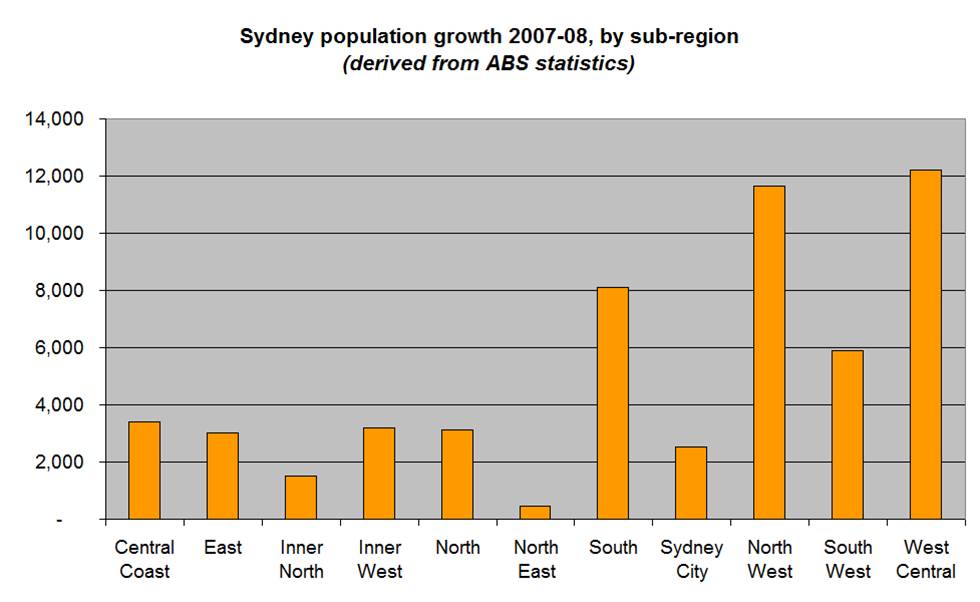
From a strategic planning perspective, the population growth estimates make interesting reading. Despite the majority of Sydney’s population living in eastern Sydney, a majority of the growth occurred in the three sub-regions that comprise Greater Western Sydney (GWS), which increased by 29,781 compared to eastern Sydney’s 25,266. The top two and fourth sub-regions in terms of total growth were in GWS: West Central (12,227), North West (11,664) and South West (5,890). The third, South (8,097), was in eastern Sydney (see table 2 and graph).

In terms of growth rates, GWS grew by 1.6% compared to eastern Sydney’s 1.0%. At the sub-regional level West Central grew the fastest, at 1.8%.

 TABLE 2: SUB-REGIONAL POPULATION GROWTH, SYDNEY (based on ABS data)

SUB-REGION

2003

2007r

2008p

Growth 2003-08

Growth 2007-08

Growth % 2007-08

Central Coast

301,205

307,136

310,546

9,341

3,410

1.1%

East

279,191

285,514

288,517

9,326

3,003

1.1%

Inner North

296,877

306,865

308,359

11,482

1,494

0.5%

Inner West

217,916

232,553

235,735

17,819

3,182

1.4%

North

262,874

264,227

267,346

4,472

3,119

1.2%

North East

231,727

237,922

238,371

6,644

449

0.2%

South

646,973

659,531

667,628

20,655

8,097

1.2%

Sydney City

146,108

170,173

172,685

26,577

2,512

1.5%

Eastern Sydney Total

2,382,871

2,463,921

2,489,187

106,316

25,266

1.0%

North West

743,791

771,226

782,890

39,099

11,664

1.5%

South West

403,011

415,875

421,765

18,754

5,890

1.4%

West Central

661,201

693,653

705,880

44,679

12,227

1.8%

Gtr. West. Sydney Total

1,808,003

1,880,754

1,910,535

102,532

29,781

1.6%

Sydney Metro. Total

4,190,874

4,344,675

4,399,722

208,848

55,047

1.3%

Non Metropolitan Total

2,480,530

2,559,151

2,583,334

102,804

24,183

0.9%

NSW Total

6,671,404

6,903,826

6,983,056

311,652

79,230

1.1%

popn-growth-by-subregion

The upshot of this is that population growth has accelerated in Greater Western Sydney over the 12 months to June 2008 with over 54% of Sydney’s growth, compared to just under half of total growth in the five-year period to 2008 (table 3).

Growth rates were particularly low in the Inner North (0.5%) and North East (0.2%) which had a combined growth of less than 2,000 people. All eastern Sydney sub-regions had growth of less than 3,000 people each, with the previously-noted exception of South Sydney which grew by more than 8,000.

 TABLE 3: EASTERN AND WESTERN SYDNEY GROWTH RATES (based on ABS data)


2003

2007r

2008p

Growth 2003-08

Growth 2007-08

Eastern Sydney

56.9%

56.7%

56.6%

50.9%

45.9%

Western Sydney

43.1%

43.3%

43.4%

49.1%

54.1%

However, a significant proportion of this growth has occurred as urban consolidation in the well-established suburbs of the West Central LGAs, particularly Auburn and Parramatta but also Bankstown, Fairfield and Holroyd which experienced growth of around 2,000 people each. Growth also occurred in the North West sub-region LGAs which have a mixture of established and new release areas, such as Blacktown, Baulkham Hills and Penrith, as well as in Liverpool in the South West.

These results need to be carefully considered by everyone involved in planning and providing infrastructure and services, not to mention those seeking to increase densities in established areas, particularly in eastern Sydney. GWS has done much of the “heavy-lifting” in accommodating Sydney’s growth and if this pattern continues, the point at which Greater Western Sydney surpasses eastern Sydney’s population will occur sooner rather than later.

 In future posts I will look at rural growth patterns as well as the implications of these figures in the context of changes in employment patterns and infrastructure provision.

Alex Gooding

If you want further analysis of current ABS demographic and other data and its implications for strategic planning, please contact the author at info@goodingdavies.com.au.

Posted in Growth, Local Government, Planning, Population, Sydney metro area, Western Sydney | Tagged , , , , , | Leave a comment

Nowra’s take on Sydney’s fate well worth a read

For those who haven’t seen it yet, writer and playwright Louis Nowra’s latest essay “Who turned out the lights?” in the Weekend Australian Magazine is a pungent summary of Sydney’s major problems, their causes and the resulting social, cultural and economic impacts.

The beginning paragraphs are available on line from the Weekend Australian website, but to read the full article you will have to purchase the paper. To summarise Nowra, the confidence that Sydney developed in its successful handling of the Olympics has disappeared, to be replaced by apathy, incompetence and above all, a lack of vision. As he notes, however, many of these problems predate the Olympics – and it is hard to disagree with Nowra’s summary:

“Many of the tribulations affecting Sydney are due to the fact that for the past two decades governments have forgotten that a city is more than its CBD and trendy inner suburbs. Outer suburbs are also integral to a city’s energy and sense of itself. But by the end of the millennium these suburbs, especially in the southwest and northwest, were fraying badly.”

Whilst his subsequent depiction of outer Western Sydney as being awash with “drugs, domestic violence and family breakdown” may be too sweeping a generalisation, there is no escaping the fact that parts of the region suffer from these problems and that complacency and policy failures by successive governments have contributed to this situation.

Nowra goes on to list some specific examples and their consequences. These start with under-investment in transport and other infrastructure (here Nowra takes a swipe at the decision to replace the northwest and southwest rail links with the CBD Metro), but also include inattention to a lagging economy, poor urban design, inept licensing laws and the collapse of the health system.

You might not agree with every one of Nowra’s arguments, but overall he builds a strong case for his conviction that Sydney has “outgrown the imagination of its politicians”. He concludes that to succeed Sydney needs to reinvest not only in infrastructure, but also in some less tangible factors such as pride, youthful enthusiasm, cultural exuberance and social diversity in order to create a “melting pot of ideas and a sense of purpose” to overcome the city’s current “malaise of apathy and cynicism”.

It would be very easy to dismiss Nowra’s criticisms as merely another polemic against the current State Government, but his critique is much more far-reaching. It should be compulsory reading for politicians on all sides, in Federal as well as State politics.

Posted in Governance, Infrastructure, Planning, Public Transport, Transport, Western Sydney | Tagged , , , , , | Leave a comment

Federal Infrastructure Funding Fallout III

Well, I said that I would outline some of the so-called “shovel ready” alternative transport projects the NSW Government could have nominated for Infrastructure Australia funding instead of the less-than-shovel-ready metro proposals that were put up. However, a lot has happened regarding transport – or at least a lot has been said about transport – since my last post.

I’ll come back to discuss “shovel-readiness” in a moment, but first to recap the past two weeks’ events. First, Dr Garry Glazebrook (UTS) released a detailed report which outlines a radically different approach to planning Sydney’s transport future. Glazebrook’s report proposes a metro system, but one quite different from that proposed by the Government, along with an upgraded heavy-rail system, light rail and a set of bus ring-routes. This is an oversimplification of a comprehensive plan, which I’ll return to in a future post.

Second, almost out of nowhere, light rail has been put back on the table by the Minster for Transport, David Campbell, who is said to have been won to the cause by seeing light rail systems in France.

Not surprisingly his initial enthusiasm to extend the line to Dulwich Hill and possibly into the CBD has run into resistance within Government (not to mention comparisons in the media with the vastly more expensive Metro), but the proposal is still being considered. Yet another feasibility study will be conducted and today the Sydney Morning Herald is reporting that inner city councils have agreed to “call the state’s bluff” by agreeing to the Government’s demand that they contribute to the cost of the study.

Campbell’s conversion to light rail apparently occurred after seeing systems in Paris and Nice, which is interesting given their nature. The Paris system comprises a set of four disconnected lines in the outskirts of the city. Like the Sydney light rail, some sections of the system have been converted from former rail lines, but they operate much more as feeders servicing the termini of Paris metro lines and other outer suburban areas.

The Nice system serves the coastal city of Nice, with a population of 350,000; the closest equivalent here in population would be Newcastle. In terms of a planned transport system, the Gold Coast light rail proposal which made up most of Queensland’s successful bid for Federal Government infrastructure funding would probably be the most similar.

Which brings us to the projects that the NSW Government could have put up for Infrastructure Australia funding. These include the North West Rail Link, probably the most expensive but arguably the most important of the cancelled/deferred rail lines. I suspect that the original heavy rail plan, to run from Epping to Rouse Hill, rather than the short-lived NW metro iteration would be the most viable option. The Epping-Rouse Hill section has also passed through all the environmental and planning hoops and could be easily integrated with the Epping to Chatswood line.

Similarly the planning for South West Rail Link is also complete. There is however a question about the timing of this project, given the economic downturn and the slowing in the rate of residential development. The third potential project, the Parramatta to Epping rail link is also a priority for the region and would make a major contribution to reinforcing the role of Parramatta, but some of the original environmental impact assessment and subsequent approvals may have to be updated.

Whilst my personal preference is for the North West Rail Link, any of these projects would have done more to meet Sydney’s transport needs than the proposed Metros, especially the CBD metro. Yes, the capacity problems in the CBD need to be addressed, but it is far from clear that the CBD metro in its current form will really address this issue – and the heavy rail projects are all a lot more shovel-ready!

Posted in Infrastructure, Planning, Public Transport, Transport | Tagged , , , , , , , , | Leave a comment

Federal Infrastructure Funding Fallout II

My last post discussed how NSW had fared relative to the other states in attracting transport infrastructure funding, particularly for public transport, in this week’s federal budget – which, in summary, was not very well.

 It’s useful to look at the five public transport projects which did receive substantial funding to see what characteristics they have in common. First cab off the rank and the project to receive by far the biggest allocation was the Regional Rail Express, which will provide a 40 kilometre link from West Werribee on the Geelong line to Southern Cross Station in Melbourne, joining the Baccus Marsh line near Ravenhall.

According the Federal Government, it will segregate V/Line regional rail services from metropolitan rail services allowing regional trains from Geelong, Ballarat and Bendigo avoid being delayed by suburban trains. It will also provide additional capacity for suburban services from Werribee, Sunbury and Craigeburn in the western growth corridor, delivering capacity for an extra 9,000 passengers in peak hour. 

The next largest public transport project is the 13 kilometre first stage of a light rail system on the Gold Coast, running from the Gold Coast campus of Griffith University to Broadbeach via Southport, which will receive $365 million. Further investment will be provided by State and Local Governments and the private sector with the line ultimately linking to the heavy rail network at Helensvale in the north and extending south to Coolangatta. The Federal Government comments that when completed this project will remove up to 40,000 cars from the road network. 

The next two largest projects are both located in Adelaide. The 42 km Gawler line to the city’s north will receive $294 million for resleepering and electrification to improve services, whilst the Noarlunga line receives $291 million for a 5.5 kilometre extension south to Seaford. Both projects complement SA Government plans to modernise Adelaide’s rail network. The final “big five” project is a $236 million investment to sink the central city section of the Perth to Freemantle rail line, releasing 50,000 sq metres of land for urban redevelopment.

There is quite a step down to the final four projects worth under $100 million each. One of these involves direct capital works – the O-bahn track extension in Adelaide, which receives $61 million for a 4.5 km link from the existing terminus to the CBD. The other three involve preconstruction works or feasibility studies for inner-city rail proposals, with the Sydney West Metro receiving $91 million, the East-West Rail Tunnel $40 million and the Brisbane Inner City Rail feasibility study $20 million.

A few things become clear from this analysis. First, the Federal Government appears to have prioritised well thought out projects providing extensions or improvements to existing heavy rail services that link to outer suburban growth areas, such the western growth corridor in Melbourne and the southern and northern suburbs in Adelaide. It is also prepared to invest substantially in new projects in outer suburban areas such as the Gold Coast light rail. 

Second, where it has funded these projects it has done so substantially and obviously with a view that they will be delivered comparatively quickly. The top five projects received enough funding to complete major stages of work and to be in operation within five or six years. 

Third, the Federal Government does not seem inclined to throw large sums of money at the inner city metro and other rail projects put forward by the various State Governments, especially if they are not shovel ready. The only inner city project to receive substantial funding was the undergrounding of the east-west rail line in Perth – and it can be argued that the (former) WA Government had already wisely invested some of the proceeds of the (former) mining boom in building two complete new rail lines to outer suburban areas in the north and south of the city. 

This caution reflects the view put by IA in its Report to the Council of Australian Governments in December 2008 regarding metro and other “new technology” transport proposals. This is worth quoting in full:

The strategic policy choice facing Australian governments is whether, and under what circumstances, new urban rail systems should adopt such technologies. However, a move towards these technologies raises many issues. To avoid a repetition of the rail gauge problem from the nineteenth century, decisions on these matters need to be made with national input and intergovernmental collaboration. The network that exists today represents more than 40 years of consistent long term planning and investment. An equivalent national commitment to such planning and investment is required in Australia if new technologies are to be applied to the public transport sector.

However, even if a decision is taken to make such a strategic shift, the existing rail networks will be a fundamental part of Australia’s urban transport networks for decades to come. Sensible investment in the capacity of those systems and in life-cycle replacement of assets will continue to be required.

In seeking Federal funding, NSW chose to put all its public transport eggs in two very big baskets– the CBD Metro and the Sydney West Metro – and received only $91 million towards preconstruction works for the latter. Clearly, neither project was assessed as being ready enough to meet IA’s criteria, nor indeed do they reflect the Federal Government’s predisposition (no doubt influenced by the IA perspective quoted above) to fund projects in outer urban areas mostly based on the “old technologies”.

The irony is that NSW did have three shovel-ready projects that met IA’s criteria but did not put them forward. I’ll consider these and some of Sydney’s strategic transport planning issues in my next post.


Posted in Infrastructure, Public Transport, Transport | Tagged , , , , , , , , , | Leave a comment

Federal Infrastructure Funding Fallout

Much has been said in the media and elsewhere about the shortfall in the Federal Budget infrastructure allocations for NSW transport projects, but it is worthwhile examining its dimensions in more detail.

Just how much (or little) will NSW receive? There are a few ways to look at this – relative to the allocations to other states, relative to population (or some other measure of demand) and relative to the total value of the project proposals lodged by the State Government.

In summary, NSW will receive $2.1 billion for two “shovel-ready” road projects and preliminary works for a single public transport project. By far the largest portion goes to the Hunter Expressway between the F3 and Branxston, which receives $1.5 billion. The Pacific Highway Kempsey Bypass has been allocated $618 million and the proposed Western Metro will receive only $91 million for “pre-construction work”.

Even with the substantial roads allocation, NSW is underweight compared to the other states, receiving only 25% of the total transport allocation (see graph 1). Victoria is the clear winner with 38% of the funding.

totaltransgraph

Take out the roads allocation and the picture is even more stark. Of the five states to receive public transport funding, NSW has the lowest allocation at just 2%, whilst Victoria receives a whopping 71% of the total public transport budget vote (graph 2). Whilst public transport related projects receive nearly 55% of the national transport infrastructure allocation, in NSW the proportion is only 4.6%.

pubtransgraph

On a per-head basis (using 2008 population figures), NSW receives just under $13 per resident, whilst the average across the five States to receive public transport funding is $225.80. Victoria will receive $611.39 per head (graph 3).

perheadgraph

The most interesting comparison is with the total projects submitted for consideration by Infrastructure Australia. Now, it is unlikely that any State Government would have expected a Federal contribution to every project on its wish list, nor would they have expected any projects that did attract Federal support to be funded in full. It is also hard to get an exact figure for the total allocations sought by each State given the “blue sky” nature of some of the figures supplied, but however you look at it NSW has done extremely poorly.

Just 1% of the total value of NSW public transport project proposals submitted to Infrastructure Australia has been funded, compared with around 19% in South Australia, 43% in Victoria and 90% in Western Australia.

Queensland received only 2% of the total value of its public transport wish list, but that state’s figure was inflated by the $14 billion estimated cost of the Brisbane metro proposals. Queensland’s allocation of $385 million was actually four tines the amount NSW received and will enable the construction of the Gold Coast Light Rail project to commence.

What does this tell us? First, that the Feds appear to have been interested in funding only genuinely “shovel-ready” projects that meet all the IA criteria, at least in this round. The successful projects also address major transport needs as part of a coherent transport strategy and, significantly, there has been an emphasis on extending and improving rail services in outer suburban areas. In my next post I will examine some of the individual public transport projects that were funded and the conclusions that can be drawn from these allocations.

Posted in Infrastructure, Public Transport, Transport | Tagged , , , , , , , , | Leave a comment

Welcome to StrategyMatters

Welcome to StrategyMatters, one of two new blogs that will be appearing on the Gooding Davies website!

As the title says, strategy matters. This applies to strategic thinking within your organisation just as it does to “big picture” strategic planning affecting the wider community. Through this blog we hope to examine some key strategic issues at both these levels, based on current research and a general survey of what’s happening on the ground in relation to planning, advocacy, policy development and project and organisation management.

To achieve this we will be making extensive use of social media as well as “traditional” sources and it is the implications of social media and the new Web 2.0 services for NGOs, small organisations, councils and government agencies that will be the focus of our other blog, Sociamind. This blog will also highlight some of the key online and other tools that organisations can use to help manage themselves and their projects.

Highlights from both blogs will also be combined in the GDC Newsletter which we will be circulating to our clients and other interested parties, with links back to the website and blogs. And, if there’s anything you want to comment on, please respond!

Posted in Introduction | Tagged , | Leave a comment