A tale of three light rail lines (and two to come) – part 1

Australian cities have come relatively late to the light rail revival which spread across the globe in the latter decades of the 20th century, but lately they seem to be making up for lost ground. There are now three substantially new or renovated lines in operation – and that’s not counting Melbourne substantial tram network – with two more on the way and several others on the drawing board.

Before I take a closer look at these, it’s useful to go over a little history. While Melbourne maintained its role as a major tram city (with one of the largest systems in the world), by the 1960s trams were removed in all other cities except for the light rail line in Adelaide.

It was not until the late 1990s that the first sign of the modern light rail revolution appeared in Australia, with the conversion of a relatively short section of a freight line in Sydney in 1997. Even then things happened slowly – while there were some extensions in Adelaide and Sydney in the 2000s, it was only after 2010 that the revival really took off.

Further extensions to these lines were completed and most significantly of all, in 2014 a completely new line not based on an existing rail corridor was opened on the Gold Coast. In addition two more new lines are planned which have strong government commitments to complete them by 2019 – a second line in Sydney and a line in Canberra.

In summary, by 2020 Australia could have five modern light rail lines in four cities. Conveniently of similar length and with broadly similar technologies, these provide a basis for comparison which provides some insights into why this revival has occurred and the direction of public transport planning in Australia.

I’m going to try to tease some of these issues out in this series of posts, though before I do so I should attempt to define exactly what “light rail” is. This will always be an inexact process because there is a considerable degree of overlap with other modes of fixed wheel transport – trams on the one hand and conventional rail on the other. However a good working  definition is provided by the American Public Transportation Association:

“…a mode of transit service (also called streetcar, tramway, or trolley) operating passenger rail cars singly (or in short, usually two-car or three-car, trains) on fixed rails in right-of-way that is often separated from other traffic for part or much of the way”.

I agree with this except that I would put stronger emphasis on the level of separation from other traffic, which provides the key distinction from traditional tramways. All the lines I’m going to talk about – the ones already operating in Adelaide, Sydney and the Gold Coast, along with the line proposed for Canberra and the second line planned for Sydney – are consistent with this definition. Parts of the Melbourne system are too, but that is still predominantly a street-based tramway. It is also not easy to incorporate Melbourne into any comparison as it is, literally, 20 times the size of any of the light rail lines in the other cities.

In the table below I’ve attempted to make a detailed comparison between the three light rail lines currently operating and the two which have solid government commitments. Apart from Melbourne, other systems not included are the proposals for Hobart and Perth which are either uncommitted or deferred, the plan for Newcastle in NSW, for which there is relatively little information and those for Western Sydney which are yet to be finalised. This table is available in a more readable PDF format here and will be the basis for this series of posts.

Australian light rail lines

Australian light rail lines

I’ll talk about some of the key similarities and differences between these systems and what we can learn from their development, starting in this post with a brief overview.

Status: as stated, lines in Adelaide (Glenelg Tram), Sydney (Dulwich Hill Line) and the Gold Coast (G:Link) are in operation. Contracts have been let for the CBD and Eastern Suburbs Light Rail (CESLR) with construction due to start later this year. The future of the Capital Metro project in Canberra is less secure; while two consortia have been shortlisted no contracts have been let and the ACT Assembly opposition has vowed to scrap the project if it wins office in next year’s election.

History and description: By far the oldest light rail line is the one in Adelaide, which opened in 1929 after a conversion from a heavy rail suburban line. It operated continuously using the original tram cars until 2007, when the first CBD extension was opened and the rolling stock replaced. The second CBD extension was completed in 2010.

The line now runs from a beachside terminus in Glenelg to the south western edge of the Adelaide CBD which it transects along the main north-south corridor before turning left running past the railway station to the entertainment centre which also has extensive parking. The line therefore provides radial commuter services from one end and a park-and-ride service from the other.

The second line to open was the Dulwich Hill Line in Sydney, in 1997. This line which is also based on the conversion of an existing railway (in this case, a freight line) from Central Station, was extended to Lilyfield in 2000. This section provides connectivity to major entertainment facilities in Haymarket and Darling Harbour as well as radial commuter services, though only as far as the southern end of the CBD.

The most recent extension, opened in 2014, extends the service as far as the end of the old freight line in Dulwich Hill where there is a second interchange with the rail network. This section provides both CBD commuter services and circumferential services between various bus and rail corridors in inner western suburbs.

As noted earlier the most significant development in recent years has been the opening in 2014 of the Gold Coast light rail line. Unlike the other systems this was not based on any existing rail corridor but was developed from scratch to provide a central transport corridor through the city, linking key centres and providing commuter services.

While the about-to-be-constructed CESLR in Sydney will be of similar length to the other lines it will be of an entirely different scale in terms of capacity and patronage. These issues will be discussed in future posts (and I have also discussed the CESLR itself in an earlier series of articles starting here), but the line due for completion in 2019 will replace a large number of commuter bus services in the city’s eastern suburbs as well as providing a circulation service in the CBD’s main north-south corridor, which will be pedestrianised.

Finally, the Capital Metro in Canberra will if constructed provide commuter services from the city’s north to the city centre – and if an extension to Russell is approved, through part of the CBD. This line is also due to be completed in 2019, but as mentioned earlier the prospects for this line’s completion are mixed with the ACT opposition committed to abandon the project in favour of improved bus services.

In my next post I will look at some of the technical and operational aspects of these three existing and two planned services and in future articles discuss some of the implications of this rapid expansion of light rail in Australia.

Posted in Growth, Infrastructure, Public Transport, Sydney metro area, Transport | Tagged , , , , , | 5 Comments

Local Government Growing Regional Australia report launched

The Australian Centre of Excellence for Local Government (ACELG) and Regional Capitals Australia (RCA) have just launched a report I co-authored with Dr Robyn Morris and Lucinda Molloy on local government’s role in building strong and sustainable regional capitals and regions.

The report, Local Government Growing Regional Australia, was officially launched at the Regional Capitals Australia conference Regionalism 2.0 in Mackay, Queensland. As the RCA media announcement of the launch of the report notes, it “explores the factors underpinning strong and sustainable regional capitals and regions, and the vital role played by local government in this crucial national issue”. This was based on extensive research we undertook over 12 months and involved an extensive literature review, socio-economic analysis and five detailed case studies of the regional capital councils of Geelong (VIC), Geraldton (WA), Launceston (TAS), Mackay (QLD) and Wagga Wagga (NSW) and their surrounding regions.

LG Growing Regional Australia vol 1 cover

Local Government Growing Regional Australia Volume 1: Report

In particular as the report’s Executive Summary notes, “the study investigated the factors that contribute to building strong sustainable regional capitals and regions with a particular focus on identifying key governance and leadership ingredients and the part played by regional capital local governments in attaining this outcome”. The report outlines some of the key drivers and inhibitors of regional development we identified. These include environmental factors, community capital, entrepreneurship, creativity and innovation, institutional factors, governance and leadership.

The report also identifies some of the key “ingredients” for growing sustainable regional capitals and regions. Many of these are specific to each region but there are some which we found have more general application. In relation to governance frameworks these included a shared commitment to supporting regional wellbeing and growth with adequate slack resources to participate effectively, effective formal regional structures which provide a framework for interaction and collaboration, the capacity for regional stakeholders to work together in developing both informal collaborations and more formal partnerships and a shared approach to leadership.

Within this framework the contribution of regional capitals is central to the development of their regions, because of their size and the agglomeration of infrastructure and services available in each of them . Some of the key shared ingredients for success adopted by a number of the councils which we documented in the case studies include:

  • the ability to work with other major stakeholders to build ‘horizontal’ or distributed leadership coalitions and policy frameworks.
  • the development of an effective advocacy strategy to engage with state and federal governments as well as the local/regional community.
  • support for projects and the adoption of strategies that support specifically the growth of the regional capital but also, directly or indirectly, the development of the wider region.
  • the development of strategies to assist in the diversification of the regional and/or local economy.
  • engagement in a proactive, flexible but professional relationship with the development sector.
  • a commitment to innovation and entrepreneurialism.
  • the capacity to respond to major negative events and to minimise their impacts.
  • an ability to ‘scan’ for future trends and respond proactively.

As the RCA media announcement notes, ACELG and RCA will circulate the report more broadly and “encourage a dialogue across governments about the key issues raised by the research, with particular regard to the ‘Future role and contribution of regional capitals to Australia’ inquiry announced recently by the Federal Government.” The research will also be presented at the ALGA 2015 National General Assembly of Local Government which will be held from June 14 – 17 2015.

The research report can be downloaded from the ACELG website in two volumes. Volume one introduces the report and contains overviews of the literature review and the case studies, along with a discussion of the research findings. Volume two contains the full literature review and case studies, along with an outline of the case study methodology. A research summary is also available from the ACELG website.

This proved to be a long and complex project and although we obtained a range of interesting and hopefully useful insights these are really only the beginning. I hope the report will stimulate further research for example, as its conclusion suggests, the conduct of longitudinal studies to test the effectiveness of significant governance initiatives over time and to explore further the nature and extent of the integration between regional capitals and their regions.


Posted in Governance, Growth, Local Government, Regions | Tagged , , , , , | 1 Comment

NSW State Election 2015: what are the major parties promising to do about transport?

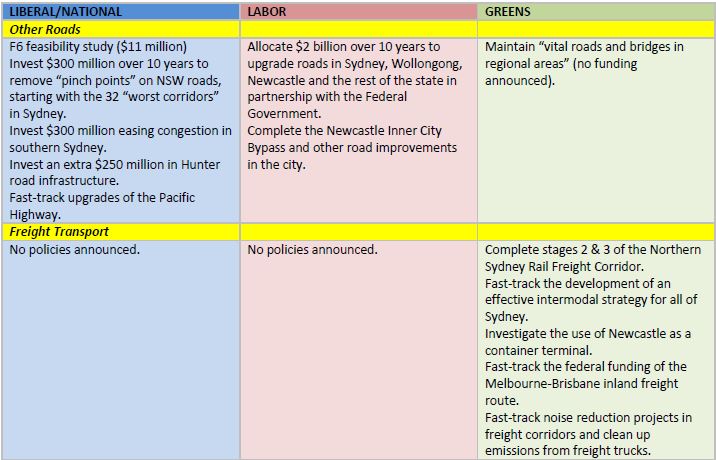
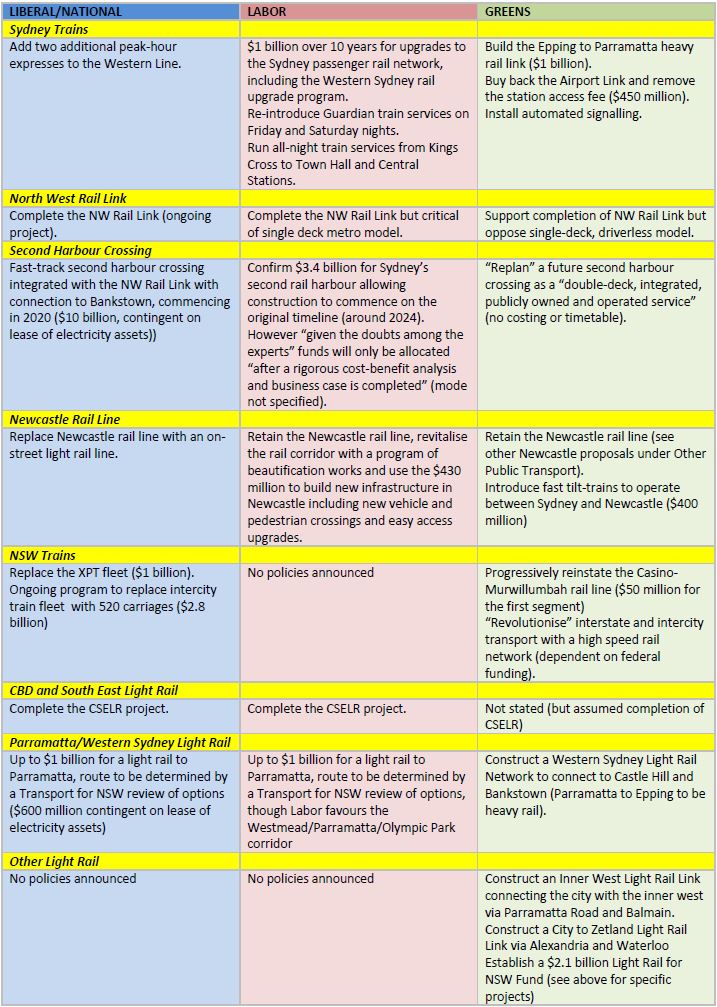
I thought it would be useful to summarise what the major parties – The Liberals/Nationals, Labor and the Greens – are promising in relation to transport in relation to the upcoming NSW state election. The following is drawn from a range of policy statements, media releases and websites and as a result is likely to be incomplete – it would seem that with the partial exception of the Greens, the days of parties releasing detailed election statements containing all their policies and election commitments in one package are over. Nonetheless this table should provide a useful starting point, though it should be noted that no responsibility is taken for the completeness or accuracy of this information.

For formatting reasons I’ve had to divide the table into four parts and display these as separate images. To download the original as a single PDF, please click here.

NSW 2015 Election Transport Promises Part 1

NSW 2015 Election Transport Promises Part 1

NSW 2015 Election Transport Promises Part 2

NSW 2015 Election Transport Promises Part 2

NSW 2015 Election Transport Promises Part 3

NSW 2015 Election Transport Promises Part 3

Transport4

NSW 2015 Election Transport Promises Part 4

 Comments

Several conclusions that can be drawn from the list of promises. All three parties are committed to completion of the North West Rail Link (with varying degrees of enthusiasm for the privatised driverless single deck metro model) and the CBD and South East Light Rail; both these projects are in any case the subject of contractual commitments. All three are also committed to constructing light rail links to Parramatta, though the approaches vary and there is a shortage of detail.

In a number of other areas there are relatively few practical policy differences between the LNP and ALP commitments, though the LNP has a bigger shopping list based on the party’s commitment to the lease of electricity assets, a policy opposed both by Labor and the Greens. The two areas where this has resulted in significant differences between the two largest parties are the second harbour rail crossing which Labor would defer (and commence only after a “rigorous cost-benefit analysis”) and the WestConnex motorway project where Labor would cancel the third-stage tunnel linking the M4 and M5.

There are also some differences between the two parties which are unrelated to the electricity privatisation issue. The most obvious of these is the approach towards the Newcastle rail line which has already ceased operations as part of the government’s redevelopment strategy for the city, to be replaced by a light rail system. Both Labor and the Greens oppose the closure and would reinstate the heavy rail line. Other examples of policy differences include the greater detail Labor has provided about its plans to improve existing rail services particularly in Western Sydney, which contrast with the commitments which the LNP has made towards purchasing new trains for the intercity and country rail networks.

There are much more significant policy – and ideological – differences between these two parties and the Greens’ proposals. Their transport policies are more detailed than those of the other parties and not surprisingly contain a much stronger commitment to public transport over roads. For example, the Greens would cancel the WestConnex and NorthConnex motorways and the F6 feasibility study and direct the funds saved into rail and light rail infrastructure; their policy document is almost silent about other roads. The Greens also oppose the embrace of privatised rail services  by the Liberals/Nationals and to a lesser extent Labor (which supports wider use of Public Private Partnerships).

The Greens would also “replan” a future second harbour crossing as a “double-deck, integrated, publicly owned and operated service” and commence construction of extensive light rail networks in Sydney’s inner west and southern Sydney. The party would also make a $250 million commitment to construct an integrated cycleway network in Sydney.

This also raises the considerable differences between the three parties in terms of how they would fund their transport commitments. The Liberals/Nationals have the most expensive shopping list, but many of their promises are contingent on successfully leasing electricity assets. Labor’s shopping list is more modest and would rely on a mixture of strategies including the redirection of Restart NSW funds, the reallocation of some funding from the sale of ports and the deferral of the abolition of some state business taxes. The Greens have the smallest transport budget, which would be largely drawn from the proceeds of the cancellation of all major road projects.

While I am not going to pick winners from this list, there are a few key observations that can be made about the transport promises for the 2015 election:

  • The clear recognition by all the major parties that the provision of public transport is critical to the future of Sydney and to varying degrees, regional NSW is encouraging. While they differ in their emphasis and level of expenditure involved, all three parties have made extensive commitments to the provision of major public transport infrastructure.
  • Despite their shared commitments to the NWRL and the CBD and South East Light Rail, along with their support for public transport generally, the government and Labor still appear to be strongly wedded to road-based transport solutions. The LNP seem determined to spend billions to complete WestConnex despite increasing criticism, while Labor would complete at least two stages of the project, This is a contrast to their counterparts in Victoria who have repudiated the planned East-West Link for Melbourne in its entirety. As noted earlier, only the Greens have explicitly opposed WestConnex, along with virtually all the other road-related project proposals.
  • It is pleasing to see that in addition to completing the NWRL, all three parties have committed to some form of light rail (LR) around Parramatta. It is puzzling though that none of the parties have embraced Parramatta Council’s recommendation of the LR link to Macquarie Park as the priority (though the Greens have committed to heavy rail in this corridor) – and somewhat disappointing that there are relatively few explicit commitments for other transport projects within Western Sydney, in particular those that might support regional centres outside Parramatta.
  • All the party platforms have tended to concentrate on big-ticket infrastructure items. With the partial exception of the Greens’ transport paper there is little discussion regarding bus services for example, or issues such as community transport or transport for disadvantaged people. Some major underlying infrastructure issues have also been ignored, for example the need to upgrade the poor state of railway tracks in many parts of regional NSW which would almost certainly be required to complement the LNP proposals for new country and intercity trains. The Greens are also the only party which has addressed freight transport issues in any detail.

As noted earlier, there are likely to be some omissions and inaccuracies in the list of transport promises outlined above. Despite this I hope that it is a useful summary – and that one of these columns (or possibly more than one, if a minority government is formed) will also provide a helpful checklist of the implementation of the transport commitments of whichever party is elected to office.

Posted in Governance, Infrastructure, Planning, Sydney metro area, Transport, Western Sydney | Tagged , , , , , , | 3 Comments

Sydney’s light rail project part 3 – trying to do too much?

In my last couple of posts I talked about some of the changes to Sydney’s CBD and South East Light Rail (CSELR) project contained in the Modifications Report (MR) which was released late last year as well as the implications of one particular change – the adoption of Alstom’s wire-free technology for the George Street pedestrianised section of the line.

CSELR route (from TfNSW CSELR Modifications Report, 2014)

CSELR route (from TfNSW CSELR Modifications Report, 2014)

One fairly important change which I haven’t discussed in detail is the revelation that came with the signing of the contract for the project – a blow-out in the cost of half a billion dollars, from $1.6 to $2.1 billion. This is a fairly mind-boggling 31.3% increase, supposedly partly to cover the increases in capacity and other changes outlined in the MR, but which also reflects the extraordinarily high cost of rail infrastructure projects in NSW compared to other states and overseas.

While I have supported the principle of the CSELR project, this increase along with some of the changes proposed in the MR and several of the questions asked by critics of the CSELR has troubled me – and a range of other observers. Obviously the project is now a fait accompli with the contract signing and the support of both the major parties in the run-up to the NSW state election later this month. I think that the south-east needs some sort of rail solution and I also believe the CSELR can still deliver on that, but it is still worth considering some of the issues involved:

Capacity: Calculations based on the revised service frequencies and increased light rail vehicle (LRV) capacity proposed in the MR of up to 466 passengers indicate a peak capacity of just under 7,000 passengers per hour in each direction on opening. This could be expanded to just over 8,600 when 18.5 rather than 15 LRVs are operated per hour.

This sounds like a lot but there has been a passionate debate on the Transport Sydney blog about whether there will be sufficient capacity to cover the many south-eastern bus routes that will be replaced by the light rail. Add to this the additional inner-west bus routes that will terminated at the Rawson Place interchange plus its role as a CBD circulator and it is hard to see how the CSELR will have enough capacity even with the longer trams now planned.

Frequency: The service is planned to open with frequencies of between four and six minutes each way with the intention to ramp this up eventually to between 3.25 and five minutes as demand increases. This means that during the day on opening there will be a 67-metre tram passing any point in the George Street pedestrian zone every two minutes in either direction and every one minute 45 seconds once the additional capacity is required. In addition I suspect that this increased frequency will be required a lot sooner than anticipated.

Travel time: Proposed travel time is between 24 and 39 minutes from Kensington and Randwick to the city. While the light rail will not be nearly as adversely affected by traffic congestion as the current bus services in peak hour and will therefore be more consistent, these times are no faster and in some cases are actually slower than than those of the bus services that will be replaced.

Amenity: Another major issue is the affect on the amenity of properties along the route and in particular the mixed impact on the viability of the planned George Street pedestrian zone. Part of the rationale for the light rail is that it will be a catalyst for and provide synergies with the proposed mall – for example, the light rail will benefit from having its own traffic-free right of way while people using the mall will also benefit from the proximity of accessible and quiet, catenary-free electric transport.

In reality however it is highly unlikely that the pedestrian zone will ever operate in the same way as say the Pitt Street Mall does now. Sure, two lanes of noisy traffic will disappear, but the other two will be taken over by trams running every two minutes or less and the centre of George Street will not be the sort of place that the not particularly tram-literate pedestrians of Sydney would want to dawdle.

Reliability: I discussed this in my last post in relation to the catenary-free section in George Street. As noted there, the Alstom APS system to be used to provide power via a safe third-rail in this section has been used in only a few cities and it is unclear how well it will perform in a Sydney summer downpour when road surfaces can be covered in centimetres of water.

Cost: As I noted, the project cost has grown over 30% to $2.1 billion and it is in this context that a number of the criticisms are relevant. At around $175 million a kilometre this is a very large sum of money for 12 km of track, all of it on the surface. Admittedly this costing probably includes elements such as the conversion of George Street to a pedestrian zone but on the other hand land costs are relatively low as the route mainly uses roads, existing bus corridors and government-owned land. By comparison the 23 km North West Rail Link (NWRL) which involves extensive tunnelling and viaduct construction will cost $8.3 billion, or only slightly over double the cost per kilometre.

In summary, the CSELR is being asked to do a lot – provide high-frequency and high-capacity line haul services to and from the south-east to replace hundreds of buses, provide CBD access for bus passengers via an interchange for hundreds of other services from the inner west and elsewhere, act as a key intra-CBD circulator, provide special events transport, contribute to the amenity of the CBD pedestrian zone – the list goes on.

This isn’t to say that it is inappropriate for any of these tasks or that it will fail at them but it can be argued that light rail is being used to tick an unrealistically wide range of boxes in relation to this project. At least some of these would have been better served by examining and adopting other modes, such as metro or heavy rail either as an alternative or to complement the CSELR. In addition, in attempting to meet all these demands, the cost of the CSELR has grown enormously.

It is however too late now to talk about alternatives – the contract has been signed and construction has started. Rather than wonder what might have been it is more useful now to look at short-term and long-term strategies to address the problems that the CSELR is likely to face, especially in relation to capacity. Here are a few suggestions:

Short-term:

  • Anticipate that the plans to gradually increase the capacity of the CESLR might have to be brought forward.
  • Provide shuttle tram services between Central and Circular Quay to increase capacity specifically for bus passengers using the Rawson Place interchange.
  • Allow some flexibility for a selection of these and eastern suburbs buses to continue running into the CBD along alternative corridors.
  • Look at managing the George Street pedestrian zone as two thin malls either side of the tram tracks rather than a single integrated pedestrian zone.

Long-term:

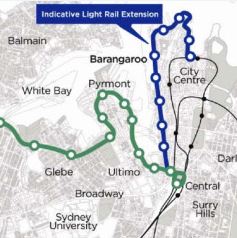
  • Provide an additional light rail corridor from Central into the city, either on the west side of the CBD along Sussex Street to the development at Barangaroo (possibly connected to the inner-west light rail line rather than the CSELR, with a bus interchange at Haymarket) or on the east side via Elizabeth and Castlereagh Streets. Either option could be looped back to link to the CSELR terminus at Circular Quay.
Proposal in 2010 for a light rail extension to Barangaroo (from Sydney Architecture Archive)

Proposal in 2010 for a light rail extension to Barangaroo (from Sydney Architecture Archive)

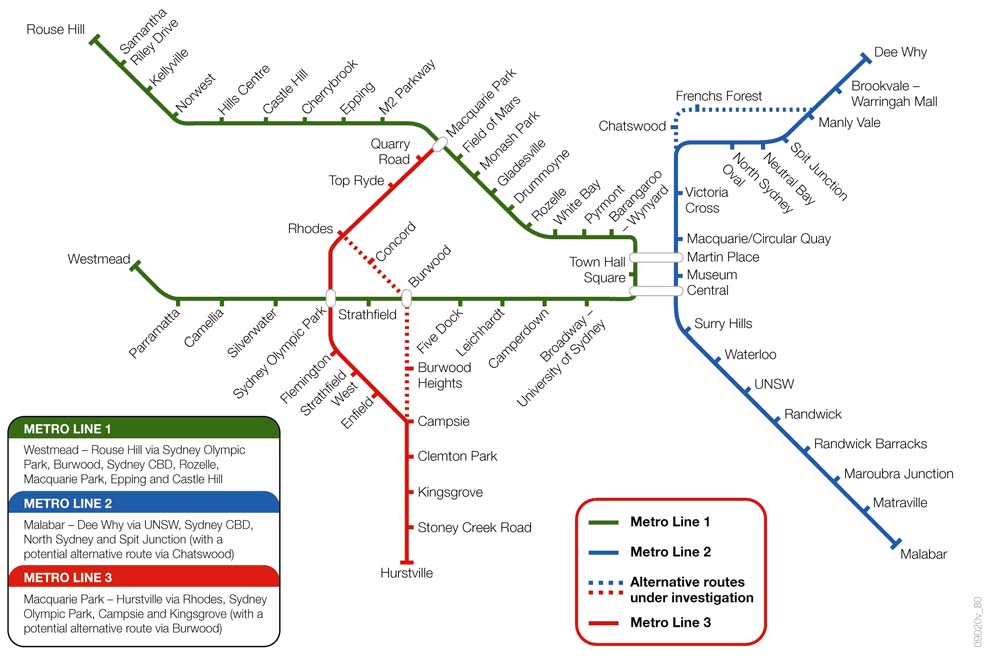
  • Provide additional capacity on the CSELR from the vicinity of Moore Park to the city. Potential options could include a route north to near Oxford Street and then across to Elizabeth and Castlereagh Streets, or even (and I am not sure of the feasibility of this) going underground to connect with the disused tunnels at St James Station. The line could terminate there to provide a light rail to heavy rail interchange and access to the east of the CBD or even be continued around underground before surfacing to connect with the CSELR terminus at Circular Quay.
  • Construct the Eastern Suburbs Metro as proposed by the now-defunct Sydney Metro Authority (more on this in a later post). This would follow the same broad route planned for the CSELR though there would be opportunities for variations such as going via Waterloo. This line would offer faster travel times as well as greatly increased capacity and the potential for interchanges with the existing and planned rail network at several CBD locations. This is the least likely option to be constructed, however, given both its expense and that it would largely duplicate the route of the CSELR.
Metro proposals 2009 (from Sydney Metro Corridor Assessment Report)

Metro proposals 2009 (from Sydney Metro Corridor Assessment Report)

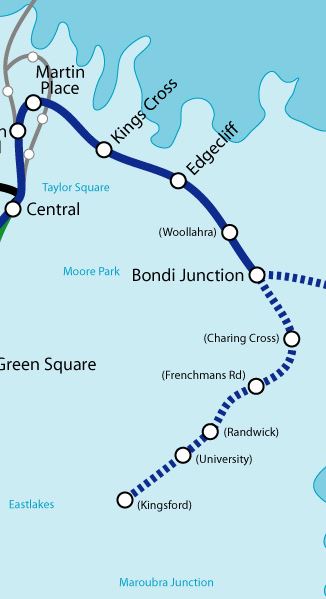
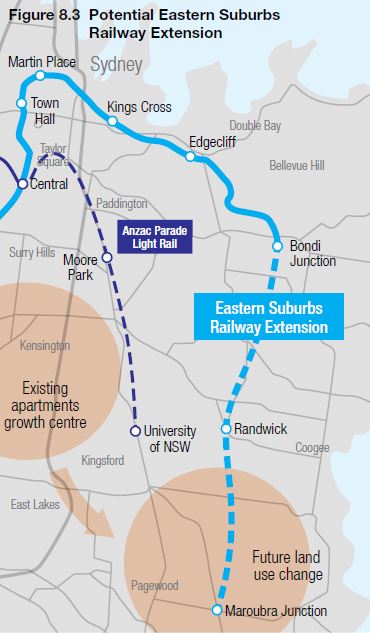
  • Extend the Eastern Suburbs Railway (ESR) from Bondi Junction to Randwick and Kingsford and/or Maroubra Junction. This would complete the ESR in the form envisaged in 1967. A six-kilometre version with only two stations (Randwick and Maroubra Junction) was proposed in the 2012 State Infrastructure Strategy; this approach could be modified slightly to provide interchanges with the CSELR both at Randwick and either Kingsford or Maroubra Junction (provided the CSELR was extended to the latter) along with one or two extra stations along the route. While I opposed the emphasis on roads and many of the recommendations made by Infrastructure NSW in that document, it’s hard to disagree with their conclusion regarding this proposal:

“An extension of the ESR would complement, rather than compete with, a light rail line along Anzac Parade to Central. The heavy rail would provide the rapid journey times and mass transit capacity into the northern CBD that light rail is unlikely to offer.” (Infrastructure NSW State Infrastructure Strategy, 2012: 115)

Eastern Suburbs Railway 1967 proposed extension (from Wikipedia)

Eastern Suburbs Railway 1967 proposed extension (from Wikipedia)

Infrastructure NSW 2012 proposal (from INSW 2012 State Infrastructure Strategy)

Infrastructure NSW 2012 proposal (from INSW 2012 State Infrastructure Strategy)

Using the NWRL as a loose guide, the cost of such an extension would be in the ballpark of $2.1 billion, or around the same again as the CSELR. Some cost savings could be made by constructing a single track from Randwick to Maroubra Junction, with provision for the construction of a second tunnel. This extension would also avoid duplicating the CSELR line, but while it is a more attractive proposal than a SE metro its expense means that it would be a very long-term proposition.

Of these options my preference would be for the construction in the medium term of a second line to the west of the CBD connected to the Inner West Light Rail (IWLR) line, combined with a bus interchange. This would have a number of advantages; as well as providing a single-seat ride for IWLR passengers into the CBD it could be used to provide more reliable capacity for inner west bus passengers as an alternative to the vagaries of trying to board crowded trams from the south-east at Rawson Place. It would also provide a public transport link to the doorstep of Barangaroo from the Central end and potentially via the Rocks for CSELR trams.

If however there is still a need for further capacity in the longer term especially to and from the south east, then the best option appears to be construction of the ESR extension. This would not be cheap, but at least the combined cost of this and the CSELR would not exceed that of the metro line which arguably should have been built in the first place.

Posted in Infrastructure, Public Transport, Sydney metro area, Transport | Tagged , , , , | 8 Comments

CBD and South East Light Rail part 2: what is the cost of going wire-free?

After my recent post on the CBD and South East Light Rail (CSELR) the final $2.1 billion cost was revealed with the signing of the contract for the project in December last year. The half-billion dollar increase from the government’s previous estimate of $1.6 billion took a lot of people by surprise and contributed to an interesting and protracted debate in the Transport Sydney blog about whether light rail is the most appropriate and cost-effective mode for that corridor. The government’s announcement also revealed more about the technology to be used in the wire-free section of George Street.

I’ll discuss the cost issue in a future post, but in the meantime I thought I would investigate further the choice of Alstom’s “Aesthetic Power Supply” (APS) over battery technology to power the wire-free section of the line in George Street. As I outlined in my previous post, this system involves a continuous electrical feeder “third rail” embedded in the road surface between the tracks. This arrangement is claimed to be safe for pedestrians as it comprises conducting segments placed at regular intervals separated by insulated joints which are energised as the light rail vehicle (LRV) passes directly over them. Power is collected through two collector shoes under the LRV.

Diagram of the APS power supply (source: Systra 2012)

Diagram of the APS power supply (source: Systra 2012)

The choice of this system has already attracted some criticism both on cost and reliability grounds. I decided to look at both these issues, especially the aspect of reliability given Sydney’s recent summer torrential rains. I came across an interesting report prepared by Systra in relation to the extension of Dublin’s LUAS light rail network which assessed the wire-free power alternatives, including the Alstom APS system. I posted several replies on the Transport Sydney blog stemming from that report but I thought I’d consolidate them into a single post here.

The report includes a number of relevant comments regarding the APS system which are worth quoting in detail:

Specific features

The maximum operating speed on APS sections is 50 km/h, while an Alstom Citadis vehicle can operate at 70 km/h with overhead catenary…. In order to mitigate local failure of the system, the vehicles are equipped with batteries. These batteries enable trams to cross failed sections of up to 50 meters. (P11)

Mechanical aspects

The APS solution requires the installation of a power rail between the running rails, embedded in the track bed… In the BXD context, the power rail must be able to withstand continuous road traffic for years, without damage.

On French projects, APS is mainly installed on segregated running sections, except for road intersections where road traffic crosses the rail… As part of its certification process, the first version of the APS system went through an endurance test to simulate the effect of urban traffic (over 700,000 cycles with 7-ton pressure wheels).

Despite this test and certification process, the first version of APS installed in Bordeaux in 2003 suffered damage at road intersections. It is worth mentioning that in this previous design, the APS rail was directly embedded in asphalt… Following this experience, Alstom revised its design to embed the APS rail in a concrete plinth to increase its resistance to road traffic. This improvement ended up being satisfactory in Bordeaux.

The latest design of APS (APS 2) now includes a reinforced power rail, still embedded in a concrete plinth. Alstom claims that it can withstand 13.5 ton axle loads.”(P18-19)

Flooding

The APS power rail, like any power rail, cannot operate when it is covered by water, because such a situation would lead to current leak when the rail is powered up, and thus tripping of the circuit breaker protecting the traction power circuit…. Flooding of the track bed is an exceptional situation which should be prevented by an appropriate drainage arrangement embedded in the track. (P20)

Energy efficiency

For safety reasons, regenerative breaking is not possible when running with the APS system, thus energy efficiency is degraded by 15% to 20%…. The cost associated with this increase in the power consumption is difficult to estimate accurately at this stage. In order to carry out this estimate, many assumptions must be made; each of them introduces potential uncertainty in the result. (P22)

The report also makes some observations about the cost of the system:

Alstom APS

The APS system is made of on-board equipment and track side equipment. To this date, on-board equipment has always been delivered on new trams…. The cost of this on-board equipment delivered on a new tram is estimated to be around 300,000 €, in addition to the basic cost of the tram.

… The cost of the APS track side equipment is estimated to be 1,850,000 €/km. (p33-34)

It is always difficult to extrapolate estimated costs from one transport project to another in a completely different city 12,000 km away, but the report’s estimate provides a starting point. Assuming 25 LRVs for Sydney, the installation of one kilometre of wire-free track and allowing for inflation since the Dublin report was published in 2012, the total additional capital cost of the wire-free option for Sydney would appear to be in the ballpark of $15,000,000. This doesn’t include any saving from overhead wiring not installed in this section, but it also doesn’t cover any additional costs that may be involved in providing extra drainage to protect the APS conduit from the impact of flash flooding.

While this isn’t exactly cheap, it appears that adopting the APS system won’t make a huge contribution to the substantial cost increase announced for the CSELR. On the other hand, the criticism that the APS will increase the cost of electricity by 20% does appear to be borne out by the Dublin report, albeit with considerable qualification. This would apply however only in the wire-free section which will make up only around 10% of the CESLR track length. This means that the overall impact on energy use is likely to be relatively minor.

The more substantial concern raised in the media (which I discussed in my last post) is that use of any wire-free technology tends to lock a light rail system into using only the rolling stock supplied by the system’s manufacturer, in this case Alstom. The Dublin report also suggests that there may still be some serious questions over the reliability of the system in torrential rain and, possibly, in relation to the potential for damage at intersections.

I’ll return to the wider issues of the cost and appropriateness of the CSELR in a future post.

Posted in Infrastructure, Public Transport, Transport, Uncategorized | Tagged , , , , | 3 Comments

CBD and South East Light Rail – modifications, implications and complications

Recent reports regarding modifications to Sydney’s CBD and South East Light Rail (CSELR)project have highlighted two aspects announced by the NSW Minister for Transport – the move to longer trams and the removal of the World Square stop. These are contained in the CSELR Modifications Report  (MR) released this month, but other aspects of the report make for interesting reading.

First the headline items. The original approval proposed vehicle specifications were for light rail vehicles (LRVs) with a capacity of 300 people that were 45 metres long, among the longest single unit articulated trams available. Although the MR describes the replacement vehicles as even longer at 67 metres, it appears that these will actually be made up of two coupled units of 33 metres each. Single tram units of this length are quite common and similar in size to the new rolling stock on the current light rail line. Running two such units coupled together is also common practice world wide.

The double units will carry up to 466 passengers. The previous approval planned for initial frequencies of three minutes in the CBD in peak periods and six on each of the two branch lines; the modification report proposes slightly lower frequencies, with trams running at four and eight minute intervals respectively from 7:00am to 7:00pm (see table). However with the longer vehicles this means that almost 7,000 passengers rather than 6,000 can be moved in peak hour in each direction. This is an increase of 16.5%, with the MR suggesting a possible 20% increase in future potential capacity from using the longer LRVs.

CSELR frequencies

CSELR frequencies (from the Transport for NSW CESLR Modifications Report)

There are other advantages to the longer option. The first is greater flexibility, especially  for Connecting Sydney, the consortium that has won the contract to operate the new line also takes over operations of the existing Dulwich Hill line next year. Platforms on this line can accommodate a maximum of 33-metre LRVs only and while it has its own recently-acquired fleet, the new operator would be able to use the CSELR rolling stock in future on this line as single uncoupled units. It may also make it easier for CSELR vehicles to access the maintenance depot for both lines to be constructed at Rozelle on the Dulwich Hill line, as they could travel over this line uncoupled.

There are some disadvantages, though. The new vehicles will take longer to traverse intersections and pedestrian crossings. There may be safety issues with a single driver having to manage passenger movements on and off the coupled trams, not to mention security concerns if the trailing LRV unit is completely unstaffed. In addition most of the platforms along the route will have to be lengthened to accommodate the proposed LRVs, though the 90-metre platforms at Central and Moore Park designed for special events will be reduced to 75 metres.

The other item that received some attention was the scrapping of the World Square stop. The MR claims that the primary cause was the substantial engineering that would be required to make the stop compatible with the Disability Discrimination Act and that it would generate lower patronage than the adjacent stops at Town Hall and Chinatown. While there is some logic to this, the decision will put increased pressure on these two potentially very busy stops and their surroundings; for example, people attending the cinemas in George Street are now likely to use – and add to the congestion surrounding – the Town Hall stop. The MR concedes this but claims the increased patronage is manageable and can be catered for in part by the longer platforms required to service 67-metre vehicles.

The implications of some of the other changes mentioned in the MR did not receive the attention they deserve. The first is the change in technology for the wire-free section of the line, between the Town Hall stop and the terminus at Circular Quay. In the original approval it was envisaged that the LRVs would rely on battery technology for this section, with overhead charging conductors to be installed at the Circular Quay, Grosvenor Street, Wynyard and QVB stops.

With LRV manufacturer Alstrom’s involvement in the Connecting Sydney consortium, it should not come as a great surprise that the company’s “Aesthetic Power Supply” (APS) has been chosen instead. This involves a continuous electrical feeder “third rail” embedded in the road surface between the LRV tracks. Unlike conventional third rails, this is safe for pedestrians, comprising conducting segments placed at regular intervals separated by insulated joints. These segments are only energised when they are trigged by a radio signal as the LRV passes directly over them. Power is collected through two collector shoes under the LRV (see diagram).

Aesthetic Power Supply (APS) diagram

Aesthetic Power Supply (APS) diagram (from Alstrom Rail Infrastructure Delivering Lifecycle Solutions)

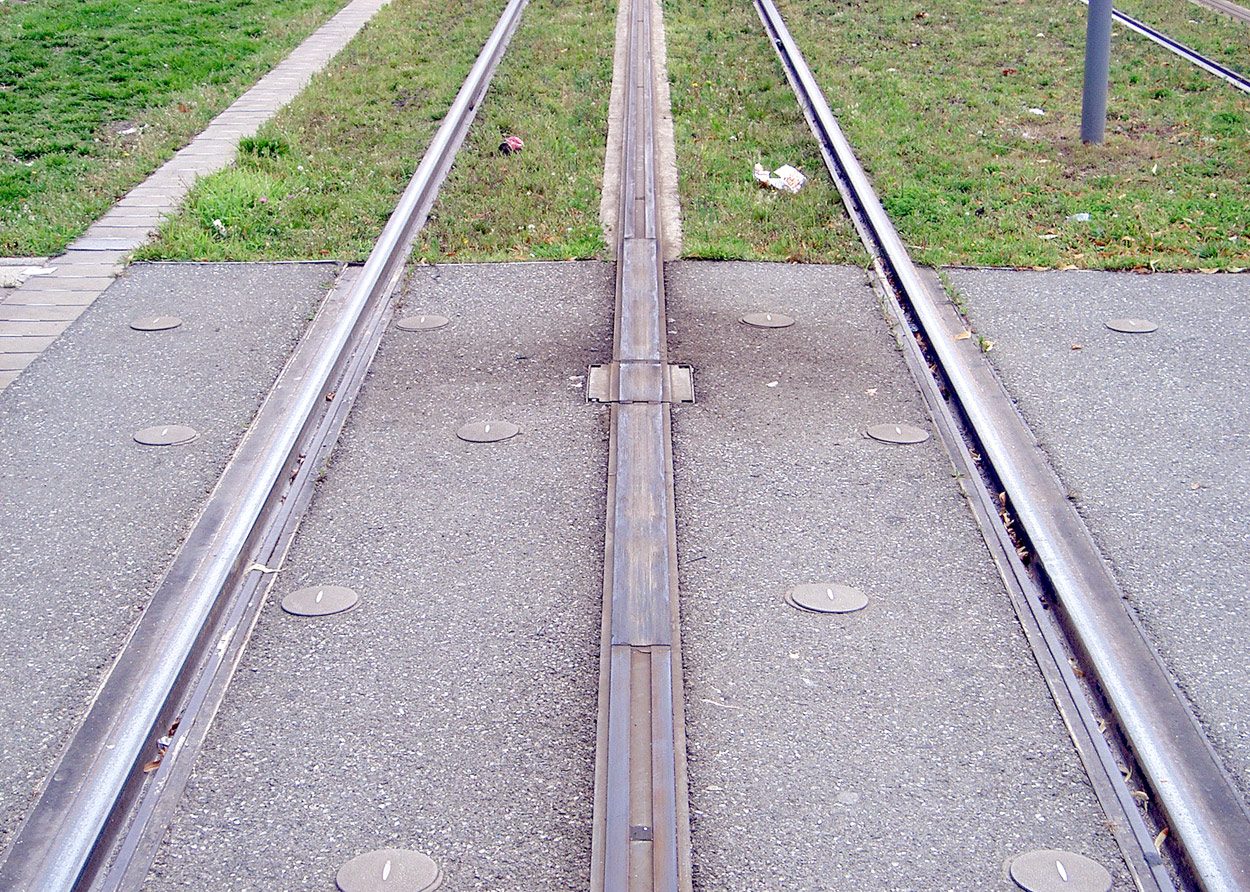
A section of APS track showing the neutral sections at the end of the powered segments plus one of the insulating joint boxes (from Wikipedia)

A section of APS track showing the neutral sections at the end of the powered segments plus one of the insulating joint boxes (from Wikipedia)

It has to be noted that only a handful of light rail systems have used APS since its inception in the Bordeaux tramway which opened in 2003. It was installed in the Angers and Reims systems which opened in 2011 and the new Dubai tramway which opened in November this year (2014) – and that’s about it.

There were also some reliability problems with the original Bordeaux system but these appear to have been ironed out. What is unclear however is how APS will cope with the sort of torrential rain Sydney has already seen this summer, when streets can be flooded for short periods of time.

The other issue of possible concern is that use of any wire-free technology tends to lock the light rail system to specific rolling stock suppliers, in this case Alstrom and any manufacturers they license. In the main, conventional trams and LRV use fairly universal technologies such as standard gauge track (though this of course can be varied) and overhead wires usually energised to 750 volts DC; trams with these specifications can be purchased virtually off the shelf or even borrowed from another system, as happened in Sydney recently. Wire-free systems are much rarer and those from different manufacturers are incompatible – for example, the battery system now abandoned for the CESLR is based on completely different principles to APS.

The other changes to the CESLR are comparatively minor, comprising some stop rearrangements and track realignments, though even these can have potentially adverse consequences. For example, as Bambal Shakibaei’s Transport Sydney blog points out, the changes to the location of the Racecourse stop and the track in this section means that users will have to cross Alison Road to reach Randwick Racecourse and could also adversely impact the recently-completed Alison Road bikeway.

Another change is the methodology used to construct the tunnel required under Anzac Parade. Previously the options being considered were chosen to avoid direct impacts on the road surface, but the MR has adopted a conventional cut-and-cover construction approach. While all traffic lanes on Anzac Parade will be maintained, the road surface will have to be realigned temporarily on several occasions to accommodate the tunnel’s construction in stages.

The release of the MR is significant in that it indicates the level of detail being considered to bring the CESLR project to reality. Some major question marks remain though, such as how the interface between a not particularly tram-literate Sydney public and 67-metre LRVs will be handled in the proposed George Street mall and how reliable – and safe – the wire-free section will be in this city’s almost tropical summer climate.


Posted in Infrastructure, Public Transport, Sydney metro area, Transport | Tagged , , , , | 2 Comments

The Sydney rail network: seven signs of a potential privatisation?

In my last post I discussed the implications of the North West Rail Link (NWRL) for the 2015 and 2019 NSW state elections. This time I thought I’d survey the wider implications of some of the state government’s public transport decisions.

The government does at at least deserve credit for committing to a major transport project in Western Sydney that doesn’t involve bitumen and tolls. Nevertheless its decision to construct and operate the line as a public-private partnership (PPP) has attracted enormous controversy and is seen by many as the first big step in a plan to eventually privatise the Sydney rail network.

However this is only area in which the government could be seen as providing some of the groundwork for privatisation to occur. To be fair, a lot of the other decisions look fairly innocuous if they are considered in isolation and would provide benefits even if the network stays in public hands. But if you consider them collectively then some interesting patterns emerge which could be seen as providing clear signs of a privatisation agenda. Starting with the NWRL itself, have a look at the list and see what you think:

  1. Constructing the NWRL as a PPP and locking in an incompatible single deck design. Let’s start with the most obvious. Not only has the government decided to construct the NWRL as a PPP, they have reinforced their determination to ensure its separation from the rest of the network not only by specifying single-deck rolling stock but also by ensuring that the tunnels are being bored too small to take double-deck trains. I won’t go into all the criticisms here as these have been well canvassed and the line is now a fait accompli, but it will be very difficult – if not impossible – ever to integrate the line with the current rail network, even if a future government wanted to do so.
  2. Building the NWRL as an automated line. While there may be other reasons for introducing fully automated operation for the NWRL, it obviously reduces labour costs, not to mention union involvement, and sets a precedent for any other new lines. It also adds another layer of incompatibility between the NWRL and the rest of the current system – unless of course additional segments of the suburban network are converted to metro operation.
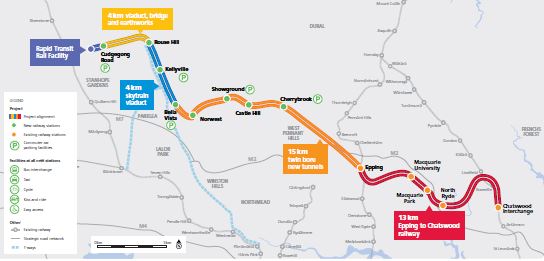
  3. Adopting a route for the NWRL that works only by taking over a significant section of the existing rail network north of the harbour… When completed the NWRL will be one of the few outer-suburban high-capacity metros in the world – and the only one to be deliberately constructed before there are any inner-city metro lines to link to. At least until the second stage is constructed, passengers heading for the CBD will have to change from a high frequency metro to suburban-style double-deck trains for the last part of the journey. Even to get to this stage a substantial piece of public urban infrastructure which forms part of the current rail network, the Epping to Chatswood Rail Link (ECRL) which was completed only five years ago, is to be integrated into the private NWRL. This route provides easy access for the NWRL to the existing north shore rail line at Chatswood and an eventual approach to the city. However the changeover will also require a seven-month shutdown of the ECRL to install new signalling, upgraded systems and the platform doors required for automatic operation.
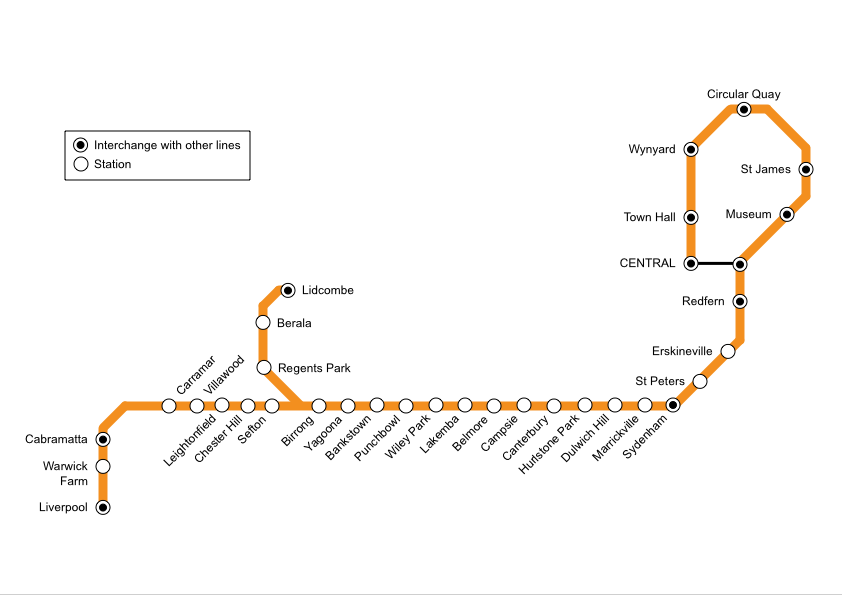
  4. …and south of the harbour for stage 2. A similar approach is proposed when the line is extended south of the harbour, with plans to convert the Bankstown line to connect to the new metro. The reasons for this choice are not entirely clear as the Bankstown line is not experiencing the same overcrowding issues as some other lines (or perhaps this is the reason for this choice…). And as well as setting an obvious precedent for privatisation if not in ownership then at least in operation of public assets, the route chosen both north and particularly south of the harbour effectively divides the existing network, making it easier to break it up into different operating segments.One practical issue with this conversion is the amount of time the line is likely to be closed. If it is going to take seven months to convert the ECRL, an underground line only five years old with only five stations (counting Chatswood and Epping) and modern design and system infrastructure, imagine how long it will take to do the same job on the line to Bankstown, which is a similar length but over a century old and with at least 11 stations to contend with.
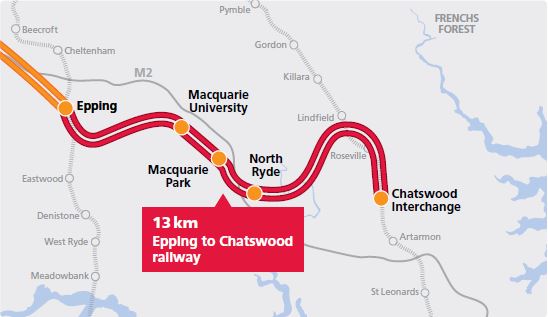
    Both to be converted: Bankstown and Epping to Chatswood lines

    Both to be converted: Epping to Chatswood and below, the Bankstown lines (sources: NSW Government: “An Overview -Epping to Chatswood Railway”, and Wikipedia)

    Bankstown_Line

  5. Introducing an electronic ticketing system while retaining an intermodal flag fall between buses and trains – and not explicitly ruling this out for the NWRL. The retention of the flag fall for interchanges between different modes (mainly between bus and train, and vice versa) with the adoption of the Opal ticketing system has already been widely criticised. However the transport minister’s stubborn reluctance to remove this may have more to do with the useful precedent it provides for private operators to be able to impose a flag fall for changing to a “new” mode such as the NWRL metro. People have been quick to say that the government plans to integrate fares on the NWRL with those on the current system, but that’s not actually what the minister said in her media release of 1st May 2013. To quote: “Importantly, the State Government will set and control fares – which will be determined the same way as fares on the rest of the Sydney rail network. The private operator will make no money directly from the fares.” So the fares won’t necessarily be the same – they will just be determined “in the same way” – and this assurance does not definitively rule out a separate flag fall.
  6. Splitting CityRail into two new entities and announcing a new fleet of inter-urban trains. The split into Sydney Trains and NSW Trainlink – which incorporates all country and intercity services – will make it a good easier to privatise or franchise the latter and the government’s announcement that it will invest $2.8 billion to replace the entire fleet of intercity trains could provide an early opportunity to do this. While potentially good news, the announcement has come as a bit of a surprise and is seen by some as overkill, given the patronage levels on many of these services. However it would make it easier for the whole of NSW Trainlink to be privatised or franchised to a private operator who would then have a clean slate to construct their own fleet of interurban trains. While nothing has been mentioned about a possible PPP for this, to my knowledge it hasn’t been ruled out either.
  7. Not selling Opal cards or top-ups at stations. Finally the decision to sell Opal cards and top-ups through pop-up kiosks, convenience stores, newsagents, other shops – in fact, almost anywhere other than a railway station ticket window, will (if the practice continues) also reduce staffing levels and costs over time. It also means that future private operators would also not be expected to maintain or provide ticket windows or other infrastructure at stations, thus reducing their costs.

So are we on the road to complete or partial privatisation of the Sydney rail network, or not? As I said at the outset, a lot of these changes while controversial can be seen as benefitting the current publicly-owned system – others, much less so. Whether or not this is the explicit motive, however, most of these changes will undoubtedly make a future privatisation much easier to achieve.

Posted in Infrastructure, Public Transport, Transport | Tagged , , , , , | 2 Comments

North West Rail Link – all change at the 2019 election?

With contracts let and tunnelling boring machines (TBMs) in the ground it is clear that the North West Rail Link (NWRL) is going to be built as a single-deck automated metro, to open between Chatswood and Cudgegong Road by early 2019 as the first stage of the Sydney Rapid Transit system.

Despite the opposition of a range of transport experts and others (and I’ll raise my hand here) the size of the TBMs clearly means that this line can never be physically integrated with the current double-deck suburban network. Despite the government’s assurances there are still some major unanswered questions about operational integration with the existing network which have the potential to be an issue for the state elections – if not the 2015 election then at the following one in 2019.

NWRL Map 1

North West Rail Link map (from Transport for NSW “An overview: Epping to Chatswood Railway”)

First, the impacts on the current network. The most obvious is the conversion of the existing line between Epping and Chatswood – the ECRL, which only opened in 2009 – to become part of the new metro line (see the NWRL website here and a more detailed overview here). The first effect will be the closure of the line for seven months in 2018 to install new signalling systems, power upgrades, platform screen doors and other infrastructure as part of the conversion process. Temporary bus routes will be established during this period, but the duration of this closure is going to make for interesting debates prior to the 2019 poll, even if the new line is open by then.

The longer term impact on the suburban network will be effectively a reversion to the operating pattern of services prior to 2009, with all services on the Main North line travelling to the city via Strathfield. Any of these passengers who have grown to like the direct service from the northern suburbs to the employment centres along the ECRL will have to get used to changing, while those travelling to beyond Chatswood to the lower North Shore and North Sydney will have to change twice. And it won’t just be these passengers who are affected. Services on the Western line will be impacted, particularly on the congested Strathfield-city section and through the CBD.

This scenario will provide an interesting backdrop for the 2019 election. Northern suburbs residents are unlikely to be enthused by these changes, no matter how frequent the new metro services are, while Western Sydney rail users are not going to be pleased by the prospect of fewer services and more crowded trains. Even the primary beneficiaries of the new line, the residents in the section from Cudgegong Road to Chatswood, may look askance at the lower proportion of seats on the single-deck trains and the fact that they too will be required to change at Chatswood, at least for a while.

The government will contend that these arrangements are just the beginning of the project and that everyone including Western line users will benefit from increased capacity when the metro is completed. It has already indicated it will take a commitment to the election next year to extend the metro to the city and beyond via a the second harbour crossing. My suspicion is that just as it has done with the first stage, it will try to sign contracts for the harbour crossing so the project is irrevocably committed before the 2019 elections. That way the whole of the private line would be a fait accompli years before it opens, even if the government loses the 2019 election.

Proposed route for the metro when completed (from Transport for NSW "An overview: Epping to Chatswood Railway"

Proposed route for the metro when completed (from Transport for NSW “An overview: Epping to Chatswood Railway”)

As commentators and voters there is an opportunity for us to use the 2015 and 2019 elections to ask hard questions about issues such as how the interchanges between the NWRL and the existing network are going to be handled and whether and how the line should be extended across the harbour without further degrading the existing rail network but also maximising the advantages of a metro. For example the current plans (which are sketchy at best) propose that the Bankstown line be converted to metro to provide the southern arm of new line but they also suggest there will be only three new stations in the city and none between Central and Sydenham. At the very least there should be an additional station to serve the Sydney University/Camperdown area, but at a wider level converting the Bankstown line to become a metro is unlikely to bring substantial benefits to most Western Sydney residents.

There is also the wider question of whether the NWRL is a stalking horse for the eventual privatisation of the whole Sydney rail network. The more I look at this the more I think this is on the cards. The technical virtues of the new metro are not really the point – this decision is much more about ideology. The government wants to build a private line with automatic operation and low staffing costs which any future government is going to find impossible to integrate back into the current network. Instead, bits of the existing network will be converted to metro and effectively given to the operator, and I’m not sure that process will stop with either ECRL or the Bankstown line.

I think the long-term aim may be to break up the rail network and sell and/or franchise the bits to the private sector – provided in the first instance that the metro operates successfully and proves to be popular with users. And I think this will be an interesting test, with voters getting the option to respond next year but particularly in 2019 just after the service opens.

This also leaves the question of what approach the opposition should take towards the project in both the 2015 and 2019 elections. Bearing in mind that an opposition’s main job is to oppose, here a few suggestions off the top of my head for Labor:

  1. Commit to completing the NWRL, but defer the second stage indefinitely or at least until the operational issues on the Western line are fully resolved.
  2. Commit to the government’s broad plan for completing the NWRL and extending the metro south of the harbour but promise to do it faster/cheaper and/or better, for example by addressing a few of the issues raised in the comments above. I would think for example that committing to close the PERL for a shorter period of time and committing to a station at Sydney University would be two options.
  3. Commit to the plan to complete the NWRL but look at alternatives to the Bankstown line. One obvious contender would be for the line to head westwards under Parramatta Road to Parramatta, possibly via the redevelopment around Sydney Olympic Park.
  4. Here is my final and very Machiavellian suggestion – propose extending the NWRL from Chatswood not to the city but across the north side to, say, Neutral Bay, possibly as a very long-term promise to extend it to the northern beaches. This could be combined with a proposal to build the second harbour crossing as a heavy rail double-deck line to meet this “North Sydney” metro. This option would provide additional capacity for the heavy rail system along with an interchange for the private metro, but would also confine it to the north side of the harbour permanently.


Posted in Infrastructure, Public Transport, Sydney metro area, Transport, Western Sydney | Tagged , , , | Leave a comment

Lots of carrots for fewer councils: NSW Government responds to the Local Government Review Panel Proposals

It’s been a long time coming but the State Government has finally announced its response to the Independent Local Government Review Panel’s findings and recommendations.

The Panel’s report was completed in October 2013 but its release was delayed until January this year, with councils given a further opportunity to lodge submissions. The government’s response was further delayed by a change of Premier and subsequently planning minister and there was speculation that the government might shelve the reform process at least until after the next state election.

However this week – nearly 12 months after the Panel finished its work – the Premier has announced the ‘Fit for the Future’ (FFTF) package. The package involves some fairly substantial carrots, the most significant being $258 million to “assist councils who decide to merge and make the changes needed to provide better services to communities”.

FFTF website

The following summary has been compiled from a number of pages and documents on the FFTF and associated websites (see the end of this post for the list). The package comprises $153m for Sydney councils and $105m for regional councils; in the metropolitan area newly merged councils with a population over 250,000 will receive $10.5 million with an additional $3 million for every additional 50,000 people up to a maximum of $22.5 million (ie, for a council with at least 350,000 people). In rural areas any two councils merging will receive $5 million, three councils $11 million and for $13.5 million, all regardless of size. The government has declined to nominate a target for the number of amalgamated councils in either the city or the country.

Councils are also offered “cheaper finance for councils to build and maintain the facilities that communities need”, saving them up to a claimed $600 million and up to $100 million savings through “reductions in red tape and duplication”. An additional $13 million will also be available to “support local transition committees and ensure elected representatives are involved in the merger process.”

There are also a number of changes to the “local government system”, including to legislation, the state government’s interaction with councils and the support that it provides to local government. In relation to the legislation the government’s response indicates that it “broadly supports” the recommendations of the separate Local Government Acts Taskforce and intends to develop a new Local Government Act to be phased in from 2016/17.

However in the short term it will amend the current Act to remove a number of the current restrictions on tendering. These changes include the delegation of the acceptance of tenders to support regional procurement and lifting the prescribed tendering threshold for councils to $250,000 to align it with the State Government tendering threshold. However the wording of this point suggests this increased threshold might only apply to ‘fit for the future’ councils, i.e., ones that have gone through the FFTF reform and amalgamation process.

The government has also supported the Panel’s recommendations to establish Joint Organisations (JOs), at least for rural councils. The government will provide $5.3 million or $300,000 each to fund 15 JOs outside the metropolitan area. The rationale for the JOs is drawn directly from the Panel’s proposals:

They will be empowered to bring all councils in defined regions together to discuss and agree to strategic regional priorities for their communities. They will also create a mechanism for State and local Government to collaborate on agreed priorities in a more consistent, structured and effective way than ever before.

The JO option will not however be extended to metropolitan councils, where the government has made it clear its preferred option is amalgamations. Clearly this approach is favoured in rural areas as well, but the JO proposal confirms the Panel’s view that amalgamations will not always be appropriate in regional areas where distances and low densities make the economics of amalgamation more elusive. In the metropolitan area the government has “supported in principle” the Panel’s proposal for the establishment of a Metropolitan Council of Mayors but is somewhat vague on the details.

In the next few posts I will consider some of these responses in more detail, drawing on the fairly extensive documentation available on the FFTF website. Here are some of the key websites and publications:

Posted in Uncategorized | Leave a comment

The second Sydney airport – dead, or just resting? (part 4: final)

With media reports that a Federal Government announcement about a second airport for Sydney at Badgerys Creek is eminent, this is an appropriate time for me to complete my series of posts about the proposal.

As with my previous posts on this issue, I begin with a disclaimer – I was the CEO of WSROC, the Western Sydney Regional Organisation of Councils, from 1996 to 2008 and therefore was involved in many of the debates about the proposed second Sydney airport.

To recap on my earlier articles:

In Part 1 I outlined the history of the project and how the mishandling of the airport issue and airport politics in the 1990s had eroded community confidence in the environmental assessment process and consequently support for an airport in Western Sydney.

In Part 2 I summarised some of the arguments being advanced in favour of the proposed airport, both in terms of the demand for air travel and the potential for an airport to substantially boost job creation in Western Sydney, noting that it will only achieve this if it is integrated with the required transport infrastructure and major investment in other facilities.

I also pointed out that the factors that had led to the region’s previously strong opposition to the airport have not gone away – including legitimate concerns regarding noise pollution, impacts on air and water quality and traffic congestion. If any airport is to proceed, these will have to be managed effectively.

In Part 3 I considered two key questions. The first was whether we really need a second airport in Sydney. My response was yes, because the demand for medium and long-distance high-speed travel will continue to increase, despite any misgivings about our carbon footprint and use of scarce resources.

In addition any expansion of the current airport would have major and politically unpalatable impacts on one of the more densely populated parts of Sydney. I also concluded that high speed rail might have been a viable option if planning had commenced 20 years ago, but even if agreement could be reached on its construction right now (which is highly improbable) it is unlikely it would be finished in time to address current capacity issues (however this doesn’t rule out its future development).

If my logic about the need for a second airport is accepted, the second question therefore is about the best place to put it. Leaving aside the proposed expansion of the Richmond RAF base as at best a stop-gap measure, only two other sites are currently under serious consideration, Badgerys Creek and Wilton.

I considered both of these against two key criteria – their potential environmental impact, both on local ecological systems and the amenity of affected residents, and their potential to provide economic benefits, particularly for Western Sydney.

My conclusion based on a reading of the documentation was that while Badgerys Creek is likely to have a lower impact than an airport at Wilton on the natural environment, it will have a greater impact on the environmental amenity of local residents because it is closer to urban areas. However, this proximity would also give (in theory at least) the most affected residents the best accessibility to a new airport and therefore a locational advantage as potential users and in particular employees of any airport at Badgerys Creek.

So, the long-delayed “homework” I set myself in part 3 to be completed in the final post of this series is to answer the question: do the potential benefits for residents located within the footprint of any airport at Badgerys Creek, as well as the wider Western Sydney community, outweigh the environmental impacts both on the same group of residents and the wider community?

As I indicated in my last post, part of the delay is because I have found it very difficult to make up my mind about this issue. After looking at the evidence my conclusion, and it one that I am still frankly uncomfortable with, is that the answer is a very qualified “yes”, but only if the backers of an airport are prepared to pay the right “price” for an airport – and Western Sydney has every justification in demanding that this price be set very high.

Let me explain what I mean, and what I think should happen. First, if the Federal Government has decided to proceed with a second airport, it should also (and ideally with State Government cooperation) seek to engage with the community of Western Sydney to work out ways to identify and quantify the environmental impacts and the potential economic and other benefits, as well as strategies to manage and minimise the former while maximising the latter.

As a minimum requirement the Government’s proposal should include the following:

Environmental impacts: Plans for the airport itself, including design, construction and operational strategies that contain a core commitment to doing everything possible to limit environmental impacts on both the amenity of nearby residents and the natural environment.

These plans should include a detailed, rigorous and impartial analysis of these environmental impacts and a systematic evaluation of the options available to minimise them.

Compensation: As part of the environmental protection strategy, a commitment to fully compensate affected residents and businesses, especially those who made business and life decisions to stay or invest in the area based on the bipartisan “commitment” that an airport would never be built at Badgerys Creek. This commitment should contain initial (and generous) estimates of the costs involved.

Infrastructure: Plans for and a commitment to full funding of all the associated infrastructure, including all the road and rail links required to ensure the airport can maximise its potential without contributing to Western Sydney’s current transport problems.

However there are indications the Federal Government may approve only a $200 million for a roads package, without any mention of the extension of the South West Rail Link to the site. As the NSW Premier drily noted, the package seems to be “missing a zero”.This is an absolutely critical element; if the government refuses to fully commit to the associated infrastructure (including roads and the rail extension), the airport proposal should be rejected.

Employment creation and training: Plans and policies for detailed employment and training strategies that will leverage the airport to maximise employment opportunities for Western Sydney residents.

These will have to go way beyond the back-of-the-envelope calculations of the total number of jobs the airport can create; instead these plans will need to identify the specific policies, infrastructure and education investments along with the other actions required to create these jobs both at the airport and in related industries.

Development of these policies should also involve universities, councils, economic boards, community sector and other relevant organisations. The policies should also contain a commitment to work with secondary and tertiary education institutions across the region to ensure that when the airport opens Western Sydney residents will have both the opportunities and skills to take a majority of the positions created both on and off the airport – and not just low-paid and relatively unskilled jobs in the service sector.

The policies should also contain commitments to ensure that small and medium enterprises in Western Sydney get opportunities to tender for work during the airport’s construction and operation.

Consultation and engagement: Commitments to the regional engagement and consultation strategy I mentioned earlier. And while this process should include dialogue with key stakeholders and residents across the region, it should not be limited to the usual suspects. While I am not necessarily advocating a regional referendum on the issue, this is one option that should be considered.

Furthermore the community engagement strategy should not be a one-off process; even if the airport proposal gains broad support there should be high levels of transparency in its development and the establishment of an ongoing framework for consultation.

In summary, I have come to the conclusion very reluctantly that the benefits of an airport at Badgerys Creek may have the potential to outweigh its environmental and other impacts. However achieving this outcome and obtaining the best possible result for the region will require an enormous commitment.

Ultimately it is the Federal Government that must make a strong and comprehensive case for the proposal. There is no doubt that the minimum requirements I outline above would be very expensive to implement. However, if the government’s case is unconvincing and in particular if it attempts to cut corners by failing to address these requirements, the region has every right to reject the proposed airport.

Finally, it is important to remember that while a new airport could do much to boost the region’s employment, by itself it cannot meet all of the region’s job creation needs and is unlikely to stem the decline in the region’s employment containment. These issues will be covered in a future post.

Posted in Airport, Infrastructure, Transport | Tagged , , , , , | Leave a comment