Report released on options to enhance regional collaboration amongst NSW councils

The NSW Independent Local Government Review Panel has just released Options to Enhance Regional Collaboration amongst Councils in NSW.

This report was prepared independently for the Panel by Gooding Davies Consultancy and is available from the Panel’s website, along with a media release announcing the report and outlining some of its key themes.

The publication of the report follows the release two weeks ago of the Panel’s second discussion paper, Better, Stronger Local Government. The Panel is seeking public comment until March 2013.

All media and other inquiries should be directed to Mr Vaughan Macdonald at the Panel on 02 4428 4179 or 0400 455 067.

Posted in Uncategorized | Tagged , , , | Leave a comment

StrategicMatters – the new StrategyMatters

StrategyMatters is having a temporary change of hosting arrangements while our main website undergoes a major update – and a temporary change of name, to StrategicMatters.

While there is a minor name change, the principle remains the same: strategy matters! In restarting this blog after a long break we will continue to examine key strategic issues, based on current research and a general survey of what’s happening in relation to planning, transport, advocacy, policy development and project and organisation management.

This blog will continue to complement the social media and online services focus of our other blog, Sociamind, which is also being relaunched but which retains its current title. Both blogs will also highlight key research and other projects undertaken by Gooding Davies Consultancy, as well as responses to important current issues.

Posted in Admin | Leave a comment

Porto Metro – how to retrofit a light rail system

Using the Porto metro on a recent trip to Portugal was a revelation. The system serves Portugal’s second-largest city, Porto, which has an official population of only 250,000 but which serves a wider urban region of about 1.6 million.

The metro is only 10 years old, with six lines, 67 km of track and 80 stations, and cost about 3.5 billion euros to construct. It was built from scratch though in some places it has used old tram corridors. The core of the system is a spine of shared track running east-west under the centre of the city from Estádio do Dragão, the main football stadium, with five of the lines fanning out westwards from this spine to provide suburban coverage.

One of these lines extends further east from the stadium while the sixth line interchanges with this spine to provide north-south coverage, including a spectacular crossing of the River Douro on the Luiz I Bridge, the upper deck of which was converted for exclusive light rail use. The central part of the system is underground with 15 stations; the rest of the system is at grade, with sections running in street reservations.

The system uses a mixture of 100% low-floor Eurotrams and newer 70% low-floor Flexity Swift tram-trains, both running as coupled sets. The Eurotrams seem more comfortable and roomy but the Flexity Swifts are better suited to high speed running on the longer routes.

The system is very impressive in action. The surface stations are simple but functional while the underground ones are well-designed and easy to access. Services are reasonably frequent (especially in the central spine) and the trams are clean and comfortable.

There are some limitations; for example, the platforms are relatively short, which limits options to extend vehicle length in future. The track sharing through the central spine of the system means that a breakdown in this section can cripple most of the network and could also cause problems with congestion in future. However it seems to be a very cost-effective arrangement for a small to medium-sized city.

20121121-094517.jpg
Tram leaving São Bento station on the Porto Metro

It is hard not to travel on the Porto metro without thinking about which Australian cities would be candidates for similar systems, or at least where elements of its design could be applied. Certainly those involved in projects such as the Gold Coast rapid transit line currently under construction, the on-again off-again extension of Adelaide’s tram line and the proposed Perth Metro Area Express should all take a good look at Porto – as should those proposing light rail projects in cities like Canberra and Newcastle.

Transport NSW should also consider a study tour to Porto. An extension of the current Sydney light rail network as a new line from Circular Quay to the University of NSW could incorporate many of the Porto system’s planning and design principles, for example combining use of the existing bus corridor with selected underground sections, not to mention an upgrade to new vehicles similar to the Eurotrams.

However the most important lesson from Porto is not so much in what they have done but how they did it. Porto illustrates that the planning and implementation of new networks, particularly light rail, should be done holistically, instead of the haphazard and piecemeal approach which continues to be the norm in many Australian cities.

Posted in Transport | Tagged , , | Leave a comment

Welcome to StrategicMatters – the “new” StrategyMatters!

Welcome to the launch of StrategicMatters, an updated version of the StrategyMatters blog linked to the Gooding Davies Consultancy website.

A temporary change of hosting arrangements specifically for this blog while our main website undergoes a major update means that the name has had to change as well, at least for a little while. However the principle remains the same: strategy matters! In restarting this blog after a long break we will continue to examine key strategic issues, based on current research and a general survey of what’s happening in relation to planning, transport, advocacy, policy development and project and organisation management.

This blog will continue to complement the social media and online services focus of our other blog, Sociamind, which is also being relaunched but which retains its current title. Both blogs will also highlight key research and other projects undertaken by Gooding Davies Consultancy, as well as responses to important current issues.

Posted in Uncategorized | Leave a comment

Gooding Davies regional organisation study released

A major audit of regional organisation of councils (ROCs) in NSW and Western Australia prepared by Gooding Davies Consultancy has just been released.

The study was prepared for the Australian Centre of Excellence for Local Government (ACELG) and the Northern Sydney Regional Organisation of Councils (NSROC). It compares the structures, operations and activities of ROCs in both states as well as the implications for these organisations of the different local government reform processes currently underway in both jurisdictions.
It suggests some future directions and proposes recommendations for appropriate legal and business structures that would allow ROCs to operate more effectively.

As the ACELG website states: “The analysis is important for understanding the function of ROCs and their relationships between local councils and different levels of government. ROCs have a varied impact around Australia; some ROCs have led to major reforms including council consolidation, while in other circumstances they have enhanced their member councils’ capacity and performance.”

Foir an overview of the study visit the ACELG website or click here to download the study report directly.

Posted in Governance, Local Government, Regions, ROCs | Tagged , , , | Leave a comment

Trams in the CBD and heavy rail across the Bosphorus – examples for Sydney

Recently I looked at what Sydney could learn from Istanbul’s electronic ticketing system, which is part of a much wider story about how the public transport in Turkey’s largest city is being transformed through a massive investment in public transport infrastructure to meet the needs of a city of over 13 million people.

Although they are very different cities and Istanbul dwarfs Sydney in population terms, there are similarities. Both share the physical challenges of being divided by large bodies of water and steep ridges – and both have responded in similar ways, for example, by making extensive use of ferries. Both also adopted tram networks partly to deal with the hilly terrain, only to rip these up in the fifties and sixties in favour of cars and buses.
Now, both are undergoing suburban expansion in suburbs away from the coast and beyond the reach of each city’s current public transport infrastructure, while experiencing redevelopment in some older waterside suburbs. Initially both cities responded by investing heavily in road infrastructure, but are now looking belatedly at retrofitting (at considerable expense) public transport systems to deal with congestion and high car dependency, including heavy rail, light rail and busways.

Ferry traffic and the tramway crossing Istanbul's Golden Horn

Ferry traffic and the tramway crossing Istanbul's Golden Horn

There are of course major differences, apart from population size. Istanbul’s Bosporus and Golden Horn represent a much bigger challenge than Sydney Harbour and so its ferry system is much more extensive. On the other hand, Sydney may have got rid of its trams but it is blessed with an extensive suburban rail network, whereas Istanbul essentially has only two run-down and under-used suburban rail lines.

Istanbul’s other challenges are also far greater than Sydney’s; the city is close to the North Anatolian Fault and has experienced several major earthquakes in its history. This calls for special techniques in underground railway construction, especially if you are contemplating crossing under the Bosporous, which is over 60 metres deep.

If that wasn’t enough there is also Istanbul’s history as the capital of the Byzantine and then the Ottman Empires to contend with. For example, excavation works for the hub of a new rail network at Yenikapi have run into the remains of a fourth-century port, including a number of Byzantine vessels preserved in mud. Archaeological work on this site has already delayed the project by a number of years. As one of the project managers responsible observed, “I can’t think of any challenge this project lacks.”

Istanbul may face many more difficulties than Sydney and may be coming off a lower base in terms of pre-existing infrastructure, but it certainly has been more proactive in recent years. A metro, two light rail lines and a tramway have been constructed, along with a busway. Ironically, the tramway (which provides a public transport spine through the crowded heart of old Istanbul) and the busway (which links suburban population and employment centres) appear to be more extensively patronised than the new light rail and metro links, not to mention the older heavy rail lines.

The Istanbul tramway operates successfully despite very tight clearances

The Istanbul tramway operates successfully despite very tight clearances

This is partly due to the relatively poor connectivity between these transport systems. Some current interchanges are very poor. For example, the Istanbul public transport map would have you believe that there is an interchange between the tramway and light rail at Aksaray, when this actually involves a 300 metre hike across several busy roads. Other “interchanges” are closer but still require crossing busy unsignalled highways to change from one line to another.

In an attempt to overcome this, the new transport interchange at Yenikapi is meant to bring together the heavy rail lines from Europe and Asia (the latter via the already-completed but not yet operational Mamaray tunnel under the Bosphorus), linking them with Istanbul’s metro and light rail lines. The light and heavy rail extensions associated with this will also provide better connectivity with the tramway – when the much-delayed interchange construction is eventually completed.

Yenikapi interchange under construction

Yenikapi interchange under construction

Despite these problems there is still a lot that Sydney can learn from Istanbul, apart from the willingness to get on with the job of building infrastructure (regrettably, this is a lesson Sydney could draw from many other cities). Some examples include:

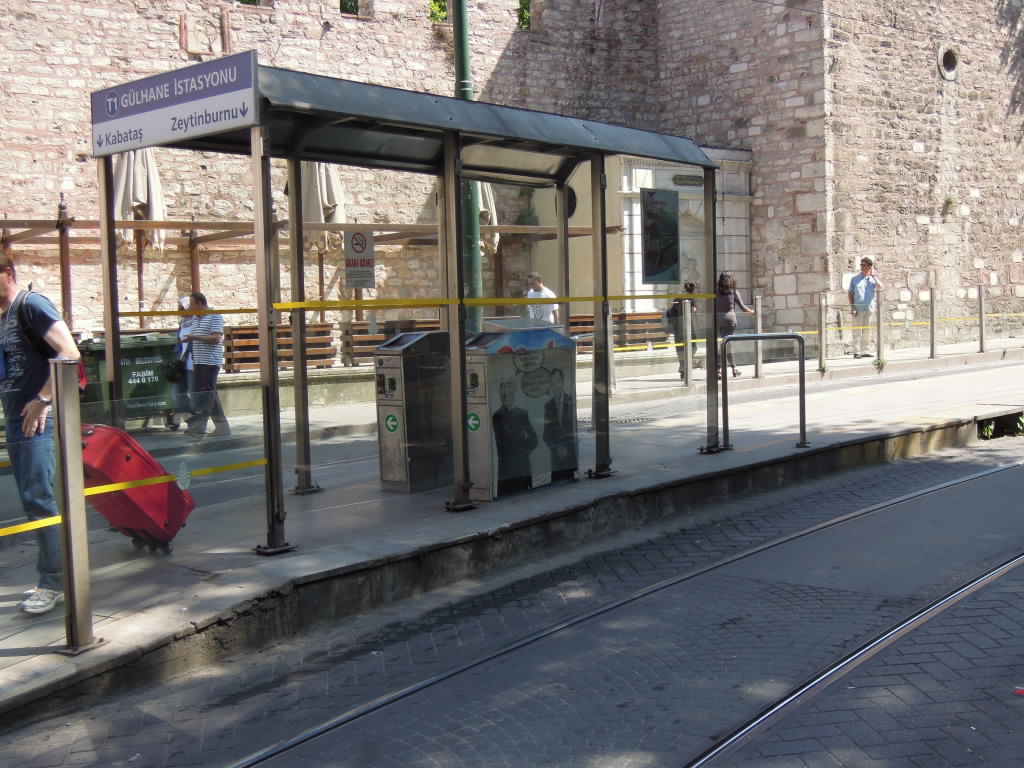
• Istanbul’s T1 tramway which threads through the narrow streets in the heart of the city provides a dramatic example of how light rail can operate successfully in busy and narrow CBD streets and in corridors where for environmental, engineering or budgetary reasons it is not possible to build metros. Compared to this, expanding Sydney’s light rail into the CBD and out to the eastern suburbs should be a doddle.

• The T1 tramway also demonstrates how trams cope with extremely high demand. While they are very well patronised to the point of being crowded, the high frequency of the trams in the T1 corridor seem to provide enough capacity. On this basis, any eastern suburbs extension of Sydney’s light rail should easily be able to meet demand until (and if) a metro is built, provided provision is made for much higher service frequencies than those on the current light rail.

Typical tramway station in Istanbul - with typical patronage levels

Typical tramway station in Istanbul - with typical patronage levels

• If the challenges of building a heavy-rail tunnel under the deep, wide and earthquake-prone Bosphorus can be overcome, then it should be relatively straightforward to construct a second heavy rail crossing across Sydney Harbour, either in tunnel or as a second deck on the harbour bridge.

• It is also important to look at how such a link can be integrated with other transport modes on either side of the crossing. Interestingly, the approach in Istanbul appears to be use heavy rail to provide links between metros and other transport modes on both sides of the Bosphorus rather than attempting to join these directly. This approach may be relevant to Sydney, where for example a northern beaches light rail network could link to a heavy rail crossing north of the harbour.

• The Turkish government has not been afraid to set specific and ambitious targets for public transport patronage and then to make the required investment in infrastructure required to meet these targets. This is perhaps the ultimate lesson for NSW transport planners.

Posted in Public Transport, Sydney metro area, Transport | Tagged , | Leave a comment

The Akbil and the Istanbulkart – lessons from Istanbul in electronic ticketing

Before I post my follow-up to the fare integration post, I thought I’d make a short diversion to Istanbul which is where I am at the time of writing. Apart from its intrinisc fascination as a city, Istanbul is also very interesting from a public transport perspective and has quite a few lessons for transport planners in Sydney and elsewhere.

In a future post I’ll talk a bit more about the investments in Istanbul’s infrastructure but for now I’ll take a quick look at the fare system. For the most part, Istanbul is a flat-fare, token-based transport network. Tramways, buses, metros, light rail and railways require token entry, either on-board or at a turnstile, with each “jeton” or token costing 1.75 Turkish Lira or about 95 cents Australian, irrespective of the journey length.

This entitles you to a single trip on a single mode or vehicle, with no interchanges. I’ll come back to the Istanbul concept of “interchanges” in future as part of my discussion on infrastructure, but for the moment all you need to know is that for the most part, each change of mode or even vehicle requires use of an additional token. Ferry journeys use the same concept but here the price can vary with the journey length. Even simple curbside tram stops have token entry through turnstiles.

Istanbul tramway token and smartcard turnstiles

Istanbul tramway token and smartcard turnstiles

In addition Istabul has not one but two forms of integrated ticketing. The first “Akbil”, which is reputedly being phased out, is my favourite. According to Wikipedia, Akbil is an acronym formed from “akıllı”, which stands for “smart”, and “bilet” meaning “ticket”; Akbil is actually a small stainless steel “button” that looks remarkably like a large watch or clock battery but which has a computer chip inside.

The Akbil is used to store value for public transport use; once purchased from a kiosk or shop it can be topped up using fare machines at major transport hubs. Every time you pass through a public transport turnstile or board a bus you touch the Akbil to a little receiver which deducts the fare, giving you a discount of roughly 6% on the cost of a token.

In addition an Akbil can be used for more than one passenger by touching on again for each person. More significantly, it also provides a further deduction for multiple use within a two-hour period (though not when you are using it for multiple passengers), thus overcoming the penalty inherent in the token system for users who have to change modes or vehicles on the same journey.

Akbil is supposedly being phased out in favour of the Istanbulkart, a stored-value “electronic wallet” similar to the Oyster card. Apart from it’s credit card format, Istanbulkart operates in a very similar fashion to Akbil; you purchase it and top it up the same way and place it on the readers on every turnstile at the start of each trip. The card format is slated for wider use to pay for parking fees, taxis, admission to museums, movies, theatres and other cultural venues and even as a form of ID (see Turkey Travel Planner for more details).

Istanbul Akbil and Istanbulkart smart tickets

Istanbul Akbil and Istanbulkart smart tickets

So what can Sydney learn from Istanbul’s experience in introducing electronic ticketing? Well, the first and most obvious thing is that they’ve actually gone and done it in all the time that NSW has talked about doing it, in large part because of the simplicity of the fare structure.

While I’m not a fan of flat fares, it’s obvious that Istanbul’s token system made it much easier to introduce electronic ticketing. Not only is there (pretty much) only one fare to incorporate, there is no need to make people touch off at the end of each journey. Touching off is probably unavoidable in any multiple-fare system (otherwise people get charged the maximum fare) but a simple zone-based structure is obviously going to be much easier to integrate into an electronic system.

The second is that, surprisingly, barrier entry seems to work even in the most unlikely of places, provided (again) the system is simple to use and fares are relatively low. Istanbul can be a fairly chaotic at times, but people seem to respect the system and even in the many places where it would be easy to get away with I did not see any attempts at fare evasion. No doubt it occurs, but it does not seem widespread.

The third is the commitment to overcome flagfall costs inherent in the flat-fare token system by offering discounts for multiple journeys. While Sydney does not have flat fares, bus users in particular suffer from the same problem that their Istanbul counterparts do (or did) – a journey involving multiple vehicles ends up costing much more than one of equivalent distance which can be made using a single bus. To a large extent the Akbil and Istanbulkart overcome this with the introduction of what is effectively a time-based ticket, which seems to work very well.

And why do I prefer Akbil over its more “modern” card replacement? I think it’s partly subjective – the little Akbil button and holder has a more tactile feel than a transport card – and partly practical. The Akbil can reside happily in your pocket attached to your key-ring, making it easy to pull out at turnstiles, while using the card involves digging out your wallet or purse, finding the Istanbulkart among all the other cards, placing it on the reader and then putting it away again.

Posted in Public Transport, Sydney metro area, Transport | Tagged , , , | Leave a comment

Another small step for fare integration…

The recent partial integration of Sydney’s Metro Light Rail (MLR) ticketing with the MyMulti/MyZone system is another welcome if very modest step towards a true integrated ticketing and fares system for Sydney’s public transport.

You can now use a MyMulti 1, 2 or 3, a MyMulti Day Pass, a Pensioner Excursion Ticket (PET) or a Family Funday Sunday ticket on the light rail. All these tickets have to be purchased prior to boarding a tram.

However, CityRail single-trip, return or weekly tickets are still not valid, nor are any bus-only tickets or concessions apart from the PET. Metro Light Rail also continues to issue the full range of its own tickets which are valid only for its own services. More on ticketing issues in my next post but first, how are the new arrangements operating and what has been the impact on patronage?

Trams don’t have ticket validators, so when you board a tram and show the conductor a My Multi or other valid ticket, he or she will usually issue a zero-value ticket. This is simple in practice but a ticket showing “$.00” value is a very odd thing to receive.

MyMulti zero ticket

MyMulti zero ticket (image from Wikipedia)


Given the absence of ticket validators on trams, this approach may be understandable as a temporary measure for counting how many NSW Transport tickets are being used. However, it could hardly be described as a watertight form of accounting. Indeed, on one of the trips I made just after the new fare arrangements were introduced the tram was so crowded that the conductor did not bother to issue “zero fares” to most of the people with NSW Transport tickets.

This brings us to patronage. I don’t have any figures (and if any are released, bear in mind the method of counting) so my evidence is based on my observations and anecdotal evidence, but there seems to be a small but noticeable increase in the number of tram users, particularly older users who qualify for PETs.

In particular there seems to be more people using the tram for short-haul trips, especially between Central, Capitol Square and Paddy’s Markets. For most people this is a walkable distance, but if you are infirm, carrying a lot of shopping or just in a hurry, the tram provides by far the best public transport connection between these points, especially if you already have a PET or MyMulti.

While the overall patronage increase seems relatively small, I was struck by the large number of passengers who did produce MyMulti and PET tickets on the tram, especially coming from or going to Central. This would seem to indicate that a significant proportion of people are already using the light rail in combination with trains; now they can use their MyMulti and other valid tickets without having to pay an additional tram fare.

Given the location of the current MLR terminus at Central, this is hardly surprising, but it also reflects the fact that the current ticket integration model tends to favour passengers transferring from trains rather than those who catch buses. For many train users, purchase of a weekly MyMulti costs little more than a weekly rail ticket but provides much better value – including now the light rail – and doesn’t lock them into travel between two stations on a particular corridor.

For bus users, especially in the inner city, it’s a different story. Even a Zone 1 MyMulti is relatively expensive, especially if passengers don’t have any opportunities to use trains or ferries. For these users, Travel10s are a cheaper alternative and offer reasonable flexibility – but these tickets, like all bus tickets, are not recognised on the light rail.

Part of the problem lies in the “unfinished” nature of the MyMulti ticket system, which I’ll look at in my next post.

Posted in Infrastructure, Public Transport, Sydney metro area, Transport | Tagged , , , , | Leave a comment

A long break

Apologies to anyone following this blog. I’ve had a long break due to the death of my mother at the end of April. I’ll be resuming posts very soon.

Posted in Uncategorized | Leave a comment

Will the new NSW Transport Authority succeed?

Yesterday’s announcement by the new NSW Government of the creation of a new Integrated Transport Authority (ITA) not only fulfils a major election promise but also highlights the extent of the government’s transport ambitions.  

The announcement also echoes many of the governance recommendations of the Sydney Morning Herald (SMH) Independent Public Transport Inquiry. This called for a similar coordinating transport authority, though the government’s ITA will have a much bigger remit. There are other key differences, but let’s start with the similarities which are striking (and pleasing for those of us who worked on the SMH Inquiry).

The SMH Inquiry proposed a transport coordination authority managed by an independent board to plan and manage all aspects of Sydney’s public transport. Rail, bus and ferry operators would have been contracted on a contestable basis to provide services to the authority, which would have taken over and integrated their planning powers.

The SMH Inquiry report also proposed that the authority would prioritise customer service and the importance of providing each public transport user with a complete journey to meet their requirements rather than a set of disconnected bus, rail or ferry trips. This would have involved a branch dedicated to integrating all aspects of service provision including fares, ticketing, timetables, interchanges and information provision.

While the SMH proposal did not incorporate the management of car-based transport, the authority would have had a strong say in the approval of major new road projects.

The government’s ITA is very similar in that it will also integrate all aspects of public transport. It also emphasises customer service; there will be a division specifically dedicated to “Customer Experience”, which in the words of the Ministerial media release, “will make sure journeys are as simple and seamless as possible”.

There are other structural similarities, with divisions responsible for planning, services, projects and policies. The ITA will also take over planning powers from the individual transport agencies, much as the SMH Inquiry proposed, and use these resources to develop a comprehensive transport “masterplan”.

There are however some significant differences. These can be summarised as follows:

  • The ITA will not be managed by an independent board, although an independent advisory board will be appointed by the government. The exact relationship of this to the ITA is unclear.
  • The ITA will take over procurement, long-term planning and policy-making from the Roads and Traffic Authority (RTA) as well as from public transport agencies, thus giving it direct oversight of major road projects.
  • The ITA will also manage freight transport and oversee transport across the State, not just in greater Sydney.
  • However, it will not have the final say on major infrastructure projects, with the government intending to establish a state infrastructure body.

Despite these differences, the government’s new body is a huge step forward for transport planning and management in NSW. It is hard to disagree with the sentiment in the joint ministerial media release about the need to replace the current disconnected transport “silos” with a “streamlined agency which plans and delivers for all modes” and to concentrate on improving the transport user’s experience.

There is also compelling logic in integrating and extending the planning and management of transport statewide and to include road and freight transport as well as public transport. However, the government’s new approach is very ambitious and not without its risks:

  • The first challenge for the new body will be getting on top of this enormous range of responsibilities and the associated expectations. While the primary reason for not including roads planning and transport management outside Sydney in the SMH Transport Inquiry recommendations was that these areas were outside its main terms of reference, there was also a desire to keep the proposed authority as lean as possible and focussed on Sydney’s public transport, which is a big enough challenge in its own right. The ITA has been handed a much more complex role and will need to be able to balance the competing demands of city and country, roads and public transport.
  • Taking over planning powers from the current piecemeal collection of agencies and in particular the RTA will involve not just a short-term period of dislocation but also a long-term process of major cultural change, both within the agencies and at the political level as well. This will not be easy; for example, the attempted merger (by the previous state government) some years ago of infrastructure, transport and landuse planning had similar aims. However it began to unravel soon after the departure of the responsible Minister and was quietly dismantled shortly thereafter.
  • Indeed, the Roads Minister has openly acknowledged the need to change the public perception of the “arrogance” of the RTA. Given the dominant role it has played in NSW infrastructure planning for decades and its success in getting motorway projects built, it will be fascinating to see if the RTA meekly accepts its new role of being just another transport provider.
  • Having created a “mega-authority” with such far-reaching powers over all aspects of transport, it is understandable that the government has decided to separate the process of managing the state’s overall infrastructure program from transport planning. However, it will need to clarify the relationship between the two authorities and also how the additional funds required to meet the huge shortfall in public transport infrastructure will be provided.

Despite these concerns, the Government is to be congratulated on what is, in “Yes Minister” parlance, a “courageous” decision.  Given the widespread public cynicism regarding previous public transport plans and announcements, it will need to be equally courageous in ensuring that the planning and prioritisation processes to be implemented by the authority are also credible and transparent and above all, that the resulting projects are funded and built.

Posted in Governance, Infrastructure, Public Transport, Sydney metro area, Transport | Tagged , , , , , | Leave a comment