Revitalising Local Government: Panel recommends new regional structures (part 3: comments and conclusions)

This is the third in a series of posts about the recently-released NSW Independent Local Government Review Panel’s final report Revitalising Local Government.

In my first post I provided a brief overview of section 11 of the report which deals with the Panel’s recommendations for the creation of new Joint Organisations (JOs). In the second I outlined the Panel’s recommendations regarding the role of JOs in State-local cooperation and their formation in the metropolitan region. This post considers some of the broader implications of these recommendations.

As I noted in the previous posts I was commissioned by the Panel to prepare a paper on options to enhance regional collaboration amongst councils and in particular the role of Regional Organisations of Councils (ROCs – see Volume 2 of the report’s supporting documents). I should also state particularly in relation to this post that I was the CEO of a metropolitan ROC for 12 years.

Now to consider the Panel’s regional Joint Organisation proposals. As I noted in the earlier posts, the Panel’s proposals for “new look” county councils as a basis for regional collaboration received strong criticism. In light of these responses the Panel decided to start again with a “substantially modified set of proposals” based on a new more flexible model with a new and possibly less value-laden name – “Joint Organisation” (JO).

However the Panel has not retreated from its view that strong regional structures are vital, not only in the delivery of council services but more critically in playing a central role in representing and supporting local government in regional strategic planning, project coordination and governance. In doing so it has again rejected suggestions that existing ROCs are an appropriate vehicle due to their “embedded culture” of volunteerism which the Panel believes undermines their capacity to act effectively and consistently.

I have struggled with this issue but I think the Panel has made the right call – which is a difficult position for me to take, given my history of involvement in ROCs. Some ROCs are very effective, but others are less so. As the Panel notes in quoting the results of my research, this reflects the disparities in the size, number and wealth of member councils, as well as “variations in the level of commitment and institutional leadership”.

Many ROCs also have to negotiate a wide range of attitudes including (at times) hostility from other levels of government as well as parochialism, indifference or neglect from their own members. As a result they can be pushed into marginal roles, undertaking “safe” projects rather than the important ones, or bypassed entirely.

Hence the Panel’s proposal for completely new regional structures with mandatory membership, compulsory mayoral involvement and a defined set of core functions. There is likely to be criticism that this will remove the sense of council ownership of the new regional structures and reduce their independence, but I don’t think that will occur if these bodies have a stronger and more strategic role and if there is a well-designed process to engage councils in creating them. The Panel’s framework for establishing the JOs (p.82) is a great start, but more thought does need to be given to transitional arrangements from current ROCs (as well as from County Councils) to the new bodies.

The Panel has also recognised that cultural change will need to occur within councils as part of this process. In a step beyond its previous proposals it now seeks to “embed” JO participation in both State and local government planning, for example giving JOs a primary role in selecting local government representatives to participate in state planning processes and requiring councils to prepare information on regional strategies in conjunction with the relevant JO for inclusion in their own strategic planning and delivery processes.

This reflects the Panel’s position in relation to a much wider discussion implicit in the reform debate– what is the purpose of local government? Should the reform process concentrate on improving efficiency and performance of councils in delivering traditional council services, or should it seek to expand local government engagement into a much broader role in strategic planning and metropolitan and regional governance?

There is not enough space to go into these issues here, but the Panel has emphatically decided that the reform process should try to achieve both outcomes – a position which I support. The Panel has decided that the new JOs should be also instrumental in both roles, but particularly the latter. This reflects the number of strategic issues that are best managed at a regional rather than a local or statewide level as well as a recognition that many councils are inherently disadvantaged when they try to negotiate individually with the state government.

The Panel’s recommendations on JOs alone would lead to a major shakeup of the local government sector, but these is also question of the relationship between these proposals and the Panel’s other recommendations, especially those regarding council mergers. Again there is insufficient space to discuss this here, but it is fair to say that while the Panel is still arguing that amalgamations are necessary, it is now offering a more nuanced approach as to how and where these should occur.

For example it has decided to treat rural and urban areas quite differently. For every council outside the Sydney, Hunter, Central Coast and Illawarra regions the Panel has developed a range of options, including for many an apparent choice between JO membership or merger. However it is clear the Panel sees benefits in establishing a JO framework even if all the proposed mergers were implemented. In other words participation in JOs would be both a minimum and mandatory requirement for all rural councils, regardless of size.

In urban areas and especially in the Sydney metro region the approach is different. In Sydney for example the Panel really is proposing “either/or” choices. One option is to largely retain the current number of councils and rely on sub-regional JOs (see map in part 2) to engage in metropolitan governance and strategic planning processes as well as to deliver shared services.

However the Panel wants this option deferred pending consideration of its preferred proposal, which is to substantially reduce the number of councils through amalgamation so that “each has the resources and credibility to be a player in metropolitan affairs in its own right” (p.98). Under this scenario, councils would come together as a strong metropolitan-wide Council of Mayors (COM) instead of forming JOs.

The main difficulty with this approach is the potential for the consideration of mergers to drag on and for the outcome to fall between two stools, with an intermediate and inconsistent set of amalgamations making the creation of JOs difficult but also resulting in too many councils to create an effective Council of Mayors. It may be necessary to develop intermediate scenarios in which some amalgamations occur while groups of smaller un-amalgamated councils are required to form JOs. A combination of the chairs of these JOs and the mayors of larger councils could then form a COM.

Conclusion

In framing its recommendations the Panel appears to have tried to push the envelope as far as it could on mergers while respecting the government’s commitment that there would be no forced amalgamations. In this regard the JOs could be regarded either as a stepping-stone to council mergers, or as an alternative to them – and quite possibly, both.

The JO approach presents both the state government and councils with a set of interesting and potentially converging choices. For the state government, the JO model could provide an attractive example of its commitment to substantial council reform and an opportunity to recast its often-troubled relationship with local government as a partnership – especially if it is unable or unwilling to implement immediately some of the other options, such as amalgamations.

Meanwhile councils could also be drawn to the JO model as a way to develop a more meaningful relationship with state government, though some may also see JOs as a way of staving off amalgamations, especially in urban areas (this may be one of the reasons the Panel was much more explicit in preferring mergers rather than the formation of JOs for the metropolitan area).

Using the JO model to stave off amalgamations or other reforms may be short sighted but the converse could be be even worse. The state government could reject JOs as being an inadequate alternative to council mergers. Alternatively the local government sector could also oppose the model as being a “back-door” approach to achieving the same outcome, while destroying their current regional structures.

Such a negative response would be unfortunate, as the Panel puts a strong case for the instrumental importance of a greatly enhanced role for local councils in regional and metropolitan governance, alongside and complementary to its other recommendations. As I stated at the end of my last post, the joint organisation model and the associated recommendations would move regional collaborative arrangements between councils from their current relatively peripheral status to centre stage in the reform process, providing a critical interface between State and local government in statewide strategic planning, metropolitan governance and service delivery.

Posted in Local Government | Tagged , , , | Leave a comment

Revitalising Local Government: Panel recommends new regional structures (part 2: state-local cooperation and strategic planning)

This is the second in a series of posts about the recently-released NSW Independent Local Government Review Panel’s final report Revitalising Local Government.

In my last post I provided a brief overview of section 11 of the report which deals with the Panel’s recommendations for the creation of new Joint Organisations (JOs). In this post I will deal specifically with the Panel’s recommendations regarding the role of JOs in State-local cooperation and their formation in the metropolitan region.

I also need to reiterate that I was commissioned by the Panel to prepare a paper on options to enhance regional collaboration amongst councils and in particular the role of Regional Organisations of Councils (ROCs – see Volume 2 of the report’s supporting documents) which has informed some of the Panel’s findings and recommendations.

Inter-government relations and strategic planning

The Panel has indicated that a key function for the proposed JOs would be providing a basis for State-local cooperation. This would complement implementation of the NSW government’s arrangements for regional cooperation, for example the Regional Action Plans which form part of the State Plan, Regional Growth Plans and the regional coordination system managed by the Department of Premier and Cabinet (DPC). To quote the Panel on the significance of this:

These [NSW government] moves present a rare opportunity for local government to become a real partner in regional planning and development, provided it is organised appropriately, adopts a professional approach to inter-government relations, and is willing and able to commit significant resources to joint activities. By the same token, the State government needs to embrace a partnership approach in its dealings with local government. (p.86)

To support this approach the Panel proposes State government recognition of JOs as partner organisations for joint strategic planning and project coordination, especially in relation to implementing the plans mentioned above. The Panel has also proposed the appointment of JO representatives to State agency regional leadership groups and for council representatives on Regional Planning Boards to be appointed through JOs.

The Panel is also seeking to integrate local government engagement in these by requiring councils to include a section on key regional strategies and proposed joint projects in their Community Strategic Plans and the 4-year Delivery Programs – and for this to be prepared in consultation with other regional councils and State agencies through the JO. This material would then be consolidated by the JO for discussion with State agencies through the DPC regional leadership group, “with a view to its inclusion” in State plans and strategies, as well as helping to identify joint State-local projects.

Arrangements in the metropolitan area

In the Sydney metropolitan and Central Coast regions the Panel proposes that establishment of “fully-fledged” JOs should be deferred pending consideration of its recommendations for council amalgamation, though it does suggest its proposed sub-regional boundaries in the metropolitan area form the basis for joint sub-regional strategic planning (see map).

Local Government Review - proposed metropolitan sub-regional boundaries

Local Government Review – proposed metropolitan sub-regional boundaries

In fact the Panel’s view expressed in section 13.5 of its report is that if the number of councils in the Sydney region is substantially reduced, then sub-regional arrangements based on these boundaries would focus primarily on these planning processes and development of full JOs would probably be unnecessary. However if there is little or no restructuring of existing council boundaries, then multi-purpose JOs similar to those proposed for the rest of NSW are recommended, though given the large number of councils in parts of Sydney the proposed sub-regions could be split. The Panel notes:

Close collaboration in strategic planning, infrastructure provision and shared services would be especially important. The JOs would also be critical for strengthening partnerships with State and federal agencies to bring about more effective metropolitan governance and growth management.

If however the number of councils is substantially reduced, the Panel proposes a body similar to the South East Queensland Council of Mayors, chaired by the Lord Mayor of either Sydney or Parramatta (see section 13.8). This body would provide a “voice” for the region, representing councils and communities in state, national and international consultations. Even if the number of councils is not reduced the Panel has suggested that sub-regional Councils of Mayors could “come together periodically as a metropolitan local government assembly”.

Conclusions

Whatever occurs in relation to council mergers, the Panel’s recommendations would move regional collaborative arrangements between councils from their current relatively peripheral status to centre stage in the reform process as the key interface between State and local government in the planning process. Because I have a bit more to say about the panel’s proposals on regional collaboration than I previously planned I will address these issues in my next post.

Posted in Local Government | Tagged , , , | 1 Comment

Revitalising Local Government: Panel recommends new regional structures (part 1)

I indicated in my previous post on the release of the NSW Independent Local Government Review Panel’s final report Revitalising Local Government that I intended to provide a summary of the report’s key findings and recommendations, especially in relation to regional collaboration.

Given the scope of the report I’ve decided to do this over several posts, kicking off with an overview of section 11 which deals with the Panel’s recommendations for the creation of new joint regional organisations. This alone will involve two posts; in the first I will outline the Panel’s proposals to create these new organisations and their structure, governance arrangements and roles.

In the second I will discuss some specific aspects of the proposed organisations such as their role in inter-government relations and strategic planning, the implications for the metropolitan region and make some overall comments about the Panel’s proposals.

At this point I need to point out that I was commissioned by the Panel to prepare a paper on options to enhance regional collaboration amongst councils and in particular the role of Regional Organisations of Councils (ROCs – see Volume 2 of the report’s supporting documents).

As the Panel’s report notes, my research concluded that while ROCs have played a key role in regional cooperation over many years, their performance has been patchy and uneven, especially in the delivery of shared services. The Panel also highlighted the conclusions of my report that this variation reflected a range of factors including large variations in size, number and wealth of participating councils as well as in the level of commitment and institutional leadership. Other factors include legal limitations on regional tendering and on the ability of councils to form companies to deliver services regionally.

While the Panel received many submissions arguing that ROCs should continue as the primary vehicle for regional cooperation, it concluded that their “embedded culture” of volunteerism combined with the variability in their scope of operations and effectiveness prevented them from having an effective role, particularly in supporting local government to be a “reliable and capable partner of state agencies”.

The Panel has therefore recommended the formation of completely new regional entities, called “Joint Organisations”, to replace both existing ROCs and County Councils. This approach draws on the Council of Mayors option I proposed in my report to the Panel and more directly on the Panel’s proposal for “new look” County Councils outlined in its earlier Future Directions report.

The Panel has acknowledged that the previous County Council model had raised a number of concerns. In fact this model, which contained a detailed structure based on specific regional councils being given a leadership role within each County Council, was criticised as being unnecessarily prescriptive and inflexible when it was released. The use of the existing County Council legal framework was also perceived to be inappropriate.

The Panel has substantially reworked the model but has retained the core concept of statutory regional entities based on specified geographic areas and with specified functions, operations and governance arrangements. The Local Government Act would be amended to replace the existing provisions for County Councils with new provisions to enable the establishment and operation of the new Joint Organisations, along with mechanisms to transition the existing County Councils to the new structures.

In calling the new structures “Joint Organisations” (JOs) the Panel has also recognised the historical “baggage” that goes with the term “County Council”, not to mention many of the alternative names. Joint Organisations has been chosen as a “deliberately neutral” “generic descriptor”, with groups of councils free to call their JO whatever they like. The Panel has also decided not to propose uniform structures and processes, provided that there is a consistent overall framework. And while the JOs would effectively replace ROCs as well as County Councils, groups of councils would still be able to maintain ROCs and other cooperative arrangements for activities “not within the remit of their JO” or to establish cooperation across JO boundaries.

Membership of JOs would be mandatory and each JO would be established by a separate proclamation to be negotiated by the councils and with the Minister. The JO would comprise the mayor of each member council, but could involve additional council representatives and observers/advisers from outside local government. Councils would own and resource the JOs in a similar way to ROCs, though the Panel has floated the controversial idea of general-purpose federal Financial Assistance Grants being an additional resource.

JO staffing would be lean: there would be a Regional General Manager, an administrative team and a small group of professional staff, possibly on secondment from member councils.

Each JO would prepare a 10 year strategic business plan and 4-year delivery program which would be endorsed by member councils. The scope of shared services would be detailed in a proclamation for each JO and but all JOs would undertake core functions including strategic regional and sub-regional planning, inter-government relations and regional advocacy, strategic procurement, information and technical exchanges between member councils, road network planning and collaboration with State and federal agencies in infrastructure and service provision.

The JOs would also take over the activities of existing County Councils and undertake any other joint activities specified in the proclamation, such as major infrastructure projects, regional waste and environmental management, regional economic development, regional library services and a range of corporate services or ‘back office’ functions. Once the scope of shared services has been outlined detailed in the proclamation (including which councils are involved in each activity), there would be no opting out for at least the life of the strategic business plan.

The Panel has identified that one critical function of the JOs would be to provide a “new platform” for State-local cooperation. I will return to this theme in my next post.

Posted in Local Government | Tagged , , | 2 Comments

The NSW Independent Local Government Review Panel releases final report

The NSW Independent Local Government Review Panel’s final report, Revitalising Local Government, has just been released.

Revitalise LG 2014The Panel was established in March 2012 and was asked to look at ways to strengthen the effectiveness of local government in NSW. The review process involved three rounds of consultation, as well as extensive research into all areas of local government cooperation.

While the Panel concluded its work and reported to the State Government in October last year, the report has only just been released by the Division of Local Government today. According to the DLG circular, councils have until 7th March to lodge written submissions.

The Panel has concluded that new directions must be pursued to “revitalise the culture, structures and operations of NSW local government”, as well as its relationship with the State Government. The final report’s introduction notes that the Panel’s goal was:

A more sustainable system of democratic local government with added capacity to meet the needs of local and regional communities, and to be a valued partner of State and federal governments.

As part of the independent research commissioned by the Panel to support the review process, Gooding Davies Consultancy was asked to prepare a paper on options to enhance regional collaboration amongst councils and in particular the role of Regional Organisations of Councils (ROCs). As noted in the report this research has helped inform the Panel’s thinking on regional collaboration, which has led to recommendations for the establishment of Joint Organisations of councils (see Section 11). A copy of this research paper can be found in the Research Report which makes up Volume 2 of the supporting documents.

Local Government NSW has criticised the limited time for councils to prepare responses and has called on the NSW Premier to extend the consultation period until the end of April 2014. The association’s media release notes that because the report is “extremely detailed and complex and there are significant changes in the Review Panel’s recommendations since the last discussion paper”, councils and communities will need more time to discuss its implications.

A summary of the report’s key findings and recommendations especially in relation to regional collaboration will be provided in a future post.

Posted in Local Government | Tagged | 1 Comment

The second Sydney airport – dead, or just resting? (part 3)

As with my previous posts, a disclaimer – I was the CEO of WSROC, the Western Sydney Regional Organisation of Councils, from 1996 to 2008 and therefore was involved in many of the debates about the proposed second Sydney airport.

I struggled to write the third part of this blog series on the resurrection of proposals for a second Sydney airport at Badgerys Creek mainly because – and let’s be honest –I have found it very difficult to make up my mind about the issue.

However it is certainly not going to go away, with a recently-released NSW Business Chamber report adding to the chorus of publications calling for the airport’s construction. So I have decided I can’t put it off any longer, even if my views are still not completely resolved.

But first a very brief reprise of my earlier posts.

In Part 1 I outlined the history of the project and how the mishandling of the airport issue and airport politics under both the Hawke/Keating and Howard Governments in the 1990s had eroded community confidence in the environmental assessment process and consequently support for the airport proposal. The key failures were, first, the projections regarding noise impacts for the third runway at Sydney Airport, completed in 1994, which subsequently turned out to be the wildly optimistic and, second, the quixotic decision by the Howard Government in 1996 to expand the update for the Badgerys Creek EIS to include consideration of no fewer than five runway options spread across both Badgerys Creek and federally-owned land at Holsworthy.

In Part 2 I summarised some of the arguments being advanced in favour of the proposed airport. The primary consideration has always been the growing demand for air travel which is outstripping capacity at Sydney Airport. However structural changes to the region’s economy combined with continued population growth have also added some urgency to the second key argument which is that a new airport would provide a substantial boost to job creation in Western Sydney.

I pointed out that the factors that had led to the region’s previously strong opposition to the airport have not gone away – including legitimate concerns regarding noise pollution, impacts on air and water quality and traffic congestion. If any airport is to proceed, these will have to be managed effectively. I also noted Prof. Phillip O’Neill’s conclusion that the proposed airport would make a substantial contribution to regional jobs growth only if it is integrated with the required infrastructure and an extensive network of distribution, logistics, convention and other facilities.

So my current and still not-fully-concluded views are based around the answers to a few key questions, two of which are discussed below:

Do we really need a second airport in Sydney?

This seems straight-forward but is actually several “sub-questions” rolled into one.

The first is whether the demand for medium and long-distance high-speed travel will continue to increase. The answer is clearly “yes”, despite our misgivings about our carbon footprints and use of scarce resources. While teleconferencing and high-speed communications networks will have some impact, people in business, government and other walks of life still want to meet face-to-face – and I don’t think we’ll ever accept virtual vacations over real ones.

The second sub-question is whether the current airport can deal with this increased demand. The answer appears to be “no”, at least in the medium term, unless it is worked much more intensively and/or expanded. Both options would have major impacts on one of the more densely populated parts of Sydney and are likely to politically unpalatable.

The third sub-question is whether alternative transport technologies can deal with this increased demand. The most obvious option is high speed rail (HSR). There is no question that a fully-developed east-coast HSR network would go a long way towards meeting the demand for interstate travel and could even help manage international demand by providing much faster access to other airports.

However there is a catch. To have any impact on current demand we should have started building such a network 20 years ago – and obviously we didn’t. With the best will in the world, doing it properly is going to cost a lot of money and will take a very long time – and given the current nature of Australian politics we don’t have the best will in the world. Any HSR network is very, very unlikely to be built before all spare capacity is used up at Mascot.

This doesn’t rule out HSR entirely – there is certainly a strong case for constructing the Canberra-Sydney-Newcastle link as the first stage of the full HSR network. This in turn could be integrated with rail links to the current airport and any future second airport, depending on its location. This first stage would also help to manage and to some extent ameliorate the growth in demand for air travel, though not to the extent required to act as an alternative for a second airport.  I’ll return to these issues in a later post.

OK, if we do have to have a second airport in Sydney, what is the best site?

So the choice of site becomes the key issue. Two alternatives to Badgerys have been canvassed – the Richmond RAAF base, mainly put forward as a stop-gap measure, and Wilton south of Sydney as longer-term option (see map). Essentially the question comes down to a choice between Badgerys Creek and Wilton, as Richmond is unlikely to be viable as a long-term site. So I’ll leave Richmond out of the mix for the moment.

Airport sites map

Map of Proposed Airport Sites

Again this question has sub-questions: first, which option has the greatest environmental impact and second, which option provides the greatest benefits in terms of economic development and jobs growth?

The first question involves consideration of a set of extremely complex issues so there isn’t a straightforward answer. To oversimplify greatly, if we look at those environmental factors relating to local ecological systems including the range of species present, the effects on water catchments etc, it appears that Wilton will have the bigger impact on the natural environment especially as it will involve more complex site works during construction.

On the other hand, if we look at other environmental factors such as noise and air quality which more directly affect humans, Badgerys is likely to have a bigger impact on the amenity of a much larger group of residents living nearby both directly and through the impacts of airport-related traffic on the region’s transport systems.

Look at the second question of economic development and employment and the picture changes again. Badgerys Creek starts with the advantage of being cheaper to construct, plus its greater proximity to urban areas – the cause of its potentially greater impact on the environmental amenity of residents in these areas – would also give (in theory at least) the most affected residents the best accessibility to a new airport. This means – again in theory – that they have a locational advantage as potential users and employees of any airport at Badgerys Creek ( I’ve extracted the one-page summary of the estimated benefits and impacts of the Badgerys Creek and Wilton proposals from last year’s Ernst & Young report for the Federal government here).

So we come to the core of the question: do the potential benefits for residents located within the footprint of any airport at Badgerys Creek and the wider Western Sydney community outweigh the environmental impacts both on the same group of residents and the wider community?

As with all airport questions there is no simple answer but I’ll try to outline my take on this and outline some of the consequences and related issues in my next post.

Posted in Airport, Infrastructure, Transport | Tagged , , , | 1 Comment

Recent Presentation: Options for Regional Collaboration

Recently I presented on this topic to a joint SGS and University of Technology Centre for Local Government Roundtable on “service delivery in a changing context”.

My presentation was based on research I have prepared over the past two years analysing ROCs in NSW and Western Australia for the Australian Centre of Excellence for Local Government and NSROC and on options to enhance regional cooperation by ROCs for the NSW Independent Panel reviewing local government.

I also drew on other sources the Panel’s recent Future Directions paper, Somerville and Gibbs’ paper on legal and governance models for local government shared services and the Division of Local Government’s 2011 survey on collaborative arrangements.

A copy of the presentation can be downloaded here. In summary, I explored the reasons for councils to collaborate, the challenges involved and the requirements for a successful outcome, as well as the range of services currently shared by councils and the various models used.

The presentation also discusses some of the limitations of these models and the response proposed by the NSW Independent Review Panel, which revolves around replacing current regional collaboration structures including ROCs with a revamped County Council model.  I also outlined a few of the alternative options which have been proposed to enhance council cooperation.

While there are significant differences between all these models, some degree of consensus is emerging about both the strategic importance of local government collaboration and the priorities these collaborative processes should address, as the Local Government NSW submission to the Review Panel noted. While this submission rejected the Panel’s County Council model, it noted that “…there is certainly interest in developing a regional entity that serves Local Government interests in the interactions with State and Australian Governments and remains Local Government owned and controlled.”

The criteria, aims and directions suggested by Local Government NSW for such an entity (which I summarised briefly at the conclusion of the presentation) are a useful basis for developing and evaluating collaborative models – even if there is disagreement over the governance frameworks that should be used.

Posted in Local Government | Tagged , , | Leave a comment

Report on Australian and New Zealand Local Government reforms released

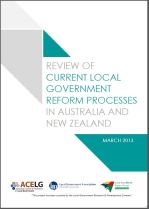
The Australian Centre of Excellence for Local Government (ACELG) has published a snapshot of current local government review and reform processes in Australia and in New Zealand that were active in late February and early March 2013.

The research report, Review of Current Local Government Reform Processes in Australia and New Zealand, was prepared by Gooding Davies Consultancy and is co-published by ACELG with the Local Government Association of South Australia. The project was initiated by the LGA SA’s South Australian Local Government Expert Review Panel.

The research builds upon earlier an ACELG paper, Unfinished Business, which examined the recommendations and outcomes of several earlier government inquiries into local government. Rather than examine a selection of the current inquiries in detail, however, the new report attempts to provide a brief overview of the 28 review and reform processes that were identified as being underway at the time of preparation nationally in Australia and New Zealand, as well as in all state and territory jurisdictions.

LG review paper coverFor further information please contact Alex Gooding (the report author: alex@goodingdavies.com.au) or Ms Melissa Gibbs, ACELG Assistant Director: melissa.gibbs@acelg.org.au

Posted in Local Government | Tagged , | Leave a comment

Another Sydney transport travesty as rail promise shunted

Today’s announcement that Federal Government funding earmarked for the Parramatta-Epping rail link in Sydney’s west has been shifted to a fund for projects not to be built until after 2019 should come as no great surprise, but it is still profoundly disappointing.

Back in March 2011 after the Liberal Government’s landslide win in the State election, I made the following observations regarding the Parramatta-Epping Rail Link (PERL) and North-West Rail Link (NWRL):

While it is difficult to argue against the new government’s case that the North West is a higher priority than the Parramatta-Epping line, both are too important to become a political football between State and Federal Government.

If both governments dig in, there is a strong risk that the Federal Government will simply trouser the $2.1 billion it has offered for the Parramatta-Epping link and use the money elsewhere. This would be a dismal result for NSW and Mr O’Farrell and the new Transport Minister should quickly exercise some nimble footwork to reach a compromise.

I don’t claim any particular prescience for this observation; indeed watching my fears come to pass has been like being the hapless witness who knows in advance an accident is going to happen but is unable to intervene as the slow-moving car (or in this case, train) wreck occurs in front of them. What makes this particular debacle especially galling, however, is that the drivers concerned – the Federal and NSW Governments – also knew it was going to happen, could see it happening, but wilfully did nothing to prevent it.

In that post two years ago I suggested an approach to avoid the looming impasse:

One solution would be to treat both links as a single, staged project, effectively providing a link from Parramatta via Epping to Rouse Hill and incorporating the full extension of the North West link to meet the existing Richmond Line.

The total cost would be considerable, but (along with the South West Link under construction) would be a major investment in Western Sydney’s future. It would mean that all major employment centres and residential release areas in the region would be linked by rail to each other, as well as to major destinations in eastern Sydney.

Of course that didn’t occur. What we got instead was a display of political gamesmanship by two governments that should know a lot better. Now we have been presented with the resulting smouldering ruin, it’s difficult to know where to begin in analysing the causes, but here’s a start:

  • The apparent disdain by the Federal Government for the transport needs of the residents of the North West sector. Even if there are sound arguments for the Parramatta-Epping link and even if the residents of the North West were unlikely to thank a Federal Labor government at the ballot box, the lack of any rail infrastructure in North West has to be the highest transport priority in Western Sydney.
  • The State Government’s blunt response that the NWRL was the only project it wanted to nominate for Federal transport rail funding – full stop. You would expect that with $2.1 billion on the table they would swallow their pride and explore about other potential rail projects including Parramatta to Epping as well as the NWRL. Think of that – two major urban rail projects in Sydney at the same time (or three, counting the South West Rail Link), but no.
  • And even if the State Government didn’t want to make up any potential funding shortfall for the NWRL given the bloated costings which bedevil NSW rail infrastructure projects, its failure to pitch some other alternative like the Parramatta to Eastwood and Macquarie Park light rail link, as proposed by Parramatta Council. While obviously it would not have the same potential for network integration as the PERL, this proposal would deliver many of the same connectivity benefits, linking residents of Western and South-Western Sydney to jobs in the Macquarie Park corridor.
  • The indecent haste with which both governments seized on the WestConnex Motorway proposal spruiked by Infrastructure NSW to extend the M4 to link with the M5, Port Botany and ultimately the CBD, as if this is the only “real” solution to Sydney’s transport problems. While there is a need to improve connectivity to the port and airport for freight traffic, the NSW Government’s proposal to build a full motorway to do this is questionable, expensive and ill-considered (Infrastructure NSW’s proposal to construct it in a slot instead of a tunnel has already been thrown out), while the Federal Government’s demand that it include a direct connection to the CBD is potentially disastrous, as pointed out by Garry Glazebrook and others.*

So what are we left with? True, the NSW Government is to be commended on its commitments to complete the South West and North West Rail Links, even if the government’s plans for the latter are likely to result in the destructive fragmentation of the city’s rail network, as Sandy Thomas has so eloquently noted.

And yes, the Federal Government has funded major urban rail and light rail projects, for example in cities such as Adelaide, the Gold Coast, Melbourne and Perth – any other city it would seem, except Sydney.

But here, in the so-called Global City where despite everything there actually is a culture of using public transport, where the needs for investment in public transport infrastructure are so pressing and where until recently the allocation of funding between the eastern and western half of the city has been so inequitable, our Federal and State politicians play brinkmanship with and ultimately walk away from a $2.1 billion commitment to fund essential public transport in Western Sydney.

Yet in an era when private car use is actually declining around the world and in Australia and when most other major cities have given up on motorways, recognising that they are the cause of and not the solution for their transport problems, the same politicians are happy to contemplate spending billions more on a motorway in eastern Sydney that will add new meaning to the word congestion.

Welcome to Sydney in 2013.

* A response to comments by Mr Paul Broad, the outgoing CEO of Infrastructure NSW, that the cancellation in the 1970s by the Wran Government of plans to wipe out large chunks of Glebe, Leichhardt and Five Dock to extend the M4 to the CBD was  a “$5 billion bad decision”: the campaign against the M4 extension (in which I was very peripherally involved) was only partly about preserving many of Sydney’s iconic inner-city suburbs – it was also because the campaigners wanted to save the city itself.

Even back then people could see the stupidity in plans to dump tens of thousands of cars in the middle of the CBD. The implications were obvious – the city clearly could not have accommodated this number of vehicles without the construction of mass carparks which probably would have resulted in the demolition of many heritage buildings. Needless to say the motorway itself would have become one huge carpark and the endless cycle of motorway expansion and urban and suburban destruction would have gone on.

That is the main reason people campaigned against this motorway and I for one do not resile from my (admittedly marginal) involvement in that successful campaign. The cancellation of the motorway was certainly not a bad decision – and the arguments against its modern reincarnation are as relevant now as they were nearly 40 years ago.

Posted in Infrastructure, Transport | Tagged , , , , , , | Leave a comment

The second Sydney airport – dead, or just resting? (part 2)

First, a disclaimer – I was the CEO of WSROC, the Western Sydney Regional Organisation of Councils, from 1996 to 2008 and therefore was involved in many of the debates about the proposed second Sydney airport.

In my previous article I looked at some key turning points in the long and complex history of proposals for a second Sydney airport at Badgerys Creek in Western Sydney which led to its seeming demise. This time around I’ll consider some of the factors which may yet bring these plans back to life, as well as some of the proposed airport’s pros and cons.

A recent Sydney Morning Herald article notes that the revival of these proposals is due to two separate issues, but broadly speaking both can be said to relate to capacity. The first is the capacity problem at Sydney Airport itself; a recent study quoted in the SMH claims that the airport will not be able to expand flight movements any further by the end of the decade to meet increasing demand during morning and afternoon peaks. Proposals to lift the hourly cap from 80 to 85 flights would extend this deadline by only a few years.

The second issue is the need to develop employment capacity in Western Sydney. Jobs growth is needed throughout Sydney to match population growth, but the problem is particularly acute in the West where these growth rates are highest. The region also has consistently higher unemployment levels than the rest of Sydney, exacerbated by an under-representation in jobs in the professional, technical and cultural sectors and the decline of the manufacturing sector, traditionally one of Western Sydney’s biggest employers.

A 2011 WSROC study also confirmed that the region’s employment “containment” – the proportion of the region’s workforce that is employed within the region is stuck at around 60%, the same figure WSROC first identified nearly a decade ago. Tens of thousands of jobs will need to be created in the region just to maintain this figure, let alone to contemplate increasing containment.

Transport systems will face an uphill battle moving the remaining 40% of the resident workforce out the region, mainly to jobs in eastern Sydney, as the population grows. Any decline in regional jobs containment would put enormous pressure on these systems. The potential to develop thousands of jobs associated with a new airport in the region is obviously very attractive.

A third factor alluded to in the SMH article is the region’s changing political complexion, with Labor losing control of many Western Sydney councils in what used to be its heartland. While both major parties are currently committed to a no second airport policy, changes in local leadership may lead to a reassessment of policies towards the airport, with WSROC reviewing its position in February.

This is not to say however that the factors which led to the region’s previously strong opposition to the airport have gone away. The most important of these are concerns over aircraft noise. While the airport’s retention on planning instruments has prevented wholesale development close to the proposed site, other suburbs further away that would still be impacted have grown considerably. People have taken the major parties at their word and either moved into these areas or stayed there on the assumption that the airport would never be built.

The second issue is air quality. While this was raised initially in relation to the impact of planes, pollution from increased ground traffic movement associated with an airport may be of greater concern. Airport-related traffic also has the potential to put the rest of the region’s existing road system under increased pressure, leading to increased congestion throughout Western Sydney.

As with all major policy debates, arguments on both sides tend to be oversold and much depends on the implementation. For example, the extent to which a second airport can help relieve the strain on Sydney Airport and make a major contribution to the region’s economy will clearly depend on the size and nature of the airport to be built.

As the University of Western Sydney’s Urban Research Centre Director Phillip O’Neill notes in a quote in the SMH article, the proposed airport will make a sizeable contribution to the region’s jobs growth only if it is integrated with an extensive network of distribution and logistics hubs, convention and entertainment centres and other facilities. This would require a substantial investment in both the airport and the associated infrastructure, which implies a level of coherent urban planning rarely seen in Australia and an airport far larger than the current airport administration may want as a competitor.

Associated with this is the need for a strong commitment to the detailed planning and upfront provision of transport infrastructure. This includes roads but most critically rail infrastructure, though this is one area in which the situation has changed for the better. The current construction of the South West Rail Link as far as Leppington would greatly reduce the potential cost of connecting the airport to the rail network as it can double as the first stage of an airport line. Completing the rail link to Badgerys Creek to be up and running before the airport opened its doors would contribute greatly to managing congestion and air quality issues.

This still leaves the core concern of many residents – aircraft noise. Although planes have become quieter, noise levels may still be unacceptable, especially if Badgerys Creek were to end up specialising in older and nosier planes used to transport freight and/or being operated on a 24-hour basis. Established residents who have made lifestyle choices to live on the rural fringe and close to the airport site based on the promises of the major parties that an airport will never be built may also be deeply unimpressed by any policy reversal, no matter what the regional economic benefits are.

This brings us to the point of looking at alternatives to the airport and what should happen if the airport were to proceed. I’ll consider these issues in my final post on this topic.

Posted in Airport, Infrastructure, Local Government | Tagged , , , , | 2 Comments

The second Sydney airport – dead, or just resting? (part 1)

Recent media reports point to a revival of plans to build a second Sydney Airport at Badgerys Creek, almost a decade since the proposal was (supposedly) killed off by both sides of politics.

The current state of play and how we got here are summarised well in a recent Sydney Morning Herald article by Jacob Saulwick and James Robertson (and a disclaimer – I was the CEO of WSROC, the Western Sydney Regional Organisation of Councils, from 1996 to 2008 and was therefore involved in many of the debates about airport planning).

I won’t repeat all the convoluted twists and turns of these debates as outlined in the article, but I agree with its assessment that one of the key factors in the growth of opposition to the second airport was the debacle of the third runway at Sydney Airport which opened in 1994. It quickly became apparent that the projections of relatively low increases in aircraft noise outlined in the Environmental Impact Statement (EIS) for the new runway were wildly optimistic.

In response the No Aircraft Noise party was formed in 1995 and quickly gathered significant votes in inner city seats in subsequent elections. As the SMH article notes, the third runway noise issue also affected Western Sydney and started to undermine support for an airport there. More generally it had a major negative impact on public confidence in all future EIS projections about aircraft noise.

This was to become significant in the second major factor in Western Sydney’s growing opposition to the airport proposal, which is not discussed in the otherwise comprehensive SMH article. In 1995/96 the Keating Federal Government announced a new EIS to update the previous EIS for the proposed airport site at Badgerys Creek which by that stage was over ten years old. After winning the 1996 federal election, the new Howard Government widened the terms of reference of this EIS to include consideration of federally-owned land at Holsworthy, as this Federal Parliamentary Library Chronology of the Second Sydney Airport confirms.

Whether or not there were sound administrative or environmental reasons for this decision, the political outcome was disastrous, at least for the airport’s supporters. To compound the issue the EIS process developed and considered five different design options and runway alignments across the two proposed sites – three at Badgerys Creek and two at Holsworthy. The upshot was that virtually every council area and community in Greater Western Sydney had a proposed runway pointing at it.

I can well remember the impact of the EIS process. The effect on local government was electric – Western Sydney council support for the proposed airport evaporated virtually overnight. WSROC had been a keen supporter of the airport proposal since at least the late 1980s, primarily because of its potential contribution to the regional economy and employment levels, but in 1997 it reversed its position. Prior to 1997 only one WSROC member Council, Holroyd, had consistently opposed the airport; after WSROC changed its stance only one council, Liverpool, remained in favour.

The federal government announced in late 1997 that Holsworthy was off the table but by then the damage had been done. The Western Sydney Alliance was formed in the same year to oppose any airport in Western Sydney. Even though the Alliance was financed by WSROC and MACROC member councils it was established as a separate single issue body rather than through the ROCs,  mainly to unite council and community group opposition across both regions. WSROC participated as an observer and cooperated with the Alliance in many campaigns, while also continuing to oppose the airport in its own right.

By the 2003 the anti-airport campaign had been successful in forcing both major political parties to renounce their support, effectively making the airport a non-issue in the 2007 and 2010 federal elections. Badgerys Creek looked dead and buried, though there have always been a few twitches directly or indirectly attributable to its corpse.

For example, the previous State Labor Government opposed the airport but kept its options open in planning the South West Growth Centre. Most of the employment land in the Centre is located to the north while the residential areas are further south; this places these employment zones close to the airport should it proceed, while using them as a convenient noise buffer between the airport site and residential precincts. The South West Rail Link which is under construction has also been planned in such a way that it could be easily extended to the airport site.

Now there are more signs that the airport proposal could be stirring into life, spurred by capacity problems at Sydney airport and the need to create jobs for Greater Western Sydney’s growing population. In part 2 I’ll look at some of these issues and the pros and cons of the airport proposal.

Posted in Airport, Infrastructure, Local Government, Transport | Tagged , , , , , | 3 Comments