The Strategic Week (no. 14, Thursday 24 March 2016) – the week in governance, planning, infrastructure and transport

Top of the Week

Claim that NZ local government reforms support collaboration over amalgamation challenged

The New Zealand Local Government Minister Peseta Sam Lotu-Iiga claims that reforms to the country’s local government sector to enable better service delivery are based on collaboration rather than amalgamation have been challenged by Wellington Council

The Minister said that the costs of local services were rising faster than council revenues and so councils needed new ways to manage finances, improve efficiencies and “create value for ratepayers”. He also claimed that current structures limited the ability of councils to work together.

“The reforms include more flexibility to collaborate and develop shared services; reorganisation processes that can be locally led and driven; and greater use of Council Controlled Organisations, with improved accountability tools to safeguard local democracy,” said Mr Lotu-Iiga.

“There are also enhanced Local Government Commission powers and processes to enable the Commission to promote and facilitate reorganisations.

“The Better Local Services package creates new options for councils and communities to improve performance and better manage local services and infrastructure”, the Minister said.

Further information provided by the government on the changes also claimed that the package “creates new options for local communities to choose from to improve their own local services and infrastructure” . It also noted that “recent attempts at reorganisations have proved unpopular so the package includes new options to improve services and infrastructure without amalgamations”.

The government hopes that legislation enabling the package of reforms will be passed by parliament by the end of the year so councils elected in 2016 “will have access to the new options” early in their  term.

Wellington City Council has however rejected proposals contained in the cabinet paper outlining the reforms which would allow council-led amalgamation proposals to proceed without a poll.

The paper proposed that “that council-led proposals of this type that meet the criteria for consultation, and have public and council support, should not be subject to polls.”

Council’s media release said that in response the council would “cease work on any future local government reorganisation” and the Mayor, Celia Wade-Brown, described the proposed reforms as “a mixed bag”.

“Mandatory polls for Local Government Commission proposals are a great idea. Encouraging Councils to amalgamate while circumventing a poll is wrong and is not in the public interest.

“We have consistently said there should be a binding public poll to decide any change to local government boundaries and Council will be making this position clear to Government as part of legislative process,” the Mayor said.

Governance

NSW councils head to court over mergers while non-merging councils head to Sept polls

According to media reports Woollahra Council was expected to vote to continue its legal action against the NSW government over forced council mergers.

As noted in TSW12, Council’s case relies on legal advice that the government has made inappropriate use of a section of the Local Government Act that was intended to facilitate voluntary amalgamations. It claims that this invalidates the merger process.

The report claims that council intends to proceed despite the costs involved and the fact that the Government has indicated that it will defend the action vigorously, indicating it will seek costs if the council’s action is unsuccessful.

A number of councils are watching the case closely. Kiama Council has resolved to receive a report on the possibility of joining the Woollahra action and is also holding a non-compulsory poll of local residents to be conducted by the Electoral Commission asking residents if they want the council to amalgamate.

Meanwhile Local Government Minister Paul Toole has confirmed that councils not merging should prepare for elections in September this year.

“If a council is a merger proposal, their council elections are aimed for March of next year,” he told parliament on Tuesday.

“For other councils we have told them it is business as usual. It is business as usual to be preparing for an election in September of this year.”

Qld Government reaffirms local government partnerships…

The Palaszczuk Government has reaffirmed its commitment to “work constructively” with the State’s 77 local governments following the recent council elections.

Premier Annastacia Palaszczuk said her Government “valued the partnership with local governments” and she has vowed to strengthen those links to generate jobs across the State.

“I congratulate the new and re-elected Mayors and councillors across the State and reaffirm my Government’s commitment to work with them. My Government has always had a constructive relationship with local government and I am determined that we will continue to work closely with councils across the State,” the Premier said.

Deputy Premier and Minister for Local Government Jackie Trad said the government had been reforming the way it “planned, prioritised and invested” in infrastructure.

“Working with local governments has been an important part of our infrastructure reform agenda and we look forward to continuing this important work with new and continuing local government representatives,” the Deputy Premier said.

… while state votes for four-year terms and incumbent Mayors

While votes are still being counted in last Saturday’s referendum on fixed four-year terms for state parliament the measure looks certain to pass, according to an ABC analysis.

The ABC reported that with 66% of the votes counted, the yes case had a clear lead of 53% to 47% (1,041,608 to 920,026).

The council elections held at the same time as the referendum have shown strong support for incumbent Mayors. In 61 of the state’s 77 councils the incumbent Mayor stood for re-election and at the last count 44 were leading the polls. In Brisbane, the Gold Coast and Sunshine Coast the incumbent Mayors were all re-elected with large majorities.

The re-election of these Mayors will also have implications for public transport infrastructure in these cities, particularly Brisbane where the centrepiece of the Lord Mayor Graham Quirk’s campaign was a commitment to a rubber-tyred metro (see TSW7) and the Gold Coast where the re-elected Mayor Tom Tate promised to provide $160 million towards a stage 3 extension of the light rail to the Gold Coast Airport (see TSW12).

SA Councils seek independent boundary adjustment process

Adelaide independent publication InDaily claims that the Local Government Association of South Australia (LGASA) is working on a “boundary adjustment process” under which minor changes to boundaries would be negotiated by neighbouring councils with more complex changes overseen by an independent body

It states that LGA CEO Matt Pinnegar raised the concept with InDaily after the South Australian Centre for Economic Studies (SACES) released a report last week calling for the “rationalisation” of local councils in the interests of economic efficiency.

Pinnegar rejected both the SACES report and the concept of forced mergers but said that under the LGASA’s approach “future decisions about council boundary changes and consolidation would be made by an independent body with appropriate skills, experience and knowledge”.

He indicated that the Association was “in talks” with Local Government Minister Geoff Brock who supported reform but also rejected the concept of “forced” amalgamations. With the abolition of the Boundaries Adjustment Facilitation Panel the Minister currently has responsibility for council boundary changes.

As InDaily notes, the LGASA proposal appears to be a response to concerns that a government could decide to adopt forced mergers similar to those in NSW. It claimed that the Minister had told the publication that the government did not support forced amalgamations “simply for the sake of reducing the number of councils” but that legislative proposals on boundary reform were being developed.

Development, Transport and Infrastructure Projects/Services

Light Rail/Tram/BRT

ACT government defers Russell light rail extension until after the election

The ACT Chief Minister Andrew Barr and Deputy Chief Minister Simon Corbell have announced that proposals for the extension of the light rail network to the Russell defence precinct will be deferred until after the next ACT election and considered as part of a stage 2 package for the project..

The Government will press on with delivery of the first City to Gungahlin stage of the network. Work is scheduled to start later this year and be completed by 2018/19.

“Just as we sought and were given a mandate for the first stage of the network, we will seek a second mandate at the 2016 ACT election for the next stage,” the joint release said.

“It is encouraging that now both sides of Federal politics back urban rail project and with the Commonwealth the major landowner, employer and beneficiary of a future stage of light rail we will continue to engage with the Commonwealth Government.

“Taking into consideration the light rail master planning work and community consultation that the government is currently undertaking we will make further announcements closer to the election about the next stage of the light rail network under a re-elected Labor government.”

Minister for Capital Metro Simon Corbell said Russell would be strongly considered, alongside other options, in the next stage of Canberra’s city-wide light rail network.

According to media reports the Chief Minister Andrew Barr said he would now develop and seek federal funding support for “a much more ambitious stage 2” involving not only Russell, but the wider parliamentary triangle and possibly Canberra Airport and the Australian National University.

“People will be very clear when they come to vote in the territory election in October what our commitment to stage 2 of the project will be and what we would intend to deliver if the government were re-elected”, he said.

Liberal transport spokesman Alistair Coe said the government should put the entire project on hold until after the election.

“It’s a very big decision for our community and the responsible course of action is to put the project on hold until October,” he is quoted as saying.

Metro

Sydney Metro – the big unanswered question

An opinion piece by Jacob Saulwick claims that there is a “$20 billion-plus unanswered question” at the heart of the Sydney Metro project – where will a second branch of the metro run south of Sydney Harbour?

Saulwick notes that north of the harbour, there are long-term plans for a branch to run under Military Road towards the Northern Beaches, but with the apparent decision to drop plans for conversion of the line between Sydenham and Hurstville to be integrated with the Bankstown line metro conversion there are no plans for an alternative. As Saulwick says, “there is patently no need for a train to run to Bankstown every two minutes”.

Sydney Metro with proposed extension to Liverpool (source: Sydney Metro)

Sydney Metro with proposed extension to Liverpool (source: Sydney Metro)

Saulwick draws on work by Dick Day, the former head of rail planning at RailCorp, to conclude that a second branch should be constructed to deal the “elephant in the room”, the large growth in rail passengers on the Western Line past Strathfield. This could involve either the construction of a completely new metro line or the conversion of the existing all-stops line to metro and a tunnel bypass for the existing suburban line from Homebush to the city.

“It is to be hoped that the government involves the community in a genuine discussion of the advantages and disadvantages of the different options, rather than its past practice of making substantive decisions behind closed doors. Those decisions often prove to be wrong,” Saulwick concludes.

Urban Heavy Rail

Sydney rail patronage data shows mixed results

A study by Fairfax media suggests that rail patronage in Sydney has “boomed in the city’s inner rings and slumped across its outer boundaries.”

The report claims that an analysis of Transport for NSW figures. shows that the number of rail commuters has soared in areas  such as Rhodes, Auburn and Green Square, where populations are exploding, while at stations such as Gosford, Penrith, Fairfield and Blaxland “rail patronage has fallen by up to 25 per cent despite modest population growth.”

The report quotes Independent transport expert Garry Glazebrook as stating that rapid growth in patronage at inner city sations reflected both an apartment boom and gentrification in these areas.

Patronage had fallen along train lines where there had been no improvements in service speeds or frequencies, such as the Blue Mountains and Central Coast lines. The decline could also be linked to an ageing population and an improved road network.

This is a shorter edition of TSW than usual due to the Easter weekend. Have a happy and safe break.

Posted in Public Transport, Sydney metro area, The Strategic Week, Western Sydney | Tagged , , , , , , , | 3 Comments

The Strategic Week (no. 13, Friday 18 March 2016) – the week in governance, planning, infrastructure and transport

Top of the Week

PM links innovation, a new cities agenda and Western Sydney plans…

While the Prime Minister’s comments during the Lachlan Macquarie Lecture at the recent Out There summit on the possibility that a rail link to the proposed Western Sydney Airport could be brought forward attracted most of the media attention (see TSW12), his extensive speech also addressed a range of other issues relating to the federal government’s cities and innovation policies.

Mr Turnbull noted that Western Sydney is Australia’s third-largest urban economy. He said it is also one of Australia’s fastest-growing regions making up nearly half of Sydney’s population “with the greatest potential for even more growth”.

He also noted however that employment levels are lower for young people and about 200,000 people have to leave the region to work, a number that is forecast to grow to about 340,000 by 2041.

“So because both the promise and the problems faced by Western Sydney are so complex, the solutions we provide must be coordinated across all layers of government and indeed the private sector,” Mr Turnbull said.

“Rapid growth is a challenge because of the demand it puts on housing and transport, the problems of congestion and mobility, the concentration of high value jobs in only a few places or the lack of local jobs.

“Our cities policy will address this by focusing on investment in transport and urban renewal, increasing the supply of housing and by improving amenity, making cities wonderful places to live.”

The PM made a clear pitch to link innovation and the development of cities, quoting urban economist Ed Glaeser who called cities “our species’ greatest invention”. He stated that “strong, well connected, liveable cities and regions are vital to support the high-tech, knowledge-intensive sectors of the new economy” and that in the “knowledge economy physical proximity and connectivity is more important than ever”.

Mr Turnbull also agreed with Glaeser’s assertion that the central goal for governments in planning and building cities is to “retain and enhance this basic function of cities, improving lives and creating opportunities for people.”

“… Cities are for people, not machines. Cities must have a human form because serving humanity is their function,” Mr Turnbull said.

“All of our policies must ensure that cities continue to provide this critical role in human progress, especially as we face the transition from the old economy to the new.

“Technology and infrastructure can smooth and enable that transition. Both can unlock potential and in the history of Western Sydney this has always been true.”

Mr Turnbull claimed that “the building blocks”of great cities are simple: “affordable housing, good transport, easy access to employment and study, reliable communications, energy and water”.

“Communities need smart, well-designed, walkable density,” Mr Turnbull said.

“We should aim to have more people in western Sydney living in an ever extending zone of the 30 minute city – where people do not have to travel too long to get to work, school or university.”

Mr Turnbull also indicated that while it would no longer “discriminate between modes”, and would fund rail as well as road projects, his government would also cease to be “a passive ATM doling out grants for infrastructure, without being especially involved or concerned about the consequences of that infrastructure… We will invest more in cities and we will do so as partners.”

The Prime Minister said that the planning and delivery of this infrastructure had to improve.

“We should approach infrastructure like the best run companies approach their business – planning, investing, delivering and operating infrastructure to get the best results for the best price.

“That means being a better partner to state and local governments – working closely together in the planning stages, ensuring that project outcomes are in step with our national goals.”

See next item for a summary of some of the responses to the Prime Minister’s proposals.

… and receives a mixed response

The Prime Minister’s comments on his government’s cities and innovation policies (see previous item) have attracted a mixed response from economic and media commentators.

Peter Martin has praised Mr Turnbull’s urban strategies noting however that the government will need to borrow money long-term to fund urban and transport infrastructure, for example through 30-year bonds financed at “exceptionally low rates”. In addition Mr Martin notes that he will encourage the states to make greater use of value capture so that federal funds can be spread further.

“Turnbull’s major projects minister, Paul Fletcher, will produce a discussion paper outlining how value-capture will work within weeks. It could open the way for all sorts of projects previously regarded as uneconomic or not yet economic, including a Melbourne-Brisbane freight rail line, a railway to the site of Sydney’s second airport, and (perhaps) a Melbourne-Brisbane high-speed passenger line,” Mr Martin said.

Peter Hartcher has also supported the Prime Minister’s strategy, noting Professor Ian Harper’s comments that “the economic benefits of getting cities right is ‘many multiples’ greater than those of tax reform” and that Mr Turnbull intends to make his cities policy “a trademark of his leadership” .

Hartcher states that “Turnbull has dumped Tony Abbott’s roads fetishism” and is prepared to commit to urban rail links – and, as noted by Mr Martin, the possibility of an interstate high-speed rail line. He noted that a very fast train in Australia “has been studied since the 1980s but never made any progress towards reality”, despite the thousands of kilometres built overseas.

This was in part due to attempts to finance previous proposals entirely through ticket sales. Instead Hartcher suggests value capture could be used, claiming that “the huge surge in land values” resulting from the project could also help pay for it.

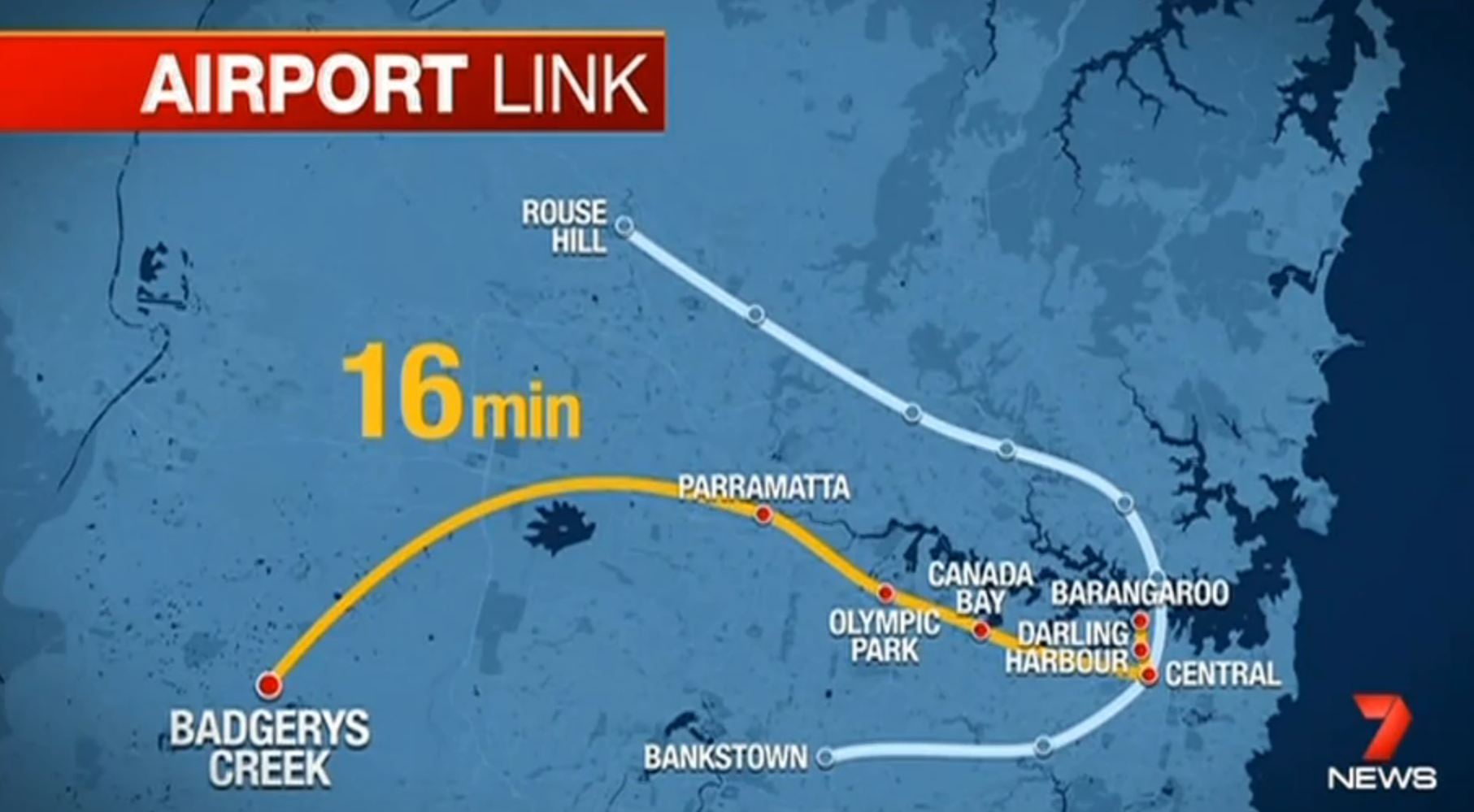
“Here is the key to the new agenda – the financing. For the new projects – the Badgery’s Creek airport rail link, the high speed Sydney-Melbourne train, for a range of other projects – the government is working on this and other mechanisms for raising the revenue without simply handing over federal tax monies,” Mr Hartcher said.

Jacob Saulwick however sounded a note of caution, specifically in relation to the proposed airport rail line, noting the promises for new rail links in Western Sydney and elsewhere made by Mr Turnbull’s predecessors which never materialised.

“Prime Minister Malcolm Turnbull’s commitment on Friday to look at what it would take to build a fast rail link to Badgerys Creek within a decade could be an exciting and city-shaping development,” Mr Saulwick said.

“Or it could represent the most tired story of all: politician, seeking support in the polls, has a flight of steel-wheel fantasy that in a few years will be an embarrassment to all concerned.”

Another “risk” identified by Mr Saulwick is that the project could be built but result in a “express train to Badgerys Creek, but at the expense of the other transport needs of the city.”

“A more pressing need would be to do something about the lack of rail capacity on Sydney’s Western Line, between Parramatta and the CBD, which the state government’s $20 billion metro program does surprisingly little to address,” Mr Saulwick said.

Kirsty Needham raised concerns regarding the Prime Minister’s proposals to use value capture to finance transport infrastructure. She noted that in relation to the planned Sydney Metro, Transport NSW is already “investigating how high-rise towers could be built, Hong Kong style, above six of the Metro’s city stations” and that companies like MTR and China Rail are “spruiking” this model in relation to other projects.

“So if the debate about whether Sydney needs more rail to combat worsening traffic congestion is now settled, governments should move on to an honest conversation with voters about the next big questions. How much privatised rail does NSW want? At what cost to the quarter-acre block?” Ms Needham said.

“How will governments ensure that rail operators/property developers deliver affordable housing designed to make Sydney more liveable for its residents, not simply to maximise railway profits?”

See later item on High Speed Rail proposals and issues.

Strategic Planning and Policy

Sydney’s congestion worsens as federal minister mulls road pricing inquiry

A Fairfax Media analysis comparing Roads and Maritime Services weekday peak hour data from 2013 and 2015 claims that speeds on some major  Sydney roads have slumped by up to 25km/h in this period.

The analysis also claims that Sydney drivers are stuck in rush hour traffic for longer, with the worst afternoon peak – on the M4 Motorway between Concord and Clyde – now spanning six hours, from 2pm to 8pm. The study revealed that worst decline was on the M2 Hills Motorway from North Ryde to Carlingford, where the average afternoon peak hour speed decreased by 25km/h to 46km/h. While the M2 upgrade completed in 2013 temporarily lifted average speeds, they have declined again since.

Michelle Zeibots, research director in Transport at UTS’ Institute for Sustainable Futures, is quoted as saying that upgrades tended to deliver only short-term improvements to traffic.

“As people are attracted to the network, speeds deteriorate before flattening out, returning to what they were before the new capacity was added,” Dr Zeibots said.

“We see these patterns after the opening of every new motorway in Sydney.”

In an ABC radio interview the federal Minister for Major Projects, Territories and Local Government Paul Fletcher indicated that the government was considering a recommendation from Infrastructure Australia (IA) to research options to introduce road pricing partly in response to increasing congestion.

In relation to the IA recommendation Mr Fletcher sated: “… is it worth looking at different approaches, would there be benefits in terms of reduced congestion, is it fairer, does it give us better roads, so those are questions that the Government will now consider whether we want to have this more detailed study that Infrastructure Australia’s recommended and that’s something we’re giving some thought to now.”

Scott Charlton, the CEO of toll road operator Transurban backed the road pricing inquiry proposal.

“Even factoring in committed projects such as WestConnex and NorthConnex, and all the currently committed rail projects, by 2035 Sydney motorists could face congestion levels on par with Mexico City and spend 110 hours a year in traffic,” he told a Committee for Economic Development of Australia luncheon.

NSW Transport Secretary Tim Reardon sounded a word of caution however, emphasising that “we have a long way to go in expanding our public transport system before we can contemplate such measures”.

NSW Government extends final fare report deadline

The NSW Minister for Transport Andrew Constance has written to Peter Boxall, Chair of the Independent Pricing and Regulatory Tribunal (IPART) to inform the organisation that the government is extending the due date for IPART’s final report on proposed NSW fare increases by six weeks to 12 May 2016.

This has been done, the letter said, “to allow the NSW Government to thoroughly consider the Tribunal’s 21 December 2016 draft report and give the Tribunal sufficient time to finalise its review after receiving the government’s announced policy position”.

According to media reports, Labor’s shadow minister for transport, Jodi McKay, has claimed that the government is “buying time” to work on a “sales pitch to try to soften the blow of steep fare rises”.IPART’s draft report proposed major changes to fares, including an increase in threshold for free travel from eight to ten journeys a week and a tightening of eligibility for the Gold Opal card.

Queensland infrastructure plan released – and criticised

The Queensland Government has released the state’s first Infrastructure Plan in more than three years, also announcing the establishment of a new State Infrastructure Fund with an injection of $500 million, “to build the infrastructure needed to grow the economy and support more than 1,000 jobs now for Queenslanders.”

The Premier said $300 million of the State Infrastructure Fund would be invested in seven critical road and rail upgrades, “to help boost capacity and reliability”.

“I made a commitment as Opposition leader to ensure that Queensland once again had a state-wide infrastructure plan, and today we deliver it,” Ms Palaszczuk said

“Our initial injection of funds will also target projects that have a clear community need and will help address important regional and economic priorities, including jobs for Queenslanders,” she said, also indicating that her government will call on the Prime Minister to match this commitment.

While the plan was generally welcomed, some regional leaders criticised it as being inadequate. For example, Sunshine Coast Mayor Mark Jamieson said it was “a case of far too little and wrong priorities” which “overlooked the needs of the Sunshine Coast”.

“The Queensland Government’s own statisticians have identified the Sunshine Coast as one of the fastest growing regions in Queensland, increasing to nearly half a million people in the next 20 years,” Mayor Jamison said.

“Yet the State Government is not shouldering its responsibilities when it comes to critical state infrastructure like road, rail and public transport.”

“State of Victoria” report identifies the state’s development scenarios…

A report as “advice” for Infrastructure Victoria prepared by consulting firm SGS Economics and Planning provides a spatial perspective on the “current and future State of Victoria”.

The report describes a number of environmental, social and economic trends affecting Victoria and the resulting infrastructure implications. These trends include an ageing population, the increasingly service-oriented and global nature of the economy and, as more of the associated employment is agglomerated in the central city, an increasing mismatch between the locations of jobs and housing with impacts on housing affordability and equality.

The report outlines a “matrix of nine possible population and employment outcomes have been generated for Melbourne and Regional Victoria”. These are various combinations of population and growth scenarios and development patterns, including “consolidated growth, business as usual and increased expansion”. It examines these outcomes on a spatial basis, for example the impact on regional cities, sub-regions of Melbourne and on the Central Sub-region.

“The Central Business District (CBD) is at the heart of the Central Subregion and how that evolves will determine the growth story of the Subregion, Melbourne, and Victoria as a whole. The boundary of Melbourne’s CBD is not a fixed line: It has expanded over time in response to structural economic change, infrastructure investments, planning policies and decisions, and evolving property market dynamics,” the report says.

It also notes that “Melbourne is in a unique position… with the benefit of having vast tracts of developable land… adjacent to the CBD which have the potential to be developed”. It cautions however that are a number of threats including climate change and extreme fire events.

Several conclusions are drawn from the study. The report finds for example that the rate and profile of population and economic growth will vary across the state, with Melbourne growing very quickly.  The growth in “higher skilled, more knowledge intensive jobs” which have “driven the renaissance of Melbourne’s central city” will continue, while regional centres will grow more slowly but age faster than the city.

Terry Rawnsley, the report’s author, told Fairfax media that Victoria needed to “think deeply” about why it built infrastructure in the first place.

“People get caught up in travel time savings or things like that, but building infrastructure is about providing people with access to services and jobs, and the ability to live happy lives,”

… while Vic government announces regional growth summit

The Victorian Government has announced that there will be a Regional Futures Summit to be held in Bendigo in July to help “drive population growth in regional and rural Victoria.”

The Summit will bring together demographers, academics, community leaders, government, industry, education and health providers “to shape new regional population strategies.” The summit will also help shape priorities for the government’s $500 million Regional Jobs and Infrastructure Fund (RJIF) as well as the work plans for the nine new Regional Partnerships.

“The Andrews Labor Government is getting on with growing and investing in rural and regional Victoria. We are working with communities, industry and local government to ensure regional Victoria is a great place to work, live and invest,” said Minster for Regional Development Jaala Pulford.

Development, Transport and Infrastructure Projects/Services

Light Rail/Tram/BRT

Newcastle tram plans reviewed

The Newcastle Herald claims that Infrastructure NSW is reviewing the state government’s light rail plans for Newcastle as part of its “assurance role”.

“One of the key roles of Infrastructure NSW is to independently review major projects throughout their planning and delivery, to help keep projects within scope, time and budget,” an unidentified spokeswoman for Infrastructure NSW is quoted as saying.

“We conduct regular reviews on all major projects, and our input to Newcastle Light Rail is no different to what we would provide for any other significant infrastructure project.”

It is unclear whether the review will look at the planning aspects of the project and no information has been provided on the Infrastructure NSW website relating to the review. According to the Herald however the spokeswoman did state that “Infrastructure NSW’s role is to advise the Government of any risks throughout planning and delivery so they can be promptly addressed.”

The article also claims that concerns have been raised by some councillors that the Connecting Newcastle document proposing light rail extensions (see TSW11) had been released by the Lord Mayor Nuatali Nelmes before it had been considered by Council. The Lord Mayor said however that the document would go before Council.

Gold Coast light rail stage 2 contractor appointed

CPB Contractors (formerly Leighton Contractors Pty Ltd) have been announced as the preferred contractor to design and build the 7.3 km extension to the Gold Coast light rail in time for the 2018 Commonwealth Games.

In announcing the appointment the Queensland Deputy Premier Jackie Trad and Minister for Transport Stirling Hinchliffe said the project will cost $420 million, with the Queensland Government investing $270 million.

“Stage Two will complete the missing link between Brisbane and the Gold Coast and will provide an immediate boost to the construction industry supporting up to 1,000 new construction jobs,” Ms Trad said.

“The business case confirmed Stage Two will contribute an estimated $160 million to the Gross State Product and now we’ve selected the preferred contractor it is full steam ahead to deliver this project in time for the Commonwealth Games.

“Light rail has already transformed the Gold Coast, but Stage Two will provide a seamless journey for these passengers to move around the Coast and connect to Brisbane.”

The stage 2 extension will connect the existing light rail line at Gold Coast University Hospital station with the heavy rail network at Helensvale station.

As well as the $270 million contribution from the Queensland Government, $95 million will be provided by the Australian Government and $55 million by the City of Gold Coast Council.

Work begins on Adelaide O-bahn tunnel

Preparation work has begun for the construction of the extension of Adelaide’s O-Bahn guided busway.

This involves early construction works for the installation of central bus lanes along Hackney Road and construction of the O-Bahn tunnel walls on Dequetteville Terrace just south of the Botanic Road / Hackney Road intersection.

The O-Bahn City Access Project is aimed at improving bus travel times and reducing congestion on Hackney Road. It will extend the O-Bahn system from the end of the busway at Gilberton into the cross-city bus lanes on Grenfell Street. The Project includes creation of new bus lanes along Hackney Road and a dedicated bus tunnel from next to the National Wine Centre to near Grenfell Street.

Metro

Sydney Metro Bankstown to Liverpool “extension study” announced, but no commitment on route or mode

NSW Minister for Transport and Infrastructure Andrew Constance has announced an investigation into “improving transport connections” between Bankstown and Liverpool, “including a possible extension of the new Sydney Metro”.

While the Minister states that “as Sydney Metro construction rapidly progresses, were taking the opportunity to plan for future transport possibilities down the track,” the investigation process appears to leave open the possibility that options and modes other than extending the metro to Liverpool will be considered.

“The first stage of Metro in the north west will open in 2019, the city and south west is due to open in 2024, and it’s important now to see what options lay beyond that,” Mr Constance said

“Now we’re investigating how we can deliver better transport outcomes for Sydney’s growing south west, including a potential extension of Sydney Metro, and this is a chance for people to have their say.”

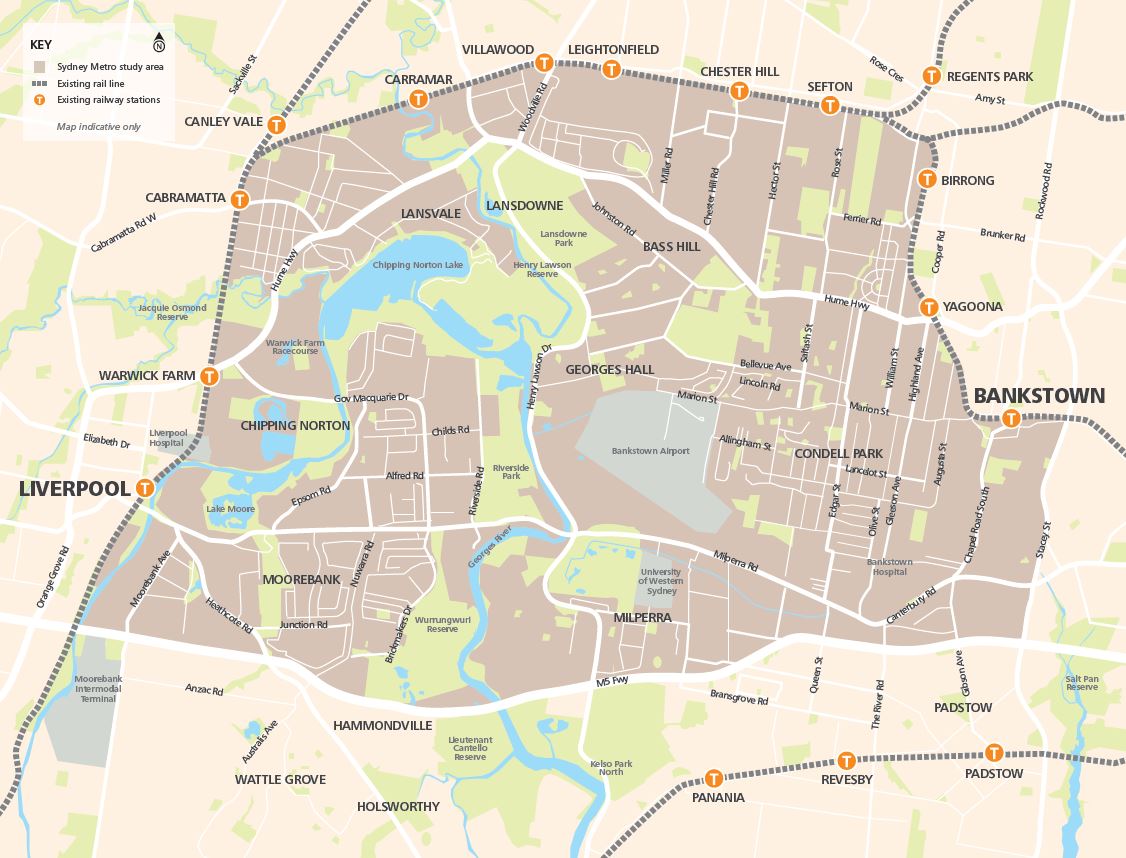
The Extension Study website and the Sydney Metro Newsletter provide some more detail including a map of the proposed study areas. While neither the website nor the letter make any specific commitments regarding mode feedback is being sought on possible station and train stabling locations, how to best connect town centres and key community facilities, as well as other important local issues that need to be considered.

Bankstown to Liverpool metro extension study area (source: Sydney Metro website)

Bankstown to Liverpool metro extension study area (source: Sydney Metro website)

Urban Heavy Rail

More high capacity trains for Melbourne…

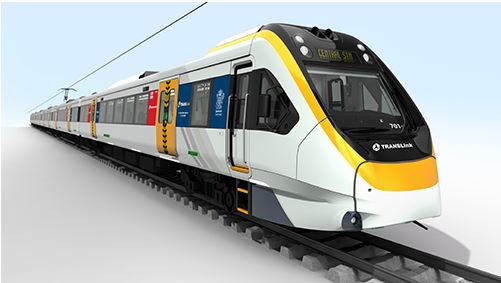
The Victorian government has nearly doubled its current order for new high-capacity trains from 37 to 65 seven-car sets, making it the “single biggest order of trains in Victoria’s history”, according to an announcement by Premier Daniel Andrews and Transport Minister Jacinta Allan.

The new trains will begin arriving in 2018 and will be used on the Cranbourne Pakenham line. The Dandenong corridor is Melbourne’s busiest and according to the media release the new longer trains, combined with power and signalling upgrades, level crossing removals and the rebuilding of five stations will boost its capacity by more than 40%, which equates to 11,000 extra passengers in the peak. The trains will also run on the new Melbourne Metro Rail cross-city line, providing capacity for 39,000 extra passengers in the peak.

“We’re making the biggest order of new trains in Victoria’s history to create local jobs, reduce congestion on Melbourne’s busiest line and make the most of Melbourne Metro Rail from day one,” Premier Andrews said.

“These 455 new carriages will be built in Victoria, for Victoria – boosting the capacity of the network and creating hundreds of long-term Victorian jobs.”

… while capacity challenge looms on SE Queensland’s rail horizon

Queensland’s Minister for Transport Stirling Hinchliffe has warned that South East Queensland’s busiest railway lines “will reach capacity in the next decade” without investment in network improvements.

The prediction was made in the South East Queensland’s Rail Horizon, the Government’s recently-released long-term rail network strategy. The Minister said the report confirmed that the busiest railway lines “will be overwhelmed by passenger growth” unless the “network capacity and congestion challenges” were addressed before 2026.

“There will be standing-room only on our commuter trains if we don’t plan for the massive population growth down the track or invest in major projects like Cross River Rail,” Mr Hinchliffe said.

“South East Queensland’s Rail Horizon released today outlines the projects and solutions to address our region’s rail network capacity and congestion challenges and ensure our infrastructure keeps place with growth.

“By 2036, the South East Queensland population is forecast to reach almost 4.9 million people and we need a better rail system to keep pace with growth and provide a better experience for passengers.”

Brisbane inner city rail constraints (source: Queensland Government website)

Brisbane inner city rail constraints (source: Queensland Government website)

The report identifies three broad strategies to respond to the capacity crisis:

  • Optimising the network, which includes actions such as improved timetabling, better management of dwell times at stations, resignalling and track upgrades;
  • Unlocking network capacity, which includes the introduction of new high-capacity trains and the development of the Cross River Rail project; and
  • Expanding network capacity, which includes new rail links such as Moreton Bay Rail Link, Salisbury to Flagstone extension, Ipswich and Springfield line extensions, Gold Coast extension, a new line to Caloundra and the North West Transport Corridor.
SEQ Rail Horizon strategies (source: Queensland Government website)

SEQ Rail Horizon strategies (source: Queensland Government website)

The document notes that because of the critical role of Cross River Rail in “easing congestion and improving accessibility into the Brisbane CBD”, the project is the state’s highest priority infrastructure project but it will require “funding contributions and cooperation” from all levels of government. It states:

“The new Cross River Rail project will take about seven years to procure, construct and become operational from the time an investment decision is made. This means a decision is required as a matter of urgency.”

HSR, Freight, other Rail

HSR unsolicited offer to be made to PM as experts spar over its benefits

Partly because of the interest of the Prime Minister in urban infrastructure and his “agnostic” approach to transport modes (see Top of the Week item) the level of interest in an eastern seaboard high speed rail (HSR) link continues to increase.

As reported in TSW11 a number of presentations from interested parties in support of HSR were made to the Standing Committee on Infrastructure, Transport and Cities inquiry into the role of transport connectivity in stimulating development and economic activity, while Shadow Minister for Infrastructure and Transport, Cities and Tourism Anthony Albanese reintroduced a private members bill to establish a High Speed Rail Auhority.

East coast HSR 2012 study proposal (source: Federal Government and Fairfax)

East coast HSR 2012 study proposal (source: Federal Government and Fairfax)

Now Fairfax media has reported that a Melbourne-based company, Consolidated Land and Rail Australia, is making an “unsolicited offer” to the Prime Minister to build a HSR link between Sydney and Melbourne. It also claims that the federal MP chairing the inquiry, John Alexander, has “enthusiastically embraced” the proposal and believes that the company is genuine in its plan. It also claims that the firm intends to finance the project using value capture techniques along the corridor.

The benefits of HSR were argued in an article by Beyond Zero Emissions CEO Dr Stephen Bygrave. He describes HSR as “a zero-emissions form of transport that would radically reduce our emissions, connect our regional and urban areas, create jobs and enhance investment,” dismissing the two main arguments against it – the high cost and a perceived lack of demand.

On the former issue he notes that the estimated cost has decreased from $114 billion as estimated by the Labor-initiated AECOM study in 2012, to a more recent figure of $68 billion.

“The costs get lower with each study, largely because of better economic analysis and modelling, and detailed studies of the rail path, particularly the routes coming into our major capital cities,” Dr Bygrave said.

On the issue of the lack of demand he claims that “Sydney to Melbourne is the world’s fifth busiest air route and Sydney to Brisbane the world’s 13th busiest”, while 60% of Australians “live within 50km of the route”. In addition Dr Bygrave believes HSR is a commercially viable proposition “that is not dissimilar to building a toll road in terms of the financial model that can be deployed”.

In a riposte to Dr Bygrave’s article, Alan Davies, writer of the Urbanist blog at Crikey describes the east coast HSR proposal as “the boondoggle that just won’t go away” and dismisses Bygrave’s decreasing cost estimates because they were developed by lobby groups “so it’s no surprise they insist it could be built for a lot less”.

Mr Davies also dismisses the claims that HSR would “radically reduce emissions” pointing to the findings of the AECOM study that the total value of negative externalities including emissions avoided by the HSR project would amount to “just $2 billion over the 50 year life of the project.”

“HSR would be such a ridiculously expensive way to reduce emissions compared to other options, it beggars belief that any progressive-minded organisation seriously concerned about climate change could propose it. It’s likely it would crowd out public funding of more cost-effective investments like renewable energy generation”, he said.

Transport: other

Real time bus data expanded in NSW

NSW Minister for Transport and Infrastructure Andrew Constance has announced an expansion in the availability of real-time bus data, “delivering customers up to the minute service information” to mobile devices.

Real time information on bus services can accessed on any of the 11 real-time transport apps that span the network from “Nelson Bay in the north, Shellharbour in the south and west to Penrith”. Work is underway to expand real time data availability across the Blue Mountains and Hunter Valley.


Posted in Airport, Employment, Governance, Infrastructure, Local Government, Planning, Population, Public Transport, Sydney metro area, The Strategic Week, Transport, Western Sydney | Tagged , , , , , , , , , , , , , | Leave a comment

The Strategic Week (no. 12, Friday 11 March 2016) – the week in governance, planning, infrastructure and transport

This edition of The Strategic Week was delayed in part to incorporate some aspects of the Prime Minister’s media comments and address to a Western Sydney summit on Friday. This will be discussed in further detail in the next edition of TSW.

Top of the Week

PM seeks to be “more ambitious” on Badgerys Creek Airport rail connection timing …

In what appeared initially to be a significant departure from his government’s previous policy approach, the Prime Minister Malcolm Turnbull has indicated that he is working towards bringing forward construction of the rail line to the planned airport at Badgerys Creek in Western Sydney so it is in place when the airport opens.

Speaking on ABC radio prior to addressing the Western Sydney “Out There” summit (see TSW11), Mr Turnbull said the government is making the airport “rail ready”.

“But we believe we should be more ambitious and what we are doing is working with the State Government to see how we can bring rail to the airport, more rail to western Sydney, ideally when the airport opens,” he said.

The Prime Minister however did not make a specific commitment regarding funding or timing, instead pointing to the potential to use value capture to fund transport infrastructure including the airport line.

“Let’s ask ourselves how do we improve our city, how do we increase the value of our city and its amenity? Then having done that with this piece of rail infrastructure, how do we then capture some of that to support its construction?”

Mr Turnbull expanded on this perspective when delivering the inaugural Lachlan Macquarie Lecture to the “Out There” Summit though he seemed to adopt a slightly more cautious tone.

“Neither the Australian nor the NSW Government can commit today to completing a rail connection by 2026, there is too little known about the route, the cost, the value created and the sources of funding” Mr Turnbull said.

“But instead of resigning ourselves to a two-decade delay, let’s lift our ambitions and ask, what would it take for rail to be operational at the airport when it opens? And if not then, how soon afterwards?

“How do we use a rail link to improve supply and hence affordability and accessibility of residential and business premises? How do we use rail to give people better access to quality jobs? How do we increase the rail catchment through changing land use?

“A lot of value will be created. Is there enough to enable a rail link to be delivered sooner than the traffic at the airport alone would warrant?” the PM said.

The next edition of TSW will examine other aspects of the Prime Minister’s Lachlan Macquarie address.

… after Minister sounds a word of caution

Mr Turnbull’s media comments and Lachlan Macquarie lecture statements on the prospects of a rail link to the planned Western Sydney airport (see previous item) seemed to go further than those of his Minister for Major Projects, Territories and Local Government Paul Fletcher.

The Minister spoke recently to a conference on high speed rail organised by the Sydney Business Chamber Western Sydney and Parramatta Council (see later item regarding this and for further discussion of the Minister’s comments).

In relation to the airport rail connection, the Minister said that the initial passenger numbers were expected to be “modest” at around five million a year which was “not sufficient to justify a rail connection”, though from the day of opening the airport “will have excellent road connectivity”.

Even when passenger numbers increase the Minister sounded a note of caution.

“Around 17 per cent of Sydney Airport users travel by train; for Brisbane Airport it is 10 per cent. In both cases the rail link operator has struggled to make commercial returns over time,” he said.

The Minister did however concede that a rail link to the airport would also service other development, pointing to the federal and NSW governments’ joint study into Western Sydney’s rail needs. This echoed a plea from Western Sydney Regional Organisation of Councils (WSROC) President Clr Tony Hadchiti.

“A very fast train from Parramatta to Badgerys Creek is a great concept, but if the route doesn’t have stations and stops along the way there will be very little benefit for commuters and businesses between these two locations,” he said.

“63 per cent of Western Sydney residents drive to work, indicating that existing public transport is not capable of carrying people where they need to go.”

Governance

NSW council merger battle gets even messier

According to media reports a number of NSW councils are fighting planned mergers on several fronts, complicating the state government’s strategy of using the Boundaries Commission process to implement the amalgamations.

Some of the approaches include:

  • Submission of alternative merger proposals. As noted in TSW11 Warringah Council initiated this approach which has been adopted by a number of other councils including Botany, Kogorah and Rockdale Councils in Sydney. In regional NSW Corowa, Jerilderee and Palarang Councils are pursuing similar approaches. Despite the fact that the these proposals have been added to the government’s council boundary review website, the NSW Local Government Minister Paul Toole has foreshadowed in comments to Fairfax media that any council-initiated proposals submitted after Warringah’s would probably not be examined with the government-backed mergers, meaning that the Boundaries Commission would deliver its verdict on these first.
  • Legal action. Woollahra Council has threatened court action unless the government drops plans to merge the council with Waverley and Randwick Councils. According to Fairfax media the case is based on the argument that the government is proceeding under the incorrect newer sections of the Local Government Act instead of the existing more provisions for forced mergers which are more cumbersome. Other councils such as Mosman are seeking legal advice about whether than can join the challenge. Woollahra council has also made a formal complaint to the NSW Ombudsman about the conduct of the public inquiry into the merger.
  • Encouraging letter-writing and other anti-merger campaigns by local residents. Other councils such as Hawkesbury City Council which are opposed to the merger have urged residents to continue writing to the Premier, Local Government Minister and local members to express opposition.

Foley announces new NSW shadow planning and transport ministers

The resignation of NSW Deputy Opposition Leader Linda Burney to run for the seat of Barton in the upcoming federal election has lead to a reshuffle and the appointment of new shadow planning and transport ministers.

The new deputy leader Michael Daley has lost the treasury portfolio to Ryan Park but takes up the planning and infrastructure portfolio. Jodi McKay, one of nine women in the shadow cabinet, being given transport to add her existing responsibilities for roads, maritime and freight.

Strategic Planning and Policy

Minister outlines federal government’s public transport strategies…

Following the release of the paper on options for a Western Sydney fast train discussed in TSW11, the Minister for Major Projects, Territories and Local Government Paul Fletcher used a long address to a conference on the topic organised by the Sydney Business Chamber Western Sydney and Parramatta Council to outline the federal government’s policies on this and a range of other public transport issues (see earlier item regarding the Minister’s comments on proposed rail link to the planned Badgerys Creek airport).

Mr Fletcher noted that “transport infrastructure is a critical part of the effective operation of a modern city”, stressing “the importance of transport— particularly public transport” to the federal government.

The Minister said he wanted to “correct the simplistic argument”, that the Abbott Government was not prepared to fund public transport, noting the funds paid to state governments through the Asset Recycling Initiative for public transport projects including the Sydney Metro.

He noted however that the Prime Minister had made it clear that the federal government will now “determine the funding of transport infrastructure projects on their merits, regardless of mode”, citing provision of $95 million towards stage 2 of the Gold Coast Light Rail Project.

“One factor which informs our thinking is the importance of public transport to provide connectivity to densely populated areas of our cities, particularly as our economy transforms,” Mr Fletcher said.

“If we are seeing a densification of our cities and inner city areas, and if this is linked with underlying economic trends, then providing efficient transport connections to and from these areas is increasingly important.”

The Minister concluded with some comments about public transport infrastructure funding, noting that the NSW government had been “doing a lot of work on value sharing”. He announced that the federal government will issue a discussion paper seeking feedback about value capture and how to encourage its use.

“Some of the questions we will be asking include:

  • “What is value capture and why should we use it?
  • “Should the public sector be bolder in employing value capture and are more city level powers critical to this?
  • “How should public sector organisations use their own property assets to realise value uplift?
  • “What role can the Commonwealth play in this space?”, the Minister said.

… while another does the same for the government’s cities agenda

The Assistant Minister for Cities and Digital Transformation, Angus Taylor, has outlined the federal government’s priorities for its cities agenda to the same Sydney Business Chamber conference on transport links between the city and Western Sydney addressed by Paul Fletcher (see previous item).

These include “improved access to quality local jobs”, housing affordability and sustainability and amenity.

“Central to this portfolio is the need for high income local jobs. We’re seeing a rapid increase in high income jobs focused on innovation, involving complex problem solving and experience. These jobs tend to co-locate in clusters,” Mr Taylor said.

A focus of the policy will be “high-tech clusters” similar to those at MIT in Boston and Stanford University in Northern California.

“As a nation we need to nurture and grow these clusters of high income jobs, for opportunity and prosperity, to support the aspirations of every Australian,” the Assistant Minister said, though he issued a caution about the challenges involved. These include the way in which population growth in outer suburban areas and some regional cities is “outpacing the delivery of jobs and services”.

“We need to use every policy lever of government – financial regulation, tax policy, immigration, environment, education policy, industry policy, infrastructure investment, even defence policy, to support and nurture these job clusters in our cities, as close as possible to where people live,” Mr Taylor said.

Other challenges include housing affordability and supply, and transport.

“We need to better understand the link between transport and development. We shouldn’t think about transport options based on the cost of moving someone from A to B. Instead we must recognise that housing developments and employment zones are heavily impacted by transport options and we need to focus on integrated developments”, he said.

Mr Taylor said that through its Cities Agenda the federal government would “work with all levels of government, industry and community” to develop agreements.

“The UK Government has created a very powerful template for this, with their so-called ‘city deals’. These are deals for cities with targets, targeted initiatives and incentives – sharply focused on economic growth and quality of life,” he said.

Development, Transport and Infrastructure Projects/Services

Development Projects and Plans

Super-tall towers planned for Brisbane and Parramatta (perhaps)

A development application has been lodged for a billion-dollar 250-metre, 76-storey building to be known as Queen’s tower to be located in Queen Street Brisbane, with “luxury residences, premium short-term accommodation and a new shopping and dining precinct.”

Meanwhile a architects Bates Smart have won a design concept competition for a $700 million, 300 metre 90-storey building in the heart of the Parramatta Square development – though Aviation authorities have not given their approval for the construction of the building to which a number aviation and airport authorities have objected. To overcome these concerns the developer Walker Corporation will lodge applications for the building in stages, starting with a DA for a 70-storey, or 243-metre tower.

Light Rail/Tram/BRT

Parramatta light rail briefing provides some answers – and more questions

  • Parramatta light rail 1: industry briefing

The NSW government briefed industry on the Parramatta light rail project at an event last Monday, revealing it will involve over 20 km of track and around 22 stops, including six major interchanges.

Minister for Transport and Infrastructure Andrew Constance said the briefing would “share further details of how planners and industry can contribute to this transformational project.” Over 500 experts attended.

“Today we’re pressing go on Parramatta Light Rail, on the site where two light rail lines will meet to create a new tram network for the west,” Mr Constance said.

“This project will provide frequent and reliable links to the great precincts of Sydney like Westmead Hospital, The University of Western Sydney, Parramatta CBD, the Olympic sporting hub and Strathfield while also sparking rejuvenation of Camellia.

“The project will be a chance for Western Sydney businesses to get on board and benefit, all while creating hundreds of jobs.”

The Minister indicated that construction could begin by late 2018 or early 2019 and that later this year “with a specific route under consultation”, wider community input would be sought.

The industry briefing document indicates that the government is looking to “commence a conversation about Parramatta Light Rail with industry”, applying “the successful elements of industry engagement programs undertaken by other Government projects such as Sydney Metro and Western Sydney Infrastructure Plan”.

The process will begin by seeking feedback to help develop a strategic business model that includes the project objectives, need, governance and level of service. Industry will be consulted on the resulting model “through a series of challenge forums” leading to second industry briefing at the end of 2016 on the government’s preferred business model and delivery strategy at a second industry briefing prior to the start of procurement.

Part 2 (next item) will consider some of the project details released at the industry briefing.

  • Parramatta light rail 2: project details

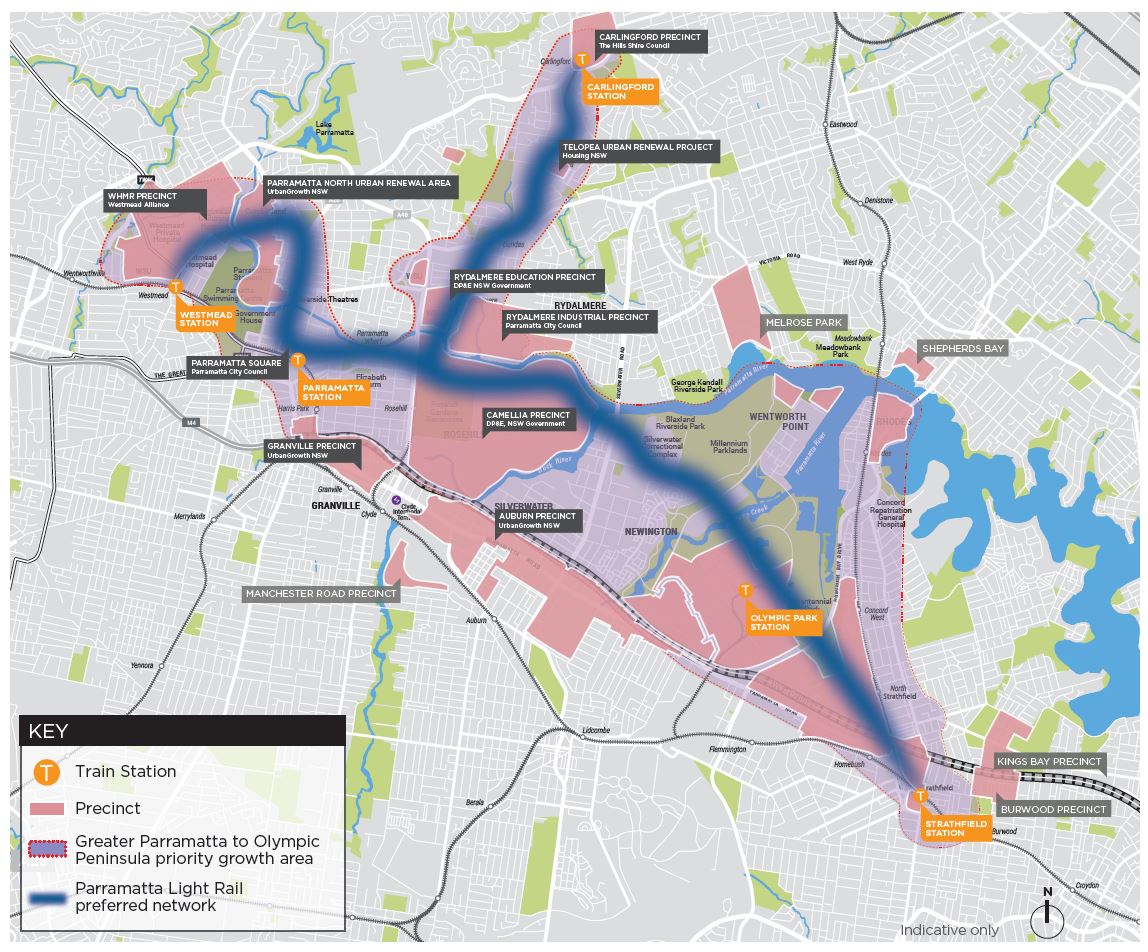
The Parramatta light rail  industry briefing document released by the government (discussed in the previous item) provided more detail about the project but also raises some questions. Some of the key points to emerge included:

Parramatta Light Rail proposed network (source: Parramatta Light Rail Industry Briefing documentation)

Parramatta Light Rail proposed network (source: Parramatta Light Rail Industry Briefing documentation)

  • The government has allocated $1 billion to the project which will need additional funding. Some of this will be provided through a special infrastructure contribution on new development in the Greater Parramatta to Olympic Peninsula Priority Growth Area through which the light rail corridor runs (see map). This will also fund other road works and infrastructure.
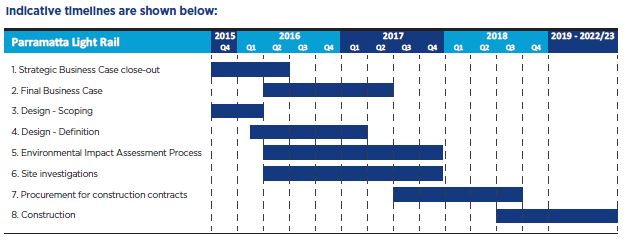
  • Construction is planned to begin in late 2018 or early 2019 and is scheduled to be complete by 2022/23 (see indicative timetable below).
Parramatta Light Rail Indicative Timetable (source: Parramatta Light Rail Industry Briefing documentation)

Parramatta Light Rail Indicative Timetable (source: Parramatta Light Rail Industry Briefing documentation)

  • As noted earlier the project will involve over 20 km of track with two branches. At the western end the line will commence at Westmead Station before running in an arc through the hospital precinct and North Parramatta to Parramatta Square and Station, then on to Camillia. This section will form the central “spine” of the planned network and presumably any future expansion.
  • The line will divide at Camillia with the western branch going to Strathfield Station via Olympic Park Station. The northern branch will run to Carlingford, replacing the existing heavy rail line between Camillia and Carlingford.
  • There will be around 20 stops which means average intervals of around one kilometre between stops. Transport interchanges are planned at Westmead, Parramatta, Carlingford (presumably bus only), Olympic Park and Strathfield Stations
  • The line will have frequent “turn up and go” services though no information has been provided on frequency or operating hours. The line will also be integrated with the Opal ticketing system (though no indication is given regarding fare structure).

“Camellia is the junction between the two routes and you would think the junction point would be a good point for buses to stop. It would also have main road access via James Ruse Drive for buses,” Mr Borger said.

On the interchange issue the Sydney Business Chamber’s Western Sydney director David Borger said to Fairfax media that he was surprised an interchange at Camellia was not included as part of the government’s preferred network.

The next item discusses some of the issues relating to the Parramatta light rail proposal.

Comment: Parramatta light rail proposal still has many unanswered questions

As noted in the previous two items, the Parramatta light rail industry briefing has provided more detail regarding the project but also leaves – and in some case raises – some unanswered questions which will need to be addressed in future consultations.

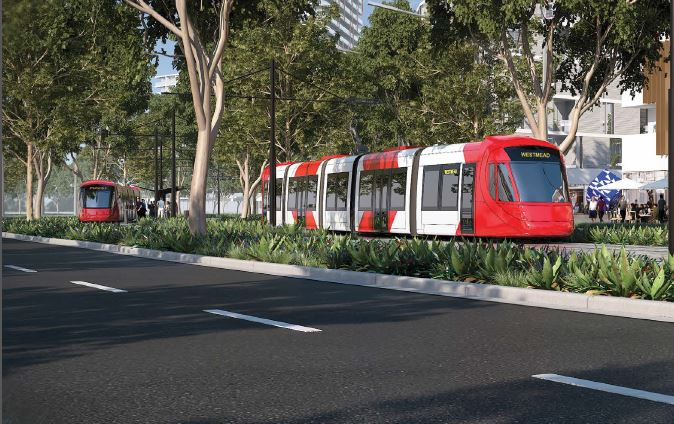
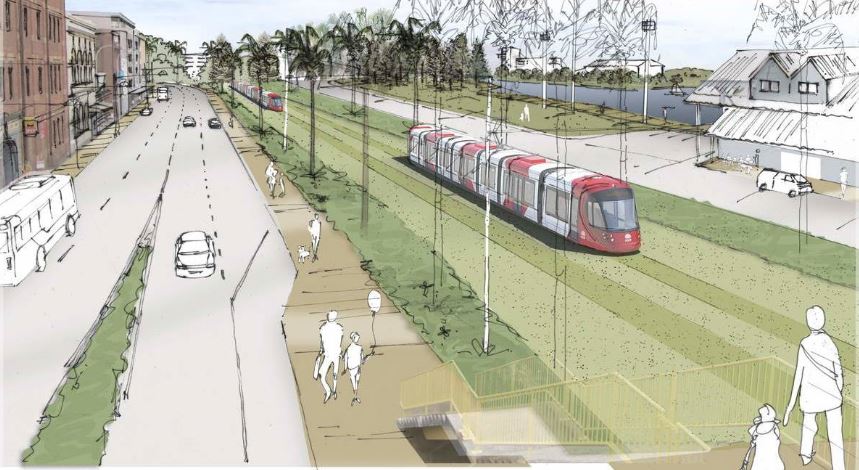
Artist's impression Parramatta Light Rail (source: Parramatta Light Rail Industry Briefing documentation)

Artist’s impression Parramatta Light Rail (source: Parramatta Light Rail Industry Briefing documentation)

Chief among these is more detail on the preferred route and location of specific stops, in particular the interchanges. As mentioned earlier it does appear that there will be around 20 stops which suggests an average one-kilometre spacing, and five interchanges.

As pointed out by Mr Borger from the Sydney Business Chamber Western Sydney branch (see previous item), there is no mention of a combined tram-to-tram and tram-bus interchange which would need to be located at or near Camellia. This would be required to allow passengers to change between the Camellia to Carlingford branch and the Camellia to Strathfield branch, and vice versa.

Little detail has been provided on the planned conversion of the Camellia to Carlingford branch, including the time involved or the alternative bus arrangements that will be put in place during this process. This will require extensive work on the existing rail bridge across Parramatta River as well as the replacement of the current electrification system and, presumably, the duplication of the existing single line. Judging by the timeframes suggested for the Epping to Chatswood and Bankstown line metro conversions and the experience of the inner west goods line to light rail conversion this could easily take around 12 months or even longer.

There is another unknown heading south from Camellia – the fate of the remaining section of the existing heavy rail line to the junction with the main western railway line at Clyde. This is not scheduled for conversion to light rail and the existing line is neither mentioned in the document nor shown on the map. This suggests that this section will be closed, and along with it the current station at Rosehill which is close to the racecourse and a number of hotels – that being said Rosehill station is only about 500 metres from the current Camellia station.

It is also unclear whether and how provision will be made to accommodate future extensions of the light rail network. This is particularly relevant on the planned Carlingford branch where the original proposals by Parramatta Council identified options for a link all the way to Macquarie Park via either Eastwood or Epping as actually being higher priority than the Olympic Park corridor. The handling of the terminus at Carlingford in the final project design will provide some clues about whether and how the government will make provision for an extension.

Finally, perhaps the biggest questions of all are the overall cost of the project and the basis on which the special infrastructure contribution to the cost will be levied. Significant sections of the Greater Parramatta to Olympic Peninsula Priority Growth Area will receive little or no direct benefit from the project, especially those which are relatively distant from the proposed light rail corridor and in some cases are closer to the existing western and northern rail lines and stations. The government has announced that it will allocate $1 billion to the project but at this stage it is a guess as to whether value capture will be able to make up the rest.

Gold Coast Mayor pledges $160 million for airport light rail link

Light rail has featured in yet another council election campaign. The current Gold Coast Mayor and candidate in the upcoming Mayoral candidate Tom Tate has committed to contributing up to $160 million towards the extension of the city’s light rail line to the Gold Coast Airport if he is re-elected.

The existing line runs between Southport and Broadbeach, with a second stage extension from Southport to Helensvale and the heavy rail network due to be completed by 2018. According to media reports Cr Tate has promised to immediately fund a $600,000 technical feasibility on a third stage to the airport. He indicated that if re-elected the Council could contribute around 11% of the estimated $1.54 billion cost, consistent with the contribution it made with stages one and two.

Cr Tate claimed that residents had overwhelmingly supported” the proposal but said that the three levels of government would again need to work together on the extension.

“But first we have to do our homework, make sure it is ‘do-able’, make sure it is what the people want and then go to state and federal governments,” he said.

“But this will be the biggest example, anywhere in Australia, of the three levels of government coming together and putting in infrastructure that is transformative for a city.”

 PM and Premier discuss Hobart light rail proposal

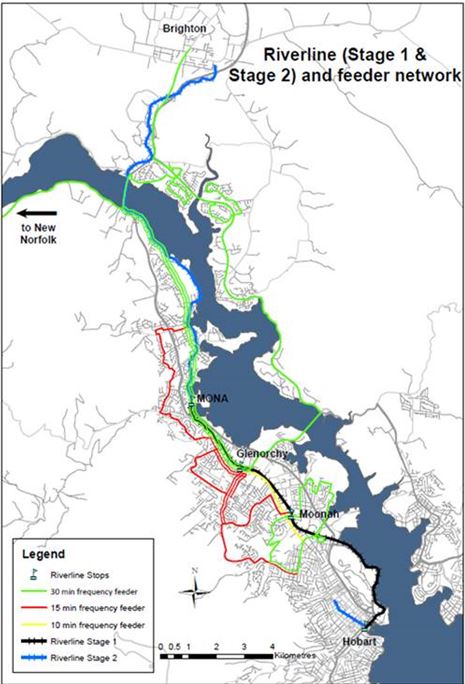
Following discussions with independent Tasmania federal MP Andrew Wilkie (see TSW11) on the proposal to convert former rail line in Hobart’s northern suburbs to light rail, the Hobart Mercury has reported that the Tasmanian Premier Will Hodgman and Prime Minister Malcolm Turnbull are discussing “innovative” ways to fund the project.

The paper also claims that Mr Turnbull had said the light rail system could be a catalyst for urban renewal and regional development in Hobart, but he is “waiting for a lead” from the State Government on the $100 million project. The funding options said to be under discussion are consistent with the Prime Minister’s recent comments on the use of value capture to fund infrastructure (see lead item).

Urban Heavy Rail

NZ PM virtually views planned Auckland station

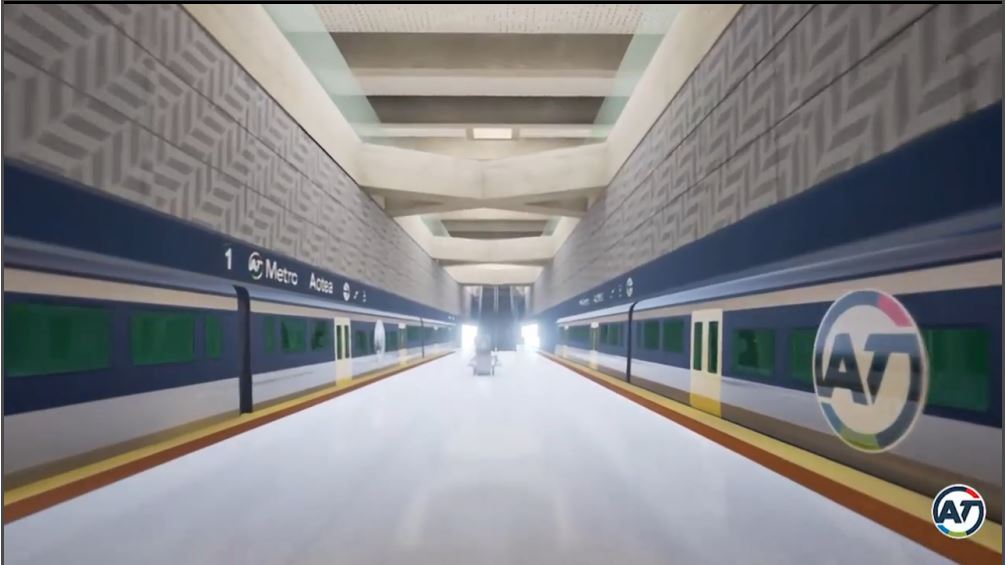
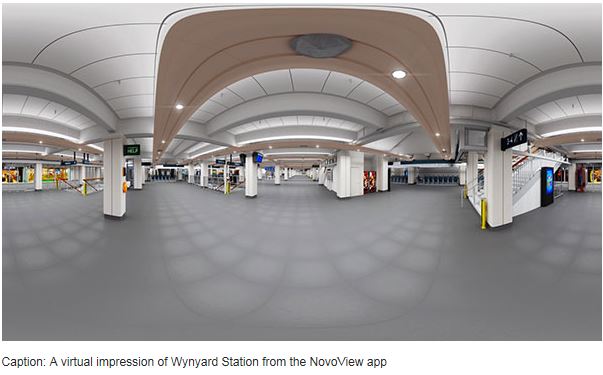
The New Zealand Prime Minister John Key “took a walk” around Aotea Station, one of the proposed two new underground station for Auckland’s $2.5 billion City Rail Link, using a virtual reality headset.

Speaking to the Weekend Herald during a visit to the CRL design offices where he viewed the video, Mr Key stressed the importance of making sure one of the biggest engineering missions in Kiwi history gets a “successful execution”.

Image from Aotea Station virtual walk-through (source: NZ Herald and Auckland Transport)

Image from Aotea Station virtual walk-through (source: NZ Herald and Auckland Transport)

“This is something that’s been talked about for decades. It’s exciting, but something you’ve got to get right,” Mr Key said.

“The successful execution of the plan will allow it to be delivered on the broad budget of $2.5 billion to $3 billion. If you don’t do that, everyone can see how challenging that might be.”

The paper noted that several issues are still to be ironed out between the national government and Auckland Council. The most important is how the project will be funded, with the council hoping the government will provide half the $2.5 billion cost.

HSR, Freight, other Rail

Contracts for planning north-south Inland Rail awarded as fast-tracking of existing east-west link announced

The federal Minister for Infrastructure and Transport Darren Chester has announced that the Australian Rail Track Corporation (ARTC) has awarded more than $11 million in contracts in recent weeks to progress planning on the Inland Rail project.

According to the Minister the contracts include” a range of crucial field studies and environmental assessments” across three states.

“Inland Rail is now in the planning and environmental approvals phase and ARTC and its consultants will commence critical field studies along the alignment over the coming weeks,” Mr Chester said.

A joint venture of SMEC and Arup won the Technical and Engineering Advisory contact. A further six contracts have been awarded to leading consultancies, GHD Pty Ltd, Parsons Brinkerhoff, AECOM, ARUP and Jacobs for the initial environmental investigations and engineering design for each of the projects in the programme.

Infrastructure Australia recently named Inland Rail as a priority initiative on the newly updated Infrastructure Priority List. The proposal envisages a Melbourne to Brisbane rail freight link with transit times of under 24 hours.

Meanwhile the Prime Minister Malcolm Turbull and and John Fullerton, CEO of the Australian Rail Track Corporation (ARTC), have announced that the ARTC will fast track a major upgrade to the east-west national rail network.

The upgrade will involve 1200 kilometres of rail replacement between Adelaide and Tarcoola. The ARTC will partner with Arrium Steel to deliver the upgrade, substantially boosting demand for steel production at the Whyalla facility.

The upgrade will replace decades old rail with stronger steel, weighing 60kg per metre compared to the current 47kg per metre, enabling axle weight to increase from 23 tonne to 25 tonne at 80 kms per hour.

How to make shorthaul rail freight succeed

The Bureau of Infrastructure, Transport and Regional Economics (BITRE) has released a report on the elements that make short-haul intermodal freight services succeed.

The Bureau’s head Gary Dolman notes in the report’s foreword that the shipping container has “revolutionised freight transport over the last half-century” but that this success has brought challenges. For example ports are typically located at the hearts of our cities so landside container movements impact on communities around the ports and contribute to road congestion.

“In response to these issues, planners and policymakers worldwide seek to transfer box movements from road to rail; and to use rail to shift port activities away from constrained maritime sites. However, road haulage stubbornly predominates in port–hinterland box movements because economics work against operating trains over shorter distances,” Mr Dolman said.

“That said, in spite of the odds being stacked against the operations, port–hinterland rail services do exist.”

The report considers the circumstances that can make such services viable and whether these can be replicated.

“Such insights can then provide guidance on the elements needed to enhance port access operations and port efficiency,” Mr Dolman said.

Vic V/Line wheel problem grinds to a resolution

Victorian Minister for Public Transport, Jacinta Allan, has announced that work to reduce wheel wear, accelerate maintenance and fix boom-gate detection issues with V/Line regional trains “had been more effective than anticipated”.

“Within a few weeks, more than 90 per cent of services across the major regional lines will be back on the tracks, including every Ballarat peak service and all but two Gippsland services – the line hardest hit by recent disruptions,” Ms Allen said.

“Travel will continue to be free for passengers on the remaining coach replacement services, with full restoration of services still on track for the middle of the year.”

The wheel wear and level crossing problems with VLocity trains resulted in buses replacing almost all V/Line services at one stage, and also claimed the scalp of V/Line CEO (see TSW6). Nearly 1200 VLocity train wheels required repair or replacement.

Posted in Airport, Governance, Growth, Infrastructure, Local Government, Planning, Public Transport, Sydney metro area, The Strategic Week, Transport, Western Sydney | Tagged , , , , , , , , , , , , , | 2 Comments

The Strategic Week (no. 11, Thursday 3 March 2016) – the week in governance, planning, infrastructure and transport

Top of the Week

High Speed Rail 1: has the time come at last for an eastern seaboard HSR?

There has been an renewal of interest in proposals for high speed rail (HSR) along the eastern seaboard of Australia, with support coming from some surprising quarters.

Recently Shadow Minister for Infrastructure and Transport, Cities and Tourism Anthony Albanese reintroduced his private members bill in federal parliament to establish a High Speed Rail Auhority, noting the positive outcomes of the study into HSR he commissioned when he was infrastructure minister.

He said that the study found that an east coast HSR between Brisbane and Melbourne would be a “game changer”.

“In relation to the capital city routes between Sydney and Brisbane and between Sydney and Melbourne, which consistently rank in the top 10 of the most travelled air routes in the world—indeed, at one stage last year, Sydney to Melbourne was the busiest air route in the world—it would put those great cities under three hours away from each other”, Mr Albanese said.

“This is truly a nation-building project. It was found that, between Sydney and Melbourne, there would be a $2.15 benefit for every dollar invested.”

Funding mechanisms for HSR and other transport infrastructure are also being investigated by the Standing Committee on Infrastructure, Transport and Cities inquiry into the role of transport connectivity in stimulating development and economic activity

Prior to addressing the committee, Mr Torkel​ Patterson, vice-chairman of the International High Speed Rail Association, said “the stars are aligning” for Australia to act on HSR, according to a Fairfax Media report.

“Australia’s flirted with it for a long time, I think this is the time to make a decision on this,” he said.

Perhaps the most unexpected expression of support came from former trade minister Andrew Robb. Fairfax Media claimed to have received a recording of a speech he gave at a freight symposium at Canberra Airport in which he praised the airport for providing space for a HSR station

The report said Mr Robb said three international companies had approached him “again and again” offering to finance and build the line, to link Canberra, Sydney and Melbourne. He claimed that high speed trains were in operation “everywhere I go”, pointing to their massive expansion in China

“… there’s not many developed countries in the world that haven’t got the advantage of this and we have to do it,” he said.

In expressing his support for HSR Mr Robb rejected one of the key criticisms of HSR – that it may not be viable due to low patronage as a consequence of Australia’s low population. He noted that systems as diverse as California 19th Century railways and Hong Kong’s current rapid transit railway system were funded by value capture associated with redevelopment rather than patronage.

“They work out where the next train line will be and they go and buy the land where the stations will be,” he said.

The federal government is continuing to work with the NSW, Victoria, Queensland and ACT governments to protect the identified rail corridors. In 2013 the project was estimated to cost $114 billion.

High Speed Rail 2: Paper outlines detailed high speed Sydney-Parramatta-WS Airport metro options

High speed – or more precisely moderate speed options – within the Sydney basin have also received detailed assessment in a paper released by Parramatta City Council and the Sydney Business Chamber – Western Sydney.

The organisations have combined to prepare a Western Sydney Airport Fast Train – Discussion PaperAccording to the paper’s Executive Summary, “the purpose of this Discussion Paper is to understand the opportunities of a Fast Train service linking the new WAS [Western Sydney Airport], Parramatta and Sydney CBD’s. The context of the study is initial high level considerations of technical limitations and opportunities, high level economic benefits and opportunities and discussion of potential funding arrangements.”

The paper notes that to “maximise the customer experience” the service must provide “frequent, all day, every day services which are safe, fast and reliable” with frequencies of five to 10 minutes to support “walk up and go” usage.

“The Fast Train concept in the context of this study is defined as modern metro style rolling stock (trains), single deck with limited type gallery seating, six or eight car sets with capacity of approximately 1,000 to 1,200 passengers per train… Train speeds in the range of 140 to 160 km/h are possible.”

The paper considers different options for each link. For the Western link from Parramatta to the airport it considers two options are viable via Blacktown or via Liverpool. The eastern link to the CBD is more complex, with four options:

    • Option 1, the existing rail corridor, has significant and multiple constraints and is unlikely to provide travel times significantly less than the current minimum of 25 minutes.
    • Option 2, a tunnel underneath the existing rail lines both to Parramatta and then south to Liverpool LGA before turning west to Leppington, has longer length and travel times but appears to have the most favourable ground conditions for tunnelling.
    • Option 3, a tunnel just south of the Parramatta River is the shortest and therefore the fastest link with the best scope for value capture but the most challenging ground conditions.
    • Option 4, a tunnel north of the Parramatta River, is longer than Option 3, but passes through more existing centres. It has less scope for value capture but better patronage at least in the medium term.
Airport rail link options v2

Source: Fairfax Media and Aurecon Australia

According to Fairfax media Sydney Business Chamber’s Western Sydney Director David Borger claimed a 15-minute rail link to the city would allow Parramatta to better compete with the Sydney CBD for jobs.

“We know there are real challenges in generating employment outside of the CBD and the solution to that problem would have to be bold – and this a bold solution that would actually shift the focus and make Parramatta a real second choice option for employment,” Mr Borger said.

“If this isn’t built, the Western Line will become increasingly congested and that’s going to hamper the efficiency of our whole city.”

 Governance

NSW councils fight government mergers with their own

Warringah Council has come up with an unusual strategy to counter the NSW government’s merger proposals – using Section 218E of the Local Government Act to lodge its own alternative proposal.

Under the government’s proposal (see TSW4) Warringah would be split in two with the northern section merged with Pittwater and the southern portion with Manly and Mosman. This option has been strongly opposed by council and also by residents at a number of local meetings.

At a 24 February extraordinary meeting Council adopted the recommendation of a Mayoral Minute to make a proposal to the Minister for Local Government for “the amalgamation of the Pittwater, Manly and Warringah local government areas into one new area”.

Warringah Council mergers (source: Fairfax Media)

Warringah Council mergers (source: Fairfax Media)

In the Minute Warringah Mayor Michael Regan said he had become aware of the option after being approached by a number of residents.

“Essentially Warringah is able to initiate its own proposal directly to the Minister for Local Government,” the Mayor said.

“This will allow Council on behalf of the community to have a further say under a different process.”

A Fairfax media report confirms that if the council initiative meets the legislative requirements the Local Government Minister Paul Toole has to refer it to the Boundaries Commission for consideration. The Premier Mike Baird said however that he still backed the government’s original option.

“I have put a position forward in terms of two [councils], I’ve supported that position,” Mr Baird said.

“But I’m happy for [a single council] to come forward…Both [proposals] bring significant benefits to the community. I’m happy for the community to have their say.”

The Fairfax report suggests that other councils may follow Warringah’s lead and lodge their own proposals.

City of Perth to expand boundaries

The Western Australian parliament has passed the City of Perth Act which expands the city’s boundaries to incorporate the University of Western Australia, Kings Park, the QEII Medical Centre, and areas that were formerly part of the City of Subiaco with about 3,000 residents.

Perth Lord Mayor Lisa Scaffidi said the legislation will “ensure Local and State Government can work together on vitally important issues”.

An ABC report noted that the Act had been by “salvaged” after the government had had to abandon wider reforms in the face of strong community opposition with Local Government Minister Tony Simpson welcoming the bill’s passage through the Legislative Council.

“This is an important moment for Western Australia, giving greater recognition to the City of Perth as the state’s capital city and acknowledging its central role in tourism and economic development,” Mr Simpson said.

“Bringing some of Perth’s most iconic landmarks into the one council will create a bigger, stronger capital city.”

Strategic Planning and Policy

Privatisation Take Two: “$1 billion national benefit” for bus privatisation claimed

Following on the rumours that the NSW government is actively considering the privatisation of the Sydney rail network (see TSW10), the Tourism and Transport Forum (TTF) has released a report claiming that the franchising of government-run bus services in Sydney, Brisbane, Canberra, Hobart and Newcastle could “generate $1 billion over five years in savings that could be used to further improve public transport services”.

The reportOn the Buses: The Benefits of Private Sector Involvement in the Delivery of Bus Services, was prepared by TTF and consulting firm L.E.K. to assess the financial and service benefits to government and commuters of competitive contracting of bus routes.

“Franchising is a great model for state and territory governments to embrace for their bus networks – it keeps the infrastructure including the buses and depots in public hands but contracts out the operation of these assets to experienced private operators for the period of the contract,”said Margy Osmond, TTF CEO

Ms Osmond noted that the bus networks in a number of Australian cities including  Melbourne, Perth, Adelaide and Darwin are managed by the private sector and that Sydney was already “halfway there” with a “hybrid system” of private and publicly operated buses. She claimed that “up to half a billion dollars” could be saved in Sydney alone.

The proposal has attracted criticism from the Bus, Rail and Tram Union.

“No matter what the government or the transport forum call it, this is privatisation,” the secretary of the union’s bus division, Chris Preston, told Fairfax Media.

“The government is trying to sell off Newcastle Buses, and they will hide behind this report to privatise Sydney Buses by stealth next.”

Western Sydney “Out There” summit draws strong speaker list

The Western Sydney Leadership Dialogue “Out There” Summit to be held on 11 March has attracted a strong field of speakers.

According to the Dialogue group, the inaugural Out There Summit will “generate and explore, new, big ideas for Western Sydney and help set the debate for regional investment, growth, governance, infrastructure and social inclusion”.

The list of speakers includes the NSW Premier Mike Baird and Opposition leader Loke Foley, the Prime Minister Malcolm Turnbull and Greater Sydney Commission Chief Commissioner Lucy Turnbull. There will be a special presentation by lawyer and WSU Brand Ambassador Deng Adut.

Development, Transport and Infrastructure Projects/Services

Development Projects and Plans

A mini-Manhattan mooted for Sydney…

A recent forum organised by the Sydney Business Chamber and Committee for Sydney in partnership with Lendlease and UTS has generated debate over plans for midtown Sydney as well as Parramatta’s relationship with the CBD.

The event discussed how cities like New York and London have regenerated their inner city precincts, as well as NSW Government plans for redevelopment.

“If Sydney is to achieve its aspiration to be a global city, we must look beyond current projects and consider what’s next,” Executive Director of the Sydney Business Chamber Patricia Forsythe said.

“The planning and procurement strategy for Sydney Midtown will be pivotal to realising the full value of the Central Station precinct. Getting this right will require a whole of government approach, and a shared vision involving the private sector and community”.

Some of the proposals discussed have generated controversy. According to a News report of the forum, Greens Newtown MP Jenny Leong said she was concerned of glib references to New York, a city that was very different to Sydney.

“What makes Manhattan work is the incredible expanse of open, green public space that is Central Park, the extensive subway systems and bus networks and the mechanisms in place to keep housing affordable — you can’t create urban density while maintaining the livability of a city without these things,” she said.

The comments of another speaker at the forum, Professor Peter Rees, also stirred controversy in Western Sydney (see next item).

… but Professor’s comments cause consternation in Parramatta

Comments of some of the speakers at the city centres visions forum (see previous item) have caused controversy in Western Sydney and especially Parramatta. According to Fairfax Media, Professor Peter Rees, a former City of London’s chief planning officer who spoke at the forum criticised the Baird government’s plan to relocate the Powerhouse Museum from Ultimo to Parramatta, saying “fix the place first”.

“You need to get people into that pretty dead area and I would be doing that before building some magnificent cultural project,” Professor Rees told Fairfax Media, claiming that “Parramatta can hardly be called a CBD”.

This drew a strong response from Western Sydney Leadership Dialogue Chairman Chris Brown, who said Professor Rees’ approach would leave people in western Sydney facing long commutes to reach good jobs.

“That is the kind of stupid planning that has gone on for the past 200 years and it has failed. While obviously some jobs will centre in the CBD we won’t stand around and let western Sydney be condemned to back office jobs,” Mr Brown said.

Parramatta Council has invited Prof. Rees “to come and see for himself” what Parramatta has to offer.

“I understand that Professor Rees has not been to Parramatta for several years and he may not be aware of the many wonderful things that are taking place here in the heart of Global Sydney,” Lord Mayor of Parramatta Cr Paul Garrard said.

“When discussing his last experience with Parramatta Professor Rees described our city as a mini CBD which was not very successful, but this is an outdated view and I think he’d find the reality very different today.”

The Lord Mayor described Parramatta as “a vibrant city that is being transformed by billions-of-dollars’ worth of private and public investment”.

“Professor Rees argues against decentralising jobs to suburban centres because it would create congestion. This shows a lack of understanding of the principle of creating a dual CBD, which is to focus jobs and transport on key, well-connected nodes,” Cr Garrard said.

Newcastle seeks to activate CBD via Hunter Street

Newcastle Council has released its vision for the city’s centre, proposing cycle ways and footpaths separated from traffic “to keep people safe and help activate Hunter Street”.

Council’s Connecting Newcastle: Our Urban Renewal Vision seeks to preserve space for parking on the edges of a dual-use centre lane and create room for wider footpaths and separated cycle ways. As well as providing a physical buffer for cyclists and pedestrians, parked cars will help create a “quieter footpath environment that will help bring people back to CBD shopfronts”.

“The shared arrangement or what’s called ‘mixed running’ will suit all commuters regardless of the mode of transport they use and help activate the city,” Newcastle Lord Mayor Nuatali Nelmes said.

“Separated cycle ways and quieter areas for pedestrians support plans to activate Hunter Street with streetscape improvements to attract people to inner-city businesses and the harbour foreshore.

“This will mark the start of an integrated public transport network with the potential to link our suburbs with the city centre, education and medical facilities as well as major transport nodes including Newcastle Airport and the Lake Macquarie Transport Interchange,” the Mayor said

The urban renewal vision also calls for the light rail to loop from Scott Street in the east around Pacific Park via Telford Street and back west along Hunter Street Mall. This will be discussed in the next item.

Light Rail/Tram/BRT

Light rail supported in Newcastle council vision…

As noted in the previous item, Council’s recently-released plan for the city centre, Connecting Newcastle: Our Urban Renewal Vision calls for the light rail (to be constructed in the CBD to replace the recently-closed heavy rail line) to loop from Scott Street in the east around Pacific Park via Telford Street and back west along Hunter Street Mall.

Newcastle light rail opportunities (source: Newcastle Council)

Newcastle light rail opportunities (source: Newcastle Council)

“The reinstatement of this unique loop will provide optimal urban renewal outcomes and reflect the city’s character and heritage,”Newcastle Lord Mayor Nuatali Nelmes said.

“Hunter Street Mall has long needed a boost and having the light rail run back along it will go a long way to restoring the area’s heyday as a busy business precinct.”

The plan also proposes a number of future opportunities for the expansion of the light rail in the longer term. These include links to Hunter Stadium, John Hunter Hospital, Newcastle University, Newcastle Airport, Lake Macquarie Interchange and to Merewether Beach.

…While Randwick Council support for Sydney light rail reaches the end of the line

Randwick Council has expressed its concerns regarding the environmental impacts of the construction of Sydney’s CBD and South East Light Rail (CESLR) and in particular the removal of hundreds of trees by effectively withdrawing support for the project.

At a meeting held on 23 February the council resolved unanimously to call on the Premier to “cease all light rail works in any area of environmental or heritage sensitivity and conduct an urgent design review of the project to ensure best design practice is employed to integrate Light Rail within existing heritage and environmentally sensitive zones within our local area”.

The resolution also urgently requested the “immediate provision” of all relevant information regarding the six-lane temporary diversion to be put in place while the light rail tunnel under Anzac Parade is constructed.

According to a News report NSW Transport Minister Andrew Constance said he was “disappointed” in the decision since the council had lobbied hard for light rail.

“It’s bizarre they now want to see construction grind to a halt,” he is reported as saying.

“I am disappointed, but it won’t distract me from getting on with delivering light rail. This is a tough and complex build, but we’re absolutely determined to get on with delivering this project.”

Hobart’s light rail proposal attracts PM’s attention

Independent federal MP for Denison Andrew Wilkie has released a statement on his recent meeting with the Prime Minister Malcolm Turnbull  in which the proposal to convert former rail line in Hobart’s northern suburbs to light rail was a major topic of conversation.

“Most time was spent exploring the proposal to restore passenger rail in the greater Hobart area”, Mr Wilkie said.

“The Prime Minister clearly sees the merit of light rail generally and the opportunity offered by the availability of the land corridor from the Hobart docks through to Glenorchy and beyond. He is also aware that the Hobart and Glenorchy City Councils are committed to the project. However the Prime Minister realises that the project cannot proceed without a firm proposal by the State Government.”

In later statements quoted in media reports, Mr Wilkie said that he was pleased the PM had given him “a good hearing” on all the issues discussed but it was the light rail in particular which piqued Mr Turnbull’s interest.

“I think that people would be well aware that Malcolm Turnbull has a particular interest in passenger rail and he sees the possibilities for Hobart,” Mr Wilkie said.

“He understands that we’ve got a land corridor just sitting there, we have a public transport problem and he seemed quite interested in the proposition.”

Mr Wilkie warned that the State Government needed to “get serious” about producing a proper proposal federal consideration.

“[The Prime Minister] can be as interested as he wants, I can jump up and down as the local federal member as much as I want, but unless and until the State Government puts together a proposal that we can bring up to Canberra … then nothing will happen.” Mr Wilkie said.

City Vision seeks to bring trams back to Auckland

City Vision which is contesting the upcoming Auckland Council elections has launched a new “Bring Back the Trams” campaign.

“Sixty years after trams were removed from our major arterial roads, our streets are choked with cars, causing delay, costs, and pollution. We believe that a modern light rail system is the key to solving these problems in our communities”, City Vision Councillor Cathy Casey said.

The group claimed that the city’s central suburbs are part of a rapid transport “void” which had been identified by Auckland Transport and that Light Rail is “the ideal way” to move people around.

“We also know that a modern Light Rail system is one of the best ways of enlivening our village centres. When people have access to fast, reliable public transport it becomes viable for them to go to their local centre to shop, eat, and socialise. Light Rail has the ability to positively transform many of our village centres that are otherwise choked with traffic and often struggle to compete”, says Roskill Community Voice Chair of the Puketapapa Local Board Julie Fairey.

Metro

Resident anger over Sydney Metro Waterloo station rejuvenation

According to media reports local residents were angered by the NSW government’s approach at a recent consultation to discuss the rejuvenation of the Waterloo housing estate that forms part of the construction of a Sydney Metro station at the site.

“We have just wasted 50 minutes, people came here to find out what the hell is going on,” Waterloo resident Paul Marshall was heard yelling during the consultation, Channel 9 reports.

“I’m 76, I’ll be dead before it’s finished,” Evelyn Morris yelled at Planning Minister Brad Hazzard, after he refused to directly answer questions at the community forum.

Local Labor MP Ron Hoenig has campaigned for the area to be improved.

“Now there’s lawn, now there’s garden, now there’s clotheslines, there are fences, there’s new roofs, there’s new guttering – and they want to bring a wrecking ball through this place, throw the people out, knock it all down,” Mr Hoenig said.

Urban Heavy Rail

New operations centre to coordinate Sydney’s trains

NSW Minister for Transport and Infrastructure Andrew Constance has announced a new rail “nerve centre will be built to consolidate operations with the aim of reducing train delays and provide faster information to customers.

The $276 million Sydney Trains Rail Operations Centre will be built at Green Square. All facets of the train network are controlled from this single location, with new technology to manage train movements and customer safety.

Artist's image of Sydney Trains Rail Operations Centre (source Transport for NSW)

Artist’s image of Sydney Trains Rail Operations Centre (source Transport for NSW)

“This new centre will ultimately improve train reliability for customers and when there are delays, information will be communicated much more quickly,” Mr Constance said.

“This is a massive commitment to a transformational project that will help ensure Sydney Trains can continue to improve the service it provides to customers.”

Knowledge from across the globe has been “sourced from London, Hong Kong and Tokyo” to ensure the centre’s design incorporates the latest technology.

NSW government $50+ million annual “windfall” from airport rail link

Fairfax Media has claimed that the NSW government is receiving windfalls of over $50 million annually from the station access fees charged at the Sydney international and domestic airport stations.

The report notes that since a “threshold” was reached in July 2014, the government has been entitled to 85% of the sales revenue from Airport Link with Airport Link paying the government almost $54 million in the year to last June, up from $27.2 million in 2013-14.

Transport Minister Andrew Constance said any funds the government received from the Airport Link contract were “put back to improved transport services or better infrastructure”. However with patronage on the line forecast to increase by about 7% this year resulting in even greater revenue for the government, there is increasing pressure for the access fee to be reduced or abolished.

EcoTransit spokesman Colin Schroder is quoted as claiming the public transport advocacy group was strongly in favour of these options, or even the government buying out the company.

“The pay off for the public from that would be massive. It would reduce road traffic in the vicinity of the airport massively … and address many of the traffic problems in the south west,” he said.

Federal-Vic discussions on Melbourne Metro proposals are positive but not conclusive

Federal Minister for Infrastructure and Transport, Darren Chester and Minister for Major Projects, Paul Fletcher, has met with the Victorian Minister for Public Transport, Jacinta Allan in Canberra to discuss infrastructure needs including the Melbourne Metro Rail project.

“We had a positive and productive meeting,” Mr Chester said in a media statement.

“The Commonwealth and Victorian Governments recognise the infrastructure challenges facing Melbourne and regional Victoria.

“The business case for Melbourne Metro Rail proposal has been sent to Infrastructure Australia, which will now proceed to evaluate the Melbourne Metro Project business case.

“In addition, I have asked Minister Allan to provide me with details on other projects that can unlock the potential of regional Victoria and create jobs and economic opportunities,” Mr Chester said.

According to Fairfax media Ms Allan said the meeting had “set up the next stage of negotiations” over funding the Melbourne metro.

“We’ve all agreed to authorise our departments to go and do the detailed next stage of works, to go through the issues that are raised in the business case,” she said.

“Today wasn’t necessarily about leaving with a cheque in hand, as nice as that would have been.”

Melbourne Flinders St Station upgrade to be complete by 2018, while Mernda rail project released to market

Victorian Premier Daniel Andrews joined Minister for Public Transport Jacinta Allan have announced that Australian construction company Built Pty Ltd has been awarded the contract to restore Flinders Street Station in a $100 million project.

Works to begin in the coming weeks include fixing the leaky roof, restoring the crumbling façade and re-painting the more than 100 year-old building. The concourse will be extended along Swanston Street, with new entrances at the western end of the station near Elizabeth Street, and in the Degraves Subway.

The main entrance on the corner of Swanston Street will be redesigned and ticketing services across the station will be revamped to allow people to get through the gates faster. New information boards and signage will also be installed. The project is expected to be complete in 2018.

“Our practical project will fix Flinders Street Station – restoring the crumbling building, fixing the leaks, and making the station more functional for the 200,000 passengers that use it every day,” the Premier said.

In a separate statement the Premier and Transport Minister have announced that Expressions of Interest to have been called to design and construct the new rail line to Mernda.

Mernda rail line extension

Mernda rail line extension

The rail extension includes a premium station at Mernda, integrated with the proposed Mernda Town Centre, and a new station near Marymede Catholic College with extensive car parking, bike storage and bus facilities.

Marymede was chosen as the first station due to its far greater car parking capacity, proximity to schools and local jobs, and because of the opportunities for value capture and partnership with the private sector. However the release notes that because of “strong community support for a third station”, bidders will be required to investigate and price the proposed station near Hawkstowe Parade as part of the tender process.

Posted in Uncategorized | 3 Comments

The Strategic Week (no. 10, Thursday 25 February 2016) – the week in governance, planning, infrastructure and transport

Welcome to the tenth edition of The Strategic Week.

With this edition the structure of TSW has been tweaked slightly; there is a new “Top of the Week” section which will contain one or two key news items. The Governance section remains largely unchanged in its focus on governance, management and structural issues but the revamped Strategic Planning and Policy section now brings together items about planning, policy and funding issues at the broader strategic level, including land use planning, public transport and infrastructure planning.

Similarly the Development, Transport and Infrastructure Projects/Services section consolidates all the items regarding plans for specific projects and services as well as their implementation and associated issues. These are still organised by type and in the case of public transport, mode.

Overall the focus of TSW is still primarily on the Sydney region but with a healthy dose of items from cities and urban areas in other parts of Australia and New Zealand.

Top of the Week

Is the NSW Government going to privatise the Sydney rail network?

Channel 9 News claims that it has obtained confidential documents that show that the NSW government is actively considering reforms to deal with the poor cost recovery of public transport, including the possible privatisation of Sydney Trains.

The story also claims that Treasurer Gladys Berejiklian was advised that was an urgent need for “greater competition” for “service delivery”.It suggests that government MPs believe the sale would only involve the franchising of operations, with the rolling stock and infrastructure remaining in Government hands.

Transport Minister Andrew Constance is reported as denying that a specific proposal had been made but appears to have left the door open, claiming that past successes with privatisation would influence the government’s decision.

“We have had some success in the past with the ferries,” he said.

“I’m not going to rule anything in or out into the future but the point I would make is there is no proposal before the government.”

The state government has already leased part of the electricity network and privatised ferry services, Newcastle buses and the metro currently under construction, with the Auditor General finding that the privatisation of Sydney ferries saved taxpayers around $100 million and led to improved services.

The move has received strong opposition. Channel 9 quotes shadow treasurer Michael Daley as saying the move would mean more expensive public transport.

“If Mike Baird sells their train network, (the public) will pay much higher fares for a much worse service,” he said.

NSW Greens MP and Transport spokesperson Dr Mehreen Faruqi has also responded strongly, calling the proposal “disgusting” which would be “an unmitigated disaster”.

“The Sydney rail network is an essential public service that has been built up with decades of taxpayers money, and it must remain in public hands – plain and simple,” she said, claiming that “privatisation of public transport has a terrible track record in Australia and the world.”

“In the late 1990s, the Victorian government sold off the trains and trams in Melbourne and even today, we still see the public transport system in Melbourne suffering from the privatisation experiment”, she said.

“The Greens will fight this proposal every step of the way to ensure our train network remains in public hands, collectively controlled by the people of NSW.”

Governance

Greater Sydney Commission – an uneasy marriage?…

Researchers at Western Sydney University Dallas Rogers And Laura Schatz, have questioned whether the Greater Sydney Commission can succeed in bringing together the disparate forces involved in urban planning.

In an article on the academic website the Conversation, Rogers and Schatz claim that tensions are mounting between “the professional practices of government planners, the participatory frameworks of planning departments and the private sector’s increasing role in shaping Australian cities.”

Based on their recent research the pair claim that little consideration has been given to the “perhaps irreconcilable incongruities” of these processes. They go on to note:

“Each dictates a different source of power to set planning agendas and make planning decisions. Each also locates this power with different people in different locations or institutional sites.

“Importantly, enabling a suite of governance processes in one planning process can undermine important aspects of the others…”

While they note there has been a move away from “top-down” comprehensive planning towards a model involving direct citizen participation, they claim there is a lack of a process to incorporate community participation into the “broader technocratic planning system”.

The situation is further complicated by the increasing role of market-led development, which limits the roles both of the  government professional planning sector and the desire for community participation.

“In effect, even if the government desired to delegate power to local citizens, some of that power already belongs to the private sector,” Rogers and Schatz note.

They conclude that Australian planning departments are in a “governance dilemma” and warn that a “critical reappraisal” of these planning systems is required to ensure that promises made by governments regarding citizen participation do not remain “at best, hollow and, at worst, misleading”.

… while SA councils and developers join in new partnership

The concerns raised by academic researchers about the relationship between professional planners, the community and the private sector in the planning process (see previous item) do not seem to have affected plans by peak local government and development industry bodies to work together in South Australia.

The Local Government Association of South Australia (LGA SA) and the Urban Development Industry of Australia South Australia (UDIA SA) have announced that they are joining forces in a “unique partnership agreement”.

According to a media release from the two organisations the relationship involves the LGA SA becoming a member of the  a member of the (UDIA SA) and forming a Joint Committee, “which will help deliver positive development outcomes to enhance South Australian communities”. The LGA will also help sponsor the UDIA National Congress which is being held in Adelaide from March 8-10.

LGA President Mayor Dave Burgess said his organisation was “delighted to be joining the UDIA..

“This partnership and collaborative approach will allow us to better assist local communities. Local government is a driver of economic development and like Councils, property developers are a key part of good planning and local place-making,” Mr Burgess said.

“Both parties want good developments and outcomes for local communities and this is what we will be working with the UDIA through this partnership to achieve.”

Vic councils reconsider state services in light of rates cap

With 75% per cent of Victorian councils committed to the State Government’s 2.5% rate cap, Municipal Association of Victoria (MAV) President, Cr Bill McArthur has claimed that some councils are considering whether they will continue to deliver services that are a State Government responsibility.

“For decades, an increasing range of services have been provided by councils under shared funding agreements with the State. The MAV’s data shows that over time, the State’s contribution has reduced, stopped completely or not kept pace with costs – leaving ratepayers to foot the bill,” Cr McArthur said.

He noted that many agreements like school crossing supervisors and SES units were originally 50:50 funding splits with the State but were increasingly unable to meet the increasing costs involved. Cr McArthur cited the school crossing supervisors program which “began as a joint 50:50 funding split in 1975 but now only has 20% of costs covered by the State, with councils contributing $44 million a year.”

“Councils know the value of these services – they provide vital community safety and social equity outcomes. However the State’s rate cap has flushed out councils’ lowering tolerance to keep asking their communities to pay for some services that should be appropriately funded from the State Budget, Cr McArthur said.

“State cost shifting in excess of $140 million a year onto ratepayers for four services is just the tip of the iceberg. It’s simply not sustainable.”

Capital Metro Agency boss to head up Canberra’s new public transport authority

ACT Minister for Transport and Municipal Services Meegan Fitzharris has announced that Capital Metro Director-General Emma Thomas will head the new Transport Canberra agency.

From July the new agency will start operations, combining the Capital Metro Agency, ACTION and the Territory and Municipal Services public transport group

“Transport Canberra will be responsible for integrating buses with the new light rail, ensuring a single ticketing system, a central contact for information and coordinated timetabling,” Ms Fitzharris said.

“Transport Canberra will focus on making the customer service experience even better with more transport choices as our population hits almost 500,000 people by 2035.”

Strategic Planning and Policy

Federal government welcomes release of Infrastructure Australia plan

In a media statement the Prime Minister Malcolm Turnbull has indicated that the federal government welcomes the release of Infrastructure Australia’s 15-year Australian Infrastructure Plan, which sets out an “Infrastructure Priority List” of more than 90 potential projects and which also contains an extensive set of recommendations on reforms to improve infrastructure delivery (see TSW9).

The statement also announced “a set of funding and financing principles that will guide the Commonwealth’s approach to funding major projects, particularly in the way we engage with states and territories.” It also said that the infrastructure plan “provides a major contribution to strategic, long term thinking about Australia’s infrastructure needs and how that can be best met, but did not endorse any of the plan’s specific recommendations.

“We expect the 15 Year Australian Infrastructure Plan will spark vigorous debate about our national policy settings – including how we get the best from our existing infrastructure, and how to make wise decisions about potential new infrastructure,”, the statement says.

“The Turnbull Government will carefully consider the recommendations, and have regard to public debate, before announcing our response to them in due course”.

Ambitious public transport and light rail plans figure in council elections

Transport plans and in particular light rail proposals have become hot topics in council and mayoral election campaigns in a number of Australian and New Zealand cities. Here are just a few examples:

Auckland (NZ): as noted in TSW9, Labour’s candidate for the Auckland Mayoralty in the upcoming elections Phil Goff has started his campaign by committing to bringing light rail to the city. He has proposed a line from the Wynyard Quarter, up Queen Street, Symonds Street and down Dominion Road.

Brisbane (Qld): as reported in TSW7, Mayoral incumbent Graham Quirk has proposed a new high frequency inner city subway system to deal with growing congestion on the city’s busway network. He has also promised a new CityCat ferry and new “SpeedyCat” express CityCat Services between the City and Teneriffe.

His opponent Labor’s Rob Harding has proposed the commencement of a light rail network and has recently released more detail about this and his wider transport plans. The primary focus is a light rail line which would connect Newstead and Fortitude Valley via the CBD to the University of Queensland, with a second line proposed between Cooparoo and Suncorp Stadium. Mr Harding is also promising more frequent and reliable bus services and cheaper bus and ferry fares.
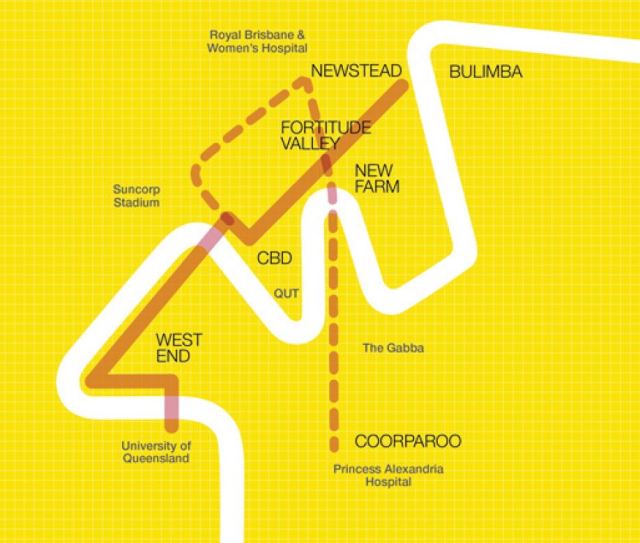
Brisbane Labor Mayoral candidate Rob Harding's light rail plan (source Rob Harding media release)

Brisbane Labor Mayoral candidate Rob Harding’s light rail plan (source Rob Harding media release)

Sunshine Coast (Qld): Tony Gibson and the Greens team for the upcoming council election have committed to an extensive public transport program, including stage 1 of a light rail from Maroochydore to Kawana Hospital/Town Centre, improved bus services, a “smart roads” strategy and lobbying for heavy rail duplication between Beerburrum and Nambour, and a heavy rail link into Maroochydore.

Central Coast (NSW): While NSW councils are not due for for six months – and may yet be delayed for amalgamating councils – light rail has emerged as a future election issue for a future Central Coas Council formed from the merger of Gosford and Wyong Councils.

According to a local media report, current Wyong mayor Doug Easton has released a light rail plan which would link Gosford to The Entrance, with stops at East Gosford, Erina, Terrigal, Wamberal, Forresters Beach, Bateau Bay and Long Jetty.

Wyong Mayor Doug Eaton 's Central Coast light rail plan (source News Ltd)

Wyong Mayor Doug Eaton ‘s Central Coast light rail plan (source News Ltd)

“Light rail has come back into its own over the past 10 years”, Clr Easton said..

“Sydney is now putting it in from the city out to Randwick, and the Gold Coast has only recently put it in, and it’s going very well.”

“Light rail is not just great for locals, but it’s also fantastic for tourists”.

NZ government and Auckland Council agree on key transport issues

The New Zealand Government and Auckland Council have released a joint report on transport issues which has been hailed by Mayor Len Brown “as a giant step forward in agreeing Auckland’s transport investments for the next 30 years”.

The Mayor claimed that the Foundation Report from the Auckland Transport Alignment Project (ATAP) shows that the government and Auckland Council already have “a high level of agreement” on the key issues future investment must address to meet Auckland’s transport needs.

“It is clear that the views between the council and the government are extremely close in thinking,” Mr Brown said.

The Foundation Report outlines current and future transport challenges for the region and is the outcome of the first stage of the project which will agree on how the transport system needs for Auckland are developed.

The Mayor conceded that for decades council and the government had “bickered” about the city’s transport issues, “but no more” as council was now “working well” with government.

“We have a shared interest to maximise value for money across all forms of transport investments throughout Auckland,” Mr Brown said.

The mayor said that with national government support for the City Rail Link, the completion of the first stage of the alignment project meant that a “common view of Auckland’s transport future” could be delivered by August.

“Then we will be able to conclude the five years of work on alternative transport funding sources by reaching agreement with the government. ATAP represents the removal of the final hurdle for bridging that $12 billion transport funding gap,” the mayor concluded.

Why has private car modal share remained so high despite new public transport investment?

The Urbanist commentator Alan Davies has questioned the efficacy of public transport projects in reducing private car use in Australian cities.

Using federal Bureau of Infrastructure, Transport and Regional Economics (BITRE) statistics he claims that despite a drop in per capita driving rates, public transport usage in Australia’s five largest capital cities “has been depressingly low for decades, while private travel (essentially cars) continues to dominate”.

Davies examines a number of planned rail projects in Sydney and (predominantly) Melbourne, claiming that for a variety of reasons – mainly because they will provide a substitute for existing bus services – they will do little to improve public transport mode share.

Davies acknowledges that most of these projects “are worthwhile improvements” in their own right but asks why they have such little impact on mode split. He concludes that in part this is because these projects predominantly service the CBD where public transport already has a high modal share, but mainly because of the increasing suburbanisation of the population and jobs in Australian cities outside the CBD – and also because only 20% of trips are for journey to work purposes.

He claims that while “Australian cities can and should have modest but effective metro-style systems that work with our low density cities”, much stronger policies are required “that actively suppress the competitiveness of private vehicles relative to public transport”.

He concludes that “unless we’re prepared to take road space and traffic light priority away from cars so that buses and trams aren’t caught in traffic, it’s doubtful Australian cities can achieve even a modest increase in the mode share of public transport.”

Development, Transport and Infrastructure Projects/Services

Light Rail/Tram/BRT

NSW Premier locks in support for Newcastle light rail despite bidder’s misgivings

The Newcastle Herald has revealed that the project manager for one of the companies bidding for the Newcastle light rail project has expressed misgivings regarding the suitability of light rail for a city the size of Newcastle, at least in the form being proposed.

The reservations expressed by Mr Laurent Offroy also raised questions about the small size of the current project and urged that it be extended.

The NSW Premier Mike Baird has defended the project, saying “light rail is non-negotiable”.

“We could just have ran buses down Hunter Street, and from a purely economic point maybe that would have been easier, but we didn’t want to do the easy thing.

“Newcastle is one of our largest cities and it should have a transport system that reflects that.”,” he said, indicating he would consider extending the 2.5 km line “spine” once it is completed.

An indication that the government intends to progress with the project is the call for tenders by Transport NSW for two project managers to help oversee the project. One position will manage enabling works and road services, the other procurement and delivery of the fixed infrastructure contract. The positions will involve 12 month contracts with the options of a further 12 month plus 6 month periods.

The Newcastle Herald has also reported that Hunter Labor MPs are seeking to put pressure on the government to commit to extending the planned light rail track

“While the heavy rail line should have never been torn up, it is important to hold Mike Baird to account over his promises regarding the light rail project proposed for Newcastle, and part of that is ensuring that improved transport links are part of the current plan,” Wallsend MP Sonia Hornery said.

“Extending the light rail proposal from inner city Newcastle to the suburbs is vital to the long-term sustainability of the region … an expanded light rail project has the potential to bring thousands of jobs to our region.”

Temporary diversion of Anzac Pde for construction of Sydney light rail

Minister for Transport and Infrastructure Andrew Constance has announced that work will start in April to build a temporary six-lane road adjacent to Anzac Parade between Lang Road and the Albert Tibby Cotter Bridge to be used by traffic while a tunnel for the CBD and South East Light Rail (CESLR) is being built.

The Minister has claimed that this approach will drop the construction time of the tunnel to less than one year and reduce the impact on traffic using the road.

“Originally we were going to build the two sides of the tunnel in separate phases, which would have taken at least 16 months, but this new plan reduces the duration of inconvenience to drivers significantly,” Mr Constance said.

The temporary road will be removed once the construction is completed.

SA Premier commits to tram business case following Infrastructure Australia endorsement

Premier Jay Weatherill has said the South Australian government will commit $4 million to prepare a “rigorous business case” for the construction of the AdeLINK tram network after it was identified as a priority project by Infrastructure Australia this week (see earlier item and TSW9).

AdeLINK, part of the state government’s Integrated Transport and Land Use Plan, identifies five new tram corridors and a sixth which incorporates the current Glenelg line.

“On Wednesday, Infrastructure Australia listed our new tram network for Adelaide as a priority project, and today, we are committing to fund a detailed business case,” Mr Weatherill said.

“This work is about ensuring AdeLINK is ready to be funded, and we will be working with the Commonwealth Government and local governments to help us advance this exciting public transport project.”

Call to extend planned Canberra light rail line

The Canberra Times has reported that ACT Chief Minister Andrew Barr is lobbying both the federal government and the opposition to commit to making a cash contribution to extend the city’s planned city to Gungahlin tram to the Russell defence precinct.

According to the paper Mr Barr said the 3.2 km extension was not dependent on federal funding but that a contribution was warranted given the area was dominated by public service employment. It would involve three extra stops and about 5,600 extra trips a day, boosting patronage by 30%.

“The Commonwealth is a major beneficiary because they own most of the land. That’s why the Prime Minister invited me to put forward a proposal while we’ve undertaken some modelling looking at land uplift for them,” the paper quotes Mr Barr as saying.

“This is exactly the model that he’s talked about in terms of infrastructure funding.”

Metro

High-rise development tenders issued for Sydney Metro station airspace…

The NSW government has issued tenders for the provision of design services for six new station sites on the planned Sydney Metro City and Southwest requiring “Over Station Development”

Fairfax reports that the tender documents involve the design of high-rise towers at Martin Place, Pitt Street and Barangaroo in the city, Waterloo in the inner east, Victoria Cross in North Sydney and Chatswood..

The tender summary states that the design team Service Provider “shall provide architectural and multi-disciplinary specialist design services as required for up to two of the of six proposed over station developments, working alongside other design team services providers serving the remaining sites.

“Tenderers may bid for up to all six sites but a maximum of two sites will be awarded to any one team.”

… as designs are released for Sydney NW Metro stations

The NSW government has unveiled two life-size station models, an underground station and above-ground concourse, which have been built for official testing for the Sydney Metro North West.

NW station design

Life-size station model for the Sydney Metro NW (source: Sydney Metro website)

‘We’re taking Sydney’s new metro stations out for a test drive to make sure we deliver the best experience possible for commuters – it’s another example of making sure our customers are at the centre this project,” NSW Transport Minister Andrew Constance said.

“These prototypes are a valuable development tool in finalising station designs and have been used in other major infrastructure projects like Crossrail in London.”

Key customer features showcased by the prototypes include sample platform screen doors, working Opal gates and machines, escalators and lifts, station and platform security cameras, video help points, toilets, as well as paving finishes, lighting  and other design elements.

Urban Heavy Rail

Vic Premier seeks federal funding for Melbourne Metro with a “compelling” business case

The Victorian government has released the business case for the Melbourne Metro with the Premier Daniel Andrews writing to Prime Minister Malcolm Turnbull to seek federal funding.

According to a media statement from the Premier, the business case has also been submitted to Infrastructure Australia, which had previously provided a positive assessment of the project and categorised it as a high priority.

The updated business case claims that the $10.9 billion Melbourne Metro would deliver a benefit of $1.10 for every dollar invested – or $1.50 when including wider economic benefits. It would also give the train network the capacity to carry 39,000 extra passengers in the peak and will create up to 4,700 jobs during construction.

The government has already committed $4.5 billion to the project and is seeking a matching $4.5 billion commitment from the federal Government.

“The business case for Melbourne Metro stacks up and we’re getting on with building the transport projects that Victoria needs,” the Premier said.

“Victorian tax dollars should be paying for Victorian projects. There are no more excuses – it’s time for the Prime Minister to show his commitment to public transport, and to Victoria.”

In an opinion piece in The Age, Josh Gordon assess the likelihood of the Prime Minister Malcolm Turnbull agreeing to the Premier’s request. Gordon notes that this project has a much stronger case than the ill-fated East West Link and that funding the metro project would also be able to answer claims Victoria has been “badly short-changed by the Commonwealth on infrastructure”. Doing so might also assist the government politically in the run-up to the next election.

He concludes however that the “parlous state” of the federal budget would make agreement to provide the full $4.5 billion unlikely and that while the federal government may provide some funding it is likely to fall short of this total.

… as Melbourne Metro project attracts market interest

The Victorian Treasurer Tim Pallas has claimed that the Melbourne Metro project has attracted strong field of expressions of interest from Australian and overseas companies.

A total of 44 organisations from 11 different countries have formally registered their interest in the largest package of works which includes construction of two nine-kilometre rail tunnels and five underground stations, as well as financing, operating and maintaining this infrastructure.

According to the Treasurer additional works will be delivered through separate procurement packages, including relocation of existing services, reconfiguration of existing tracks and signalling upgrades.

In a separate statement Minister for Public Transport Jacinta Allan announced the three bidders short listed for the next phase of the Melbourne Metro Early Works package tender process.

These works include the relocation and protection of underground services such as gas, sewer and water mains, the relocation of trees and other road features and the design and construction of access shafts.

The companies selected were

  • CPB Contractors (formerly Leighton Contractors)
  • John Holland KBR JV – comprising John Holland Group and KBR, Inc (formerly Kellogg Brown & Root)
  •  Lend Lease Coleman Rail JV – comprising Lend Lease Engineering and Coleman Rail Pty Ltd

“Today’s shortlist announcement paves the way for formal proposals and contract award by the middle of the year, the start of early works in 2017 and major construction in 2018,” the minister said.

Benefits of Auckland City Rail Link questioned amid claims that rail system needs an extra $1.4 bn

According to media reports the Auckland rail network requires a further $1.4 billion in upgrades over and above the $2.5b to be spent on the City Rail Link (CRL) for the system to hit “maximum potential”.

Auckland councillor George Wood claims that at a council infrastructure committee meeting last September a KiwiRail presentation indicated that about $400m would be needed prior to the CRL opening to upgrade the wider rail network.

On top of that, between $500m and $1b would be needed after completion of the CRL.

Meanwhile Radio NZ has pursued a freedom of information request to obtain documentation relating to the timing of the government’s contribution to CRL. One of the documents obtained is a heavily-redacted NZ Treasury report on the proposal for an early commitment which indicates that the total project cost is likely to be $2 to $3 billion (p.5).

More significantly the document while acknowledging that Auckland Council places considerable importance on the CRL as a “city-shaping project”, claims that its economic case is “not strong”, based on joint work conducted by the council and government some years earlier.

As a result the report states that “Treasury and the Ministry of Transport consider that the likely benefit to cost ratio for the project would be somewhere between 0.4 and 0.9” and that it would have only a “modest” impact on Auckland’s congestion. The rationale for this argument has been redacted from the report however and it is also unclear whether the cost benefit estimate was based on the current project or an earlier proposal.

Perth airport rail link contractor selected

Western Australian Transport Minister Dean Nalder has announced that “an unincorporated joint venture”, comprising Salini Impregilo S.p.A. and NRW Pty Ltd, has been selected as the “preferred respondent” to deliver the main works for the Forrestfield-Airport Link.

Negotiations to finalise the contract by May 2016 will now begin between SI-NRW JV and the Public Transport Authority of Western Australia.

“We envisage the contractor will mobilise on site in the coming months,” Mr Nalder said.

“This is an incredibly exciting time for a project that will change the way the people of Perth, and in particular Perth’s eastern foothills, travel to our city.”

Rail: HSR, Regional, Freight, Other

Real time data extended to NSW regional transport services

NSW Minister for Transport and Infrastructure Andrew Constance has announced that regional users will be able to access real-time information for regional train and coach services.

“The data will be available across eight transport apps, providing regional customers with the most up to date information currently available, with train updates recorded every 30 seconds and coach services every few minutes” Mr Constance said.

“For the first time regional customers will have access to the same information about their services as our metropolitan customers, and as Future Transport progresses, there will be more improvements on the horizon for regional customers.”

According to the Minister’s statement, NSW TrainLink users will be able to access real-time information for North Coast, North Western, Southern and Western regional train and coach services. The data will also be available for the South Coast line between Kiama and Bomaderry and the Blue Mountains, Hunter and Southern Highlands lines.

V/Line trains – 1,000 wheels still need to be fixed

According to media reports the Interim CEO of V/Line Gary Liddle told a Victorian parliamentary hearing on Tuesday that more than 900 train wheels on VLocity railcars still need to be repaired or replaced.

The repairs are being carried out because of the detection of excessive wheel wear on the Victorian regional trains (see TSW6).  Mr Liddle indicated that 252 VLocity wheels had been replaced so far, but 420 still had to be replaced and a further 488 would be relathed.

V/Line has also replaced 800 metres of track on the North Melbourne flyover which had been in use for just 18 months (see TSW9). Buses are still supplementing V/Line services, with full services not expected to resume until late June.

Transport: other

Better services and new buses for south Auckland

Auckland Transport has announced that South Auckland residents will get more bus services when new contracts come into effect later this year.

The new contracts being signed between Auckland Transport and a number of bus companies will also be delivered for $3.1 million less cost. In addition a “new fleet of state-of-the-art, low-emission buses” and new standards of service will be introduced.

According to the statement bus users will also see a 21% increase in hours of operation and a 15% increase in kilometres covered by the services. Despite being provided by different companies, all the buses will appear in the AT Metro livery.
Posted in Infrastructure, Local Government, Planning, Public Transport, Sydney metro area, The Strategic Week, Transport, Western Sydney | Tagged , , , , , , , , , , , , | 1 Comment

The Strategic Week (no. 9, Thursday 18 February 2016) – the week in governance, planning, infrastructure and transport

Governance

The new Federal ministry – a gain for Transport but is it a downgrade for Cities?

The Prime Minister Malcolm Turnbull announced a major reshuffle of the Federal ministry on 14 February. Among the changes particularly relevant to cities, infrastructure and transport, the Infrastructure and Regional Development Ministry previously held by retiring Deputy Prime Minister Warren Truss has been split.

Senator Fiona Nash has been appointed Minister Regional Development and Darren Chester MP Minister for Infrastructure and Transport – the latter portfolio not specifically allocated in the outgoing ministry. Paul Fletcher MP retains his ministry but the order of portfolios has been reversed – now he is responsible for Major Projects, Territories and Local Government instead of the other way around. Greg Hunt remains as Minister for the Environment.

While Transport has been given a place in the new ministry the Cities portfolio seems on the surface at least to have suffered a demotion. In the initial Turnbull Ministry there was a degree of fanfare around the appointment of Jamie Briggs as Minister for Cities and the Built Environment, only for him to resign three months later following a late night incident in a Hong Kong bar.

The new ministry no longer has a stand-alone Cities portfolio but instead an Assistant Minister to the Prime Minister for Cities and Digital Transformation, Angus Taylor MP. Echoing criticism from Labor politicians, Malcolm Farr claimed that the PM had “suddenly downgraded the concern he once offered to the millions of voters struggling with big city life”, noting that Mr Taylor “who now will be tending to issues affecting 15 million Australians residing in capitals, has his office 200km into the bush in the seat of Hume” and that he also has to look after “digital transformation”.

Alan Davis put the counter argument, noting that the previous Cities minister had been in the outer ministry with limited powers and budget, inviting “the suspicion it was a largely powerless institution designed for looks rather than action.”

He went on to note: “Cities policy now falls under the direct responsibility of Mr Turnbull, who as well as being Prime Minister is chair of Cabinet. He’s well placed to shape the agenda for cities policy, the pace of change, and coordination with other portfolios. He won’t have to negotiate with a senior Minister and a junior Minister anymore.”

Sian Johnson backed that view, noting the PM’s claim that the cities portfolio had “in reality been promoted.”

“Because it has a whole of government impact, it really needs to be in the central agency, the most important agency in the government, which is, of course, the Prime Minister’s own department,” Turnbull is quoted as stating.

First district appointments to Greater Sydney Commission

The NSW Planning Minister Rob Stokes has announced the names of four of the district commissioners who will represent local communities on the Greater Sydney Commission (GSC).

The appointments were nominated by the councils which comprise four of the six of the planning districts established as part of the GSC structure. Most of initial appointments are familiar faces in the NSW planning scene; Dr Deborah Dearing has been appointed North District Commissioner, Ms Maria Atkinson Central District Commissioner, MrSean  O’Toole West District Commissioner and Professor Edward Blakely West Central District Commissioner.

“These men and women are renowned experts in their fields and I look forward to partnering with them and their communities to make sure that, as Sydney grows, the public reaps the benefits of that growth,” Mr Stokes said.

“For the first time, the local districts of Sydney will have a seat at the table during major planning and infrastructure decisions. By working together, we can ensure our planning decisions make people’s lives better now and into the future.”

The Minister said that appointments were yet to be finalised for the South and South West districts.

NSW council mergers – consider Queensland’s mistakes say former ministers…

Two former Queensland government Ministers, David Crisafulli and Simon Finn, have stressed that data is the “key to community support” in a report prepared for the Glentworth consulting firm which reflects on the amalgamation experience in Queensland .

They claim that the case for amalgamation was based largely on an economic assessment which stressed economies of scale – but that this approach “risks inadequate consideration of the closeness of local governments to their communities or the direct impacts that these reforms can have on the provision of services”.

In their view, arguments for council amalgamation should be based instead on efficiencies that “provide tangible benefits to the community, such as lower rates and improved services” which also contribute to community cohesion, noting that the greatest resistance to amalgamation came from smaller communities fearful at the loss of services and a local voice. These fears were realised when local customer service centres were closed.

“While the economic assessment made sense, the changes immediately impacted on the proposition of a united region and sowed the seeds for ongoing distrust of the new Queensland local governments,” the authors state.

While they stress that some amalgamations “must happen” as small council areas “do not make sense in the long term”, they say the process “must involve more than just an economic rationalist argument”.

“Economic benefits derived by amalgamation need to be realised over the long term, not the short term. Local governments should not seek to realise economic benefits immediately at the expense of creating a new cohesive community. There will be no long-term economic benefits if the communities are ungovernable because of division”, Crisafulli and Finn conclude.

… while the bush says mergers are all about the city…

Meanwhile Snowy River Shire Mayor Clr John Cahill, has claimed in an media report that there is a widespread view that the NSW council merger process is “really all about Sydney and that rural communities should be left alone.”

Speaking after community consultations about the proposed merger of Bombala, Cooma-Monaro, and Snowy River Shires, Clr Cahill said that the government’s rejection of proposals to remain independent meant that the three councils “had no practical choice but to accept the Government’s merger recommendation.

“We would receive no further grants, and we wouldn’t be eligible for loan funding. That’s the life blood. That goes some way between what we receive in rates and what expenditures are,” he said.

Clr Cahill dismissed claims that the merger would result in savings of “more than $13 million in net financial savings over 20 years” as “nine-tenths of bugger-all”

“I think they’ve determined that they’re going to do this in the city. But the bush is quite different,” Clr Cahill said.

… but will they result in full-time councillors?

An article in Government News has suggested that the NSW council mergers could have one side-effect – the emergence of full-time councillors.

“With the dawning of a new age of super councils looking increasingly likely, those councillors left standing from the state’s 1,500 councillors will represent a much greater number of ratepayers – up to three or four times as many – and cover a larger geographical area. They will also need to be across a lot more issues”, the article notes.

Local Government NSW President Keith Rhoades is quoted as indicating that councillors were currently underpaid and that there had been “absolute silence” from the government about whether councillors would be paid more if the mergers progressed.

Centre of Excellence for Local Government (ACELG) and the UTS:Centre for Local Government Director Associate Professor Roberta Ryan said she could see “both sides of the debate.”

“It’s not about councillors having the skills to run a council,” Ms Ryan said. “Their role is to be strategic and to reflect the ambitions and desires of their community, to be able to account for what happens and get involved in the strategic planning. It’s not their job to manage the organisation on a day-to-day basis.”

Local Government Act reviews underway in three states

In a rare coincidence three states – NSW, Tasmania and Victoria – are currently undertaking reviews of their Local Government Acts. The three reviews are not linked however and are at different phases:

NSW

In 2012 the then NSW Minister for Local Government appointed a Taskforce to review the Local Government Act 1993 and the City of Sydney Act 1988. The Taskforce looked at ways to modernise the legislation, to ensure that it would meet the future needs of councils and communities.

The Taskforce completed its work in late 2013 and its final report and recommendations were exhibited for public comment in early 2014. The NSW Government delivered its response to the Taskforce recommendations in September 2014.

The government supported the bulk of the Taskforce recommendations and has decided to proceed with the development of a new Act through a phased process. Phase 1 will strengthen the local government system, “supporting councils to connect with their communities and build their capability”. In particular it will clarify roles and responsibilities of councillors, mayors, administrators and general managers, introduce new guiding principles and improve the standard of governance. The government is seeking feedback via a survey form.

Tasmania

Tasmanian Minister for Planning and Local Government Peter Gutwein has announced a “targeted review” of the state’s Local Government Act 1993, referring to “current community concern over how some councils are managing their affairs”

The Minister said the review would be undertaken by a Steering Committee  chaired by the Deputy Secretary of the Department of Premier and Cabinet Rebekah Burton, with representatives from the Department’s Local Government Division, the Local Government Association of Tasmania and the Local Government Professionals Australia (Tasmania).

“This targeted review of the Local Government Act will ensure the legislative framework for local government is effective and efficient, with a focus on governance improvement,” the Minister said, indicating that he wanted “everyone interested in local government to have their say and be consulted”.

A discussion paper will be released based on the review, with any resulting amendments to the Act to be introduced to Parliament by May 2017. Further information on the review can be found here.

Victoria

The Victorian Government is conducting “the first comprehensive review of the Local Government Act 1989 in a quarter of a century”. This review has arisen partly because of the impacts of hundreds of amendments made to the Act as a result of other legislation and as a result consideration will be given to “all other legislation for which the Minister for Local Government has responsibility”.

A discussion paper was prepared for which submissions closed in December 2015. All submissions are available online along with a series of background papers:

Further opportunities to participate in the review will be provided throughout 2016 including online input and a series of community forums. In addition people will be able to make a submission regarding a Directions Paper to be released later this year. “This review provides us with the opportunity to refresh the role of local government in Victoria – and the relationship between councils and the state government,” Ms Hutchins said.

The Minister for Local Government Natalie Hutchins has urged all Victorians to become involved.

It should be noted that while they obviously focus on the Victorian reforms all the discussion papers and in particular the one prepared by Graham Sansom contain material that would be relevant in other jurisdictions.

Planning: Policy/General

Report paints mixed picture of growth in Australia’s cities and regions

SGS Economics and Planning (SGS) has released a report which has used ABS national and state accounting data to develop estimates of economic activity for each major capital city, along with the regional balance of each state.

SGS states that the statistics provide “improved insights into the relative economic performance of each of Australia’s major capital cities (Sydney, Melbourne, Brisbane, Adelaide and Perth), the Northern Territory, Tasmania and the Australian Capital Territory. They also highlight the productivity challenge facing our cities.”

In 2014/15 the strongest growing regions were the Northern Territory (10.5%), Regional Western Australia (7.5%), Melbourne (3.%) and Sydney (3.0%). The other regions mostly experienced below-average growth with regional Queensland growing by only 0.1% and regional Victoria 0.3%.

In the longer term the statistics highlight the consistent contribution of Sydney and Melbourne and the “variable contributions of the resource-reliant economies of Western Australia and Queensland”.

The report notes that Sydney has traditionally been a “significant driver of Australia’s economy”, a position it ceded to Melbourne in the 2000s. However Sydney has resumed its leading role “accounting for 25.2 per cent of growth since 2010, and 30.3 per cent in the most recent year.” Meanwhile Melbourne has become increasingly important to Australia’s economy, “demonstrating its successful transformation from the ‘rust belt’ economy of the late 80s to the diversified economy of today”.

The data also shows the impact of recent resources boom on Australia’s regional economies. For example both Perth and Western Australia grew strongly in the 1990s and up until the 2010s. However the economies have diverged in 2014/15, with Perth’s growth falling to 2.1% but Regional Australia accounting for 23.7% of GDP growth. “This signifies the transition of mining in Western Australia from a construction phase to production, with new mine development curtailed by recent steep falls in commodity prices.”

Planning: Region/Area/Project

Golf course to become new Sunshine Coast CBD

Queensland Premier Annastacia Palaszczuk has turned the first sod on a project to develop a new central business district (CBD) for the Sunshine Coast.

The project is forecast to create more than 30,000 jobs by 2040 and boost the Queensland economy by $5.9 billion

“SunCentral is designed to cater for growth in the region. The Sunshine Coast region’s population is expected to grow from 335,800 people to half a million by 2040,” the Premier said.

A 53-hectare CBD development on a former golf course in Maroochydore, an urban centre on the Sunshine Coast, is on its way to being realized after work began on the site late last week.

The 53-hectare project, SunCentral, will be developed on a former golf course and is being touted as a “smart city.” More than 40% of the 53-hectare site will be parklands and waterways and it will feature a number of innovations such as Australia’s first underground pneumatic waste system and the digital management of streetlights, car parks, power and signage.

Calls to abandon Powerhouse Museum move provoke Western Sydney response

A community campaign calling on the NSW government to abandon its plans to move Sydney’s Powerhouse museum from Ultimo to Parramatta has gathered support from some high-profile inner-city residents.

According to media reports, a coalition of MPs and museum experts has been joined by actress Cate Blanchett, her director husband Andrew Upton, former Art Gallery of NSW Director Edmund Capon and former NSW Premier Bob Carr in signing a petition calling for the planned move to be scrapped. The petition which has attracted over 10,000 signatures will now be debated in state parliament.

In an open letter published in the Sydney Morning Herald some of the signatories have called on the Government to reconsider its plans.

“We support the creation of a distinctive ‘cultural beacon’ in Parramatta, but to transport a small-scale Powerhouse would be folly,” the letter reads

The campaign has met with strong opposition in Western Sydney. According to a media report the letter has been called “elitist” by Parramatta Liberal MP Geoff Lee and an “up yours to Western Sydney” by Sydney Business Chamber Western Sydney director David Borger.

Western Sydney Regional Organisation of Councils (WSROC) President Tony Hadchiti also criticised the campaign as “ridiculous”.

“Suggestions that moving the Powerhouse to Parramatta would weaken its undisputed skills and potentially damage exhibitions is, quite frankly, insulting to both the museum’s staff and the arts and cultural professionals of western Sydney,” he is quoted as saying..

“If the Powerhouse were to open further satellite sites, we should be looking at places further afield such as Blacktown, Liverpool, Penrith or the Blue Mountains, all of which have well established arts cultures.”

Infrastructure: Policy/General/Funding

Infrastructure Australia releases 15-year plan…

Infrastructure Australia (IA) has released a 15-year infrastructure plan.

According to the organisation the first Australian Infrastructure Plan “provides a positive reform and investment roadmap for Australia”. It outlines the infrastructure challenges and opportunities Australia faces over the next 15 years and the “solutions required to drive productivity growth, maintain and enhance our standard of living, and ensures our cities remain world class.”

Releasing the plan the organisation’s Chair Mark Birrell said Australia can get the infrastructure it needs and improve living standards and productivity, “if it acts now to introduce nation-shaping reforms”.

The Plan recommends reforming the funding and operation of transport infrastructure, completing the national electricity market, improving the quality and competitiveness of the water sector and delivering a telecommunications market that responds to user demand. IA claims that as a result the average Australian household would be “almost $3000 better off each year by 2040.”

“Our Plan sets out 78 recommendations for reform and provides a vision and roadmap to address today’s infrastructure gaps, and set us up to meet the challenges of tomorrow,” Mr Birrell said

Alongside the Plan is IA’s “reinvigorated” Infrastructure Priority List which identifies 93 projects and initiatives with a heavy emphasis on transport infrastructure, including new metro rail systems in Sydney, Melbourne and Brisbane, road and rail initiatives for Perth and public transport improvements in Adelaide and Canberra.

In addition a number of proposals are described as “initiatives for the future” including protection for proposed High Speed Rail corridors and new ring roads around Melbourne and Sydney.

In a media release in response Shadow Minister for Infrastructure and Transport Anthony Albanese said Labor welcomed the updated infrastructure priority list.

“The report’s recommendations, if followed, would restore the proper process followed by the former Labor Government, which required IA to assess value for public money in major projects before they received government funding,” Mr Albanese said, claiming that the government had “marginalised Infrastructure Australia” by cutting the organisation’s budget and leaving it without a chief executive for more than a year.

See the Transport section below for further information on the public transport-related projects in the IA list..

 … while Uni initiative calls for “better infrastructure”

The John Brill Centre for Project Leadership at the University of Sydney has released a paper by its director Garry Bowditch titled Re-establishing Australia’s Global Infrastructure Leadership.

The paper introduces the “Better Infrastructure Initiative” which is described as “a call to action for Australia and the world to maintain momentum for infrastructure development, while adapting to a more connected, congested and contestable world.”

The report claims that “private capital and ingenuity are vital to further public infrastructure” provided there is a greater commitment “to better public governance standards that invite innovation and value for money consistent with community standards”.

The paper proposes 10 recommendations, with the first capturing its overall philosophical direction:

“Better infrastructure service provision for all Australians, rather than just more infrastructure, is the key to more community acceptance, value for money and in turn help to re-establish Australia’s global infrastructure leadership.”

Transport: Policy/General/Funding

IA report highlights urban transport priorities

As noted earlier, the recently-released Infrastructure Australia (IA) list has a strong emphasis on urban transport and in particular urban public transport.

The introduction notes:

“The Infrastructure Priority List is designed to give structured guidance to decision makers, visibility to industry and transparency for the community. It is a ‘rolling’ list which will be updated periodically as proposals move through tages of development and delivery and to respond to emerging challenges and opportunities.”

The list includes items which range from the description of a problem through to “ully developed solutions”. To deal with this the list contains two broad groupings:

  • Initiatives: priorities that have been identified to address a nationally significant need, but require further development and rigorous assessment to determine and evaluate the most appropriate option for delivery; and
  • Projects: priorities that have undergone a full business case assessment by Infrastructure Australia and that will address a nationally significant problem and deliver robust economic, social or environmental outcomes.

While only two projects are listed as high priority projects (CityLink-Tullamarine Widening in Melbourne and Perth Freight Link), there are around 30 high priority Initiatives, of which over half are classified as addressing urban congestion. While road projects such as WestConnex are represented, a significant number are public transport initiatives.

The high priority public transport initiative list includes:

  • Sydney: Sydney Metro, Northern Beaches bus rapid transit, southern Sydney to CBD public transport enhancement;
  • Brisbane: Cross River Rail;
  • Adelaide: Gawler Line upgrade;
  • Melbourne: Cranourne-Pakenham rail line upgrade and level crossing removal, Melbourne Metro Rail.
Proposed Green Square Light Rail Route (source: SMH)

Proposed Green Square Light Rail Route (source: SMH)

Transport: Light Rail/Tram/BRT

Canberra community to have input on integrating light rail, public transport

New ACT Minister for Transport and Municipal Services Meegan Fitzharris has said that the community will be given an opportunity to provide input on how to improve Canberra’s public transport network before of the introduction of Transport Canberra on 1 July.

The Minister announced that the ACT Government will undertake an extensive survey to obtain community feedback on the current public transport network, and seek input to inform the future design and delivery of an integrated bus and light rail system.

“Transport Canberra is coming and we want to know how we can make sure it meets the needs of our growing city,” Minister Fitzharris said.

“This new agency will be founded on a strong customer service focus with a goal of winning new public transport customers. So it’s vital we develop a good understanding of what customers want and how they would like to use an integrated bus and light rail system.

“A comprehensive survey will take place in April 2016 to seek feedback from current public transport users and non-users to identify how to best improve Canberra’s public transport system so it becomes more convenient, efficient, affordable and reliable”, she said.

Question over funding for Auckland light rail proposals

According to media reports Labour’s candidate for the Auckland Mayoralty in the upcoming elections Phil Goff has started his campaign by stating that he will “make it his mission to bring light rail to the city” should he become mayor.

He said a line from the Wynyard Quarter, up Queen Street, Symonds Street and down Dominion Road would be a priority in dealing with the city’s congestion which the Productivity Commission estimates to cost the New Zealand economy $1.5 billion a year.

Mr Goff suggested some form of road charging such as a petrol tax, tolls or congestion charges could be used to raise revenue for transport and encourage a change of travel modes.

“We cannot pretend that there is some magic way of funding infrastructure that doesn’t impose any costs on anyone.

“We will need to look in part to private sector options. No funding has been set aside for light rail, for example. Without government funding, a public-private partnership will be necessary if light rail is to finally become a reality,” Mr Goff said.

Transport: Rail

WSROC questions how high speed link to airport would serve Western Sydney

Western Sydney Regional Organisation of Councils (WSROC) President Clr Tony Hadchiti has welcomed serious consideration of the proposed high-speed rail line to Badgerys Creek (see TSW7) , but says the organisation needs further detail on how the line will serve Western Sydney commuters.

“We are always excited about better public transport for Western Sydney, however any proposed line needs to serve everyday commuters as well as those travelling to and from Badgerys Creek”, Clr Hadchiti said.

“We would need to see further detail on this proposal and the alternative options before offering our support; particularly regarding the route west of Parramatta.

“If the only stops west of Parramatta are Westmead, Sydney Business Park and Badgerys Creek, this leaves little room for Western Sydney workers to access the service and therefore offers very little commuter benefit,” he said.

“WSROC looks forward to hearing further details on this project and any other proposal under consideration by the Minister.”

Track replaced to resolve V/Line wheel problem

According to media reports hundreds of metres of track used by V/Line VLocity trains on rail flyovers between North Melbourne and Southern Cross Stations has been replaced in an attempt to fix the wheel wear problem that has severely disrupted regional train services on Victoria (see TSW7).

Further sections will be replaced in the coming weeks. Interim V/Line chief executive officer Gary Liddle said the track replacement is to ensure both the track and the train wheels will be in top shape when the trains are repaired.

“The emphasis is on getting that track back in good condition as we’re putting the good new wheels on,” he is reported as saying.

“We’re making sure we’re lubricating the edges of the track, so where it touches the wheels we don’t get that accelerated wheel wear.”

Posted in Local Government, Planning, Sydney metro area, The Strategic Week, Western Sydney | Tagged , , , , | 1 Comment

The Strategic Week (no. 8, Thursday 11 February 2016) – the week in governance, planning, infrastructure and transport

Governance

Federal opposition calls for Cities Minister replacement

Federal Shadow Minister for Infrastructure and Transport, Cities and Tourism Anthony Albanese has called on the Prime Minister to appoint a new Minister for Cities to replace Jamie Briggs who resigned recently (see TSW4).

Mr Albanese said that Mr Turnbull should make the appointment quickly “if he is serious about his claim to want to champion the productivity, sustainability and liveability of the nation’s cities”

Mr Albanese called on the PM to place the position in the infrastructure and regional development portfolio, rather than the environment portfolio. He also claimed that Mr Turnbull had “done nothing concrete on urban policy” and that he had failed to reverse former PM Tony Abbott’s refusal to fund major public transport projects.

Mr Albanese concluded that the complexity of urban issues in Australia “requires a Minister for Cities who is placed within the right department and given enough clout to work with other ministers and other levels of government.”

 Criticism of KPMG NSW council merger report continues while LGA calls for single election date

State Greens MP David Shoebridge has accused the NSW government of refusing to release “25 secret reports” on the costs and impacts of proposed local government mergers.

He notes that in response to a FoI application the “Department of Premier and Cabinet have refused access to KPMG’s business case, financial modelling and impact analysis, as well as 20 separate documents authored by KPMG analyzing “he financial impacts of council mergers”.

“An honest government would give the community these documents so they could see for themselves just how much forced amalgamations will cost and put to proof the government’s unsupported claims that they will save money,” Mr Shoebridge said.

“Almost certainly the documents they are hiding, including the business case and 20 KPMG reports on forced mergers, show that ordinary residents will be paying more, and getting less, if these mergers go ahead.”

Meanwhile according to an SMH report the Local Government Association of NSW has urged the state government to hold elections for merging and non-merging councils on the same day, based on the responses to a survey involving 84 mayors.

NSW Premier Mike Baird had earlier indicated that the merger process might mean that the election date for affected councils may have to be moved from September 2016 to March 2017. The Minister for Local Government Paul Toole is quoted as responding to the LGA’s request by stating that non-merging councils should still prepare for an election in September this year.

Planning: Policy/General

Major parties outline urban concerns at Living Cities Workshop

Speakers from federal government, the opposition and the Greens have used the opportunity of the Living Cities Workshop organised by the Australian Institute of Landscape Artists to raise key issues in relation to the development of Australian cities.

The workshop which was held in Parliament House also involved a range of industry representatives developing an Action Plan and Report to the federal environment department to provide input to the Government’s Cities Policy Forum Position Paper and Summit to be released later this year (see also TSW5).

According to a statement about the event, “the Living Cities Alliance announcement will call on key organisations working across all urban planning, infrastructure, utilities and greening sectors to join the alliance to unite in providing a consultative framework to inform Government policy development, and make recommendations on target setting to make our cities greener and more liveable”.

The addresses made by Mr Paul Fletcher and Anthony Albanese are summarised in the next items. Adam Bandt’s presentation was not available at the time of publication.

Paul Fletcher address to the Living Cities Workshop

In addressing the Living Cities Workshop, (see item above) Paul Fletcher, Minister for Territories, Local Government and Major Projects noted that as well as releasing a position paper the government planned to host a National Cities Policy Forum, “bringing together leaders, experts and industry to shape a shared vision for the future of our cities”.

Mr Fletcher justified the Liberal federal government’s recent re-engagement with urban policy-making by noting that “that policies which affect our cities are policies which affect the vast majority of Australians” – given that 89% of Australians live in cities – and that “80 per cent of the dollar value of all goods and services in Australia is produced on just 0.2 per cent of our land mass”, mostly located in cities.

The Minister also noted some of the challenges involved in ensuring that Australian cities “remain liveable, accessible and productive”:

“First, effective long term planning will be critical to shaping our cities so that they deliver the economic growth needed to maintain our quality of life.

“Secondly, we need cities that support the needs of those who live, work and visit them. Smart and successful cities are underpinned by world class digital and physical infrastructure.

“Thirdly, we need sustainable, green cities with improved amenity for a more liveable environment”, Mr Fletcher said.

He then outlined some of the government’s strategies for greening cities, including the recent National Clean Air Agreement, increasing urban canopy coverage and reducing carbon emissions.

Turning to transport infrastructure he stressed its importance in underpinning the global competitiveness of major cities and urban regeneration and discussed some current options to fund major projects including the issuing of bonds and raising rates.

Mr Fletcher conceded that the sheer scale of major transport infrastructure projects “typically require at least some federal government funding if they are to proceed”. He pointed to the government’s “extensive program of infrastructure investment” but also stated that there were limits to its funding capacity. Therefore he said the government was “interested in prompting a discussion about innovative approaches to funding and financing,” including contributions from beneficiaries and value capture mechanisms.

The government also wanted to see “a more rigorous and systematic approach to assessing infrastructure projects” and to encourage “better coordination between land use and transport decisions”, the Minister said, noting that Infrastructure Australia will shortly provide the government with a 15-year Australian Infrastructure Plan. He concluded by stating that “transforming our cities will require strong collaboration across the Commonwealth, with all levels of government and with business”.

Anthony Albanese address to the Living Cities Workshop

The address by Anthony Albanese Shadow Minister for Infrastructure and Transport, Cities and Tourism to the Living Cities Workshop (see earlier item) also ranged across a number of areas relating to urban policy and noted the way in which urbanisation and in particular the design of cities was shaping people’s lives.

Mr Albanese highlighted Labor’s record in office in doubling the federal government’s roads budget, establishing Infrastructure Australia, the Major Cities Unit and the Urban Policy Forum. He noted in particular that the Labor government’s contribution to public transport funding was greater than “all other governments combined since Federation”. He went on to criticise the Coalition government’s record in dismantling some of these initiatives and then appointing a Minister for Cities “with no Budget, no department and given no job to do.”

The shadow minister praised efforts to green Australian cities, noting that as well as reducing the heat island effect, recent research suggested that greener cities made people happier and healthier and also improved productivity. He suggested that the federal government could have a role to play in “identifying and encouraging best practice, as well as facilitating and investing in its replication where appropriate across the nation.”

Mr Albanese also stressed the importance of good urban design, noting that the proposed airport at Badgerys Creek could provide “the perfect example of how this should work” and urging the incorporation of “green design” into all projects. He also called for the federal government to adopt measures to “encourage Australians to consider greener, healthier ways of getting around” and called for “a co-ordinated response addressing housing affordability, public transport and urban planning, including consideration of greater population densities along established public transport corridors.”

The shadow minister also referred to recent media reports about the threat to Sydney’s food basin from urban sprawl and rising land prices (see next item). He said that the federal government “must take a holistic approach that reflects an understanding of the diverse needs of our cities”, working with council and industry, to” determine the most appropriate response”.

Mr Albanese concluded, “in the face of climate change we must recognise that without sustainable urban design and planning at the core of each project, our cities, and the people living in them, will suffer.”

 … while Sydney’s vegetables threatened by urban sprawl

As noted in the previous item, shadow minister Anthony Albanese referred to a SMH report on the threats to Sydney’s food basin from urban sprawl and rising land prices. This draws on research conducted by the Sydney Food Futures project, which identified some of these threats and in particular the risks to perishable foods which are best grown close to their markets.

The research claims that unless there are changes, “Sydney stands to lose over 90% of its current fresh vegetable production“, with total food production shrinking by 60%. “As a result the report warns that Sydney foodbowl’s capacity to feed the city’s residents could “drop from meeting 20% of food demand down to a mere 6%”.

On the other hand the wide range of future food production scenarios developed in the research demonstrates that the current path of urban sprawl need not be “set in stone”, with “sustainable strategies and innovations that integrate food and other essential services” potentially opening up possibilities for increasing food production in the basin.

The report website notes that “creating a resilient food future for Sydney means our strategic metropolitan planning need to value and better protect agriculture from urban sprawl. Farmers and agri-businesses need viable commercial conditions, a fair price for produce, land security and a social license to operate.”

 Transport: Policy/General/Funding

NSW Transport backs innovation, encourages new apps and trials “click and collect”

NSW Minister for Transport and Infrastructure Andrew Constance has announced that he is “calling on the world’s brightest tech minds to find the next big idea that would shake up transport in NSW”.

He said that the government will host “Future Transport” – a 12 month program to “uncover the trends and technologies that will revolutionise the way the government and customers plan, build and use transport”. The program will commence with a two-day summit in April that will bring together “thought leaders, IT specialists, innovators, entrepreneurs, futurists, transport leaders and academics”. An “Industry Ideas and Innovations Lab” will also be held for companies to pitch products and ideas that could “improve transport and the customer experience”.

“This summit will be the perfect platform to ignite innovative, creative and out of the box ideas that will transform transport for the better,” Mr Constance said.

In a development related to the Future Transport initiative the Minister also announced that the makers of two major international public transport apps, Moovit and Transit App, have been given early access to currently restricted transport data. The government plans to make this material more publicly available to developers and innovators, awarding a $1.7 million contract to build a new online Open Data Hub.

Mr Constance noted that over 3 million downloads of real time transport apps have been made to date, along with 90 million requests for timetable data each month and that the new platform will make this even more accessible.

“To start, we will make real time transport data open for everyone to access – but with big developments in areas like Opal data – the possibilities are endless,” he said.

In another Future Transport-related announcement the Minister released details of a trial of a new “click and collect” service that will allow rail users to order groceries online and pick them up from specially designed lockers at a station on their way home.

Mr Constance said Sydney Trains is partnering with Woolworths on the 12-month trial, which is launching at Bondi Junction Station.

“Click & Collect lockers have been installed at Bondi Junction on a trial basis. Customers can order their shopping online from Woolworths on their mobile before 11am and pick them up before they catch the train or bus, or on their way home,” Mr Constance said.

WA government defends lack of applications for federal PT infrastructure funding

The WA Shadow Parliamentary Secretary for Western Australia and for Regional Development and Infrastructure Alannah MacTiernan has criticised the WA state government’s failure to apply for federal funding for planned projects such as the MAX light rail and the Forrestfield rail link.

“More than four months after proudly boasting that he would pursue Federal funding for two major Perth rail projects, Premier Colin Barnett is yet to formally request a cent,” Ms MacTiernan said.

According to media reports, the government has denied the accusation, with WA Transport Minister Dean Nalder claiming the Government has submitted detailed proposals for funding the airport rail link project.

“The Forrestfield-Airport link has been with Infrastructure Australia for some time, so it [the criticism] is not correct,” he is quoted as saying. Mr Nalder indicated an updated “priority list” will be forwarded to Canberra but conceded it would not include a proposal for the Max Light Rail project because the government is “still undertaking a full assessment” (see later item).

Transport: Metro

Sydney Metro Waterloo station location finalised

NSW Minister for Transport and Infrastructure Andrew Constance has announced the location of the proposed Sydney Metro station at Waterloo.

The Minister said that the station will be built underground between Botany Road and Cope Street, south of Raglan Street, with discussions now underway with affected landowners and tenants.

“We’ve locked in a station location and we’re getting on with the job of delivering the next stage of Sydney Metro,” Mr Constance said.

Western Sydney metro and high density development proposed…

Urban Taskforce CEO Chris Johnson has proposed the construction of a new metro line between the Sydney CBD and Parramatta. Noting that the cities with the best metro systems all have high densities, he proposed that the new line connect the metro station already planned for Barangaroo with four potential redevelopment sites along the east-west route which could support significant redevelopment.

Expanding on the proposal in the Sydney Morning Herald he suggested that Sydney follow the example of cities like London, Paris and New York and develop a “Central metro line” serving locations such as the Bays Precinct, Kings Bay, Olympic Park and Clyde.

Chris Johnson's proposed Central Metro Line (source: Chris Johnson/SMH)

Chris Johnson’s proposed Central Metro Line (source: Chris Johnson/SMH)

“Some form of special area levy, captured through rates and spread across the new centres, as proposed by the Committee for Sydney, could contribute funds towards the new metro infrastructure”, Mr Johnson said.

The proposal received a mixed reaction with urban designer Benjamin Driver supporting the metro proposal but claiming that 60-storey buildings along this corridor would be “difficult to justify”, noting that out of the cities nominated by Mr Johnson as examples only parts of New York had buildings this high.

… along with high-speed metro to planned Western Sydney airport

Following hard on the heels of the proposal for a Central metro line (see previous item) media reports claim that a private consortium has proposed a high speed metro line connecting the Sydney CBD with the proposed airport at Badgerys Creek via Parramatta.

The link is estimated to cost $8 billion and would offer travel times of only 18 minutes between the city and Parramatta and 34 minutes from the CBD to the airport. The media reports claim that the new line would carry 90 million passengers annually and require only $2 billion in federal and state funding.

The proposed Sydney to Badgerys Creek Metro (source: Ch. 7/Yahoo - note 16 min travel time is for Sydney to Parramatta)

The proposed Sydney to Badgerys Creek Metro (source: Ch. 7/Yahoo – note 16 min travel time is for Sydney to Parramatta)

Between the city and Parramatta the route is very similar to that proposed for the Central metro line but would extend via Westmead and Badgerys Creek airport to Leppington, the current terminus of the South West Rail Link.

Speaking on ABC radio Minister for Territories, Local Government and Major Projects Paul Fletcher offered the proposal a cautious welcome while noting thatt the airport is unlikely to require a rail line when it first opens.

“Now this morning there are reports of a private sector consortium which has a particular proposal and certainly the rail study that we’ve got underway offers an opportunity for people with ideas to put them forward and we welcome that. We are working through this process,” he said.

“Certainly we do need to look at rail for the longer term. An important point is that the rail needs to meet not just the needs of the airport but also of Western Sydney. It needs to be part of the broader rail strategy.”

 Transport: Light Rail/Tram/BRT

Canberra light rail debate continues as planning minister looks at US & Canadian examples

The ACT Liberal Opposition is continuing its campaign against the territory’s Labor government light rail plans, urging the government not to sign a contract to construct the line.

The government recently announced that the Canberra Metro consortium had been selected as the successful bidder for the project (see TSW7). The opposition’s shadow minister for transport Alistair Coe has reiterated its call for the government not to sign any contracts before the ACT’s October elections.

“Today I’ll be moving a motion calling on the government not to sign contracts before the October Election. This is the sensible and cost effective solution that places the decision on light rail into the hands of Canberrans.

“However, the Opposition expects that the government will arrogantly ignore Canberrans by rushing to sign contracts prior to the October Election. My motion today calls on the government to focus on more generalised infrastructure that could be adapted for other transport options if they sign contracts,” Mr Coe said, repeating that the opposition would cancel the project if it wins in October.

The government firmly rejected the opposition’s claims, pointing to the party’s 2012 election promise to “plan, finance and develop the first stage of a Light Rail Network” with “construction estimated to commence in 2016”. Leader Andrew Barr called the opposition’s threat “irresponsible” and “economic lunacy”.

“If they are able to carry out this threat, Canberra’s reputation will be damaged forever,” he said.

The ACT’s Minister for Planning and Land Management, Mick Gentleman, has also announced that he will lead  business and industry leaders on a “planning and Urban Renewal delegation” to America and Canada The group will study transport networks such as light rail, the creation of Urban Villages and how policy and planning stimulate economic activity in cities similar in size to Canberra.

Meanwhile an economist at the Australian National University (ANU), Adjunct Associate Professor Leo Dobes has weighed into the Canberra light rail debate with a paper claiming that many of the claimed wider economic impacts (WEI) of transport projects incorporated into conventional cost-benefit analysis are likely to be exaggerated.

“The Canberra light rail project is a very good example with 20 per cent of the benefits attributed to wider economic impacts,” Prof  Dobes said in an interview.

 Gold Coast light rail hits 10 million trips as debate grows over future routes

Patronage on the Gold Coast light rail line has reached 10 million trips in the 18 months since it opened and plans are on schedule to commence construction in April of the line’s stage 2 extension to connect with the heavy rail network at Helensvale, according to local media.

As noted in TSW1, the Gold Coast City Council has been consulting on options to extend the line southwards. Some local residents have expressed reservations about many of the proposals especially extensions to some lower density centres, while prominent Gold Coast businessman Alan Midwood has called for all expansion plans to be stopped.

Other business and community leaders have supported the proposals and Gold Coast mayor Tom Tate defended the council’s transport strategies.

“As Mayor, I support the light rail continuing on south from Broadbeach, to the airport, in stages,” he said.

“This will occur as state, federal and local funding becomes available. I am also a strong advocate of an improved bus network that feeds off the light rail ‘spine’”.

Transport: Rail

A look at the new SEQ trains

A life-size replica of South East Queensland’s new commuter train has been unveiled and will be open to the public from 13 February.

According to a government statement the replica train has been an instrumental part of the New Generation Rollingstock (NGR) project, allowing local designs to be tested and modified. The first of the 75 6-car trains project is currently being shipped to Brisbane from India and is expected to enter service in the second half of 2016. The remaining NGR fleet will be progressively rolled out onto the network until late-2018.

New Generation Rolling stock for south east Queensland (source: Queensland Government)

New Generation Rolling stock for south east Queensland (source: Queensland Government)

The new trains will increase the overall size of the South East Queensland rail fleet by 30% and “provide a safer, more comfortable journey for passengers”. The project is being delivered under an Availability Public Private Partnership (PPP) contract awarded in 2013 to Bombardier NGR Consortium (now Qtectic). The NGR trains will be maintained in the new purpose-built maintenance centre at Wulkuraka west of Ipswich.

Melbourne elevated railway plans are approved – and criticised

Victorian Premier Daniel Andrews and Minister for Public Transport Jacinta Allan have released designs for a $1.6 billion project to remove every level crossing between the Caulfield and Dandenong on the Cranbourne-Pakenham line.

Artist's impression of a station on the elevated Pakenham Line

Artist’s impression of a station on the elevated Pakenham Line (source: Victorian Government)

The plans involve elevating sections of the track to remove “nine dangerous and congested” crossings. The project includes five new stations to be built at Carnegie, Murrumbeena, Hughesdale, Clayton and Noble Park, and upgraded signalling and power along the corridor. According to the joint statement 225,000 square metres of community space will also be created.

The plans have been criticised by resident groups along the affected line claiming there was no consultation about the project. According to media reports over 2,000 people have signed a petition against the proposal, expressing concerns at the impact of the elevated line on their properties.

 Melbourne Metro “first priority” for federal Labor

The Melbourne Metro project will be “Labor’s first priority for Victorian infrastructure” under a future Labor government according to Anthony Albanese, Shadow Minister for Infrastructure and Transport, Cities and Tourism.

“If elected this year, Federal Labor will immediately convene talks with the Victorian Government and Infrastructure Australia to determine how to expedite the project.

“The Melbourne Metro will double the double the size of Melbourne’s underground train network, creating space for an extra 20,000 passengers in peak hour,” Mr Albanese said.

Mr Albanese also claimed that Victorians had been “dudded” by the Coalition Government, with the state receiving just 8% of federal infrastructure funding despite having a quarter of the national population.

Posted in Governance, Infrastructure, Local Government, Planning, Public Transport, Sydney metro area, The Strategic Week, Transport, Western Sydney | Tagged , , , , , , , , , , , , , | Leave a comment

The Strategic Week (no. 7, Thursday 4 February 2016) – the week in governance, planning, infrastructure and transport

Governance

Accusations and money fly in NSW council merger fight …

The consultation process for NSW local government amalgamations has been described as a “dog’s breakfast” and a “farce” by a number of local government leaders, according to media reports.

Mayors of affected councils and others have attacked the process of calling and organising the public hearings being held by the delegates appointed to examine and report on each of the merger proposals (see TSW4). The lack of notice for the meetings, the venues selected, the limited time available for speakers at the meeting and above all the requirement to register to attend as well as speak at the meetings attracted the strongest criticism.

“It’s an absolute farce. It’s all being controlled from the bunker in Macquarie Street and it’s all designed to drive through an agenda,” North Sydney Deputy Mayor Clr Jeff Morris is reported as saying.

Government News reported that in an apparent softening of its approach, the Department of Premier and Cabinet (DPC) which is running the process had indicated that people can still attend the public meetings even if they were unable to register, but also quoted Shadow Local Government Minister Peter Primrose who said the process was “muddled” with delegates sending out mixed messages.

“This isn’t an open and transparent process,” Mr Primrose is reported to have said. “This is a secretive smokescreen and a dog’s breakfast. The government has already made its mind up and now it’s just going through a tick-the-box exercise. It is a rort.”

The Greens have also opposed the mergers, developing an anti-merger website very similar in appearance to the state government pro-merger site but containing messages such as “what local government needs is the government committed to a policy that will ‘Fix Funding First’ – not forced amalgamations”. The site calls for the implementation of the Joint Organisation model as an alternative.

The growing intensity of the debate is also reflected in the amount of public funding being spent by both the NSW governments and councils opposing the mergers, according to figures obtained by Fairfax media. These indicate that the government has spent nearly $6 million in six months on advertisements and consultancies related to the merger process, while some councils were spending up to $100,000 each on plebiscites and phone polls to gauge community responses.

 … as Tas government supports southern council amalgamation proposals

While the NSW local government reform and merger processes have attracted a lot of media attention, an amalgamation process initiated by the Tasmanian government 12 months ago is continuing.

The Minister for Planning and Local Government Peter Gutwein met with Mayors, Deputy Mayors and council General Managers to discuss the process and indicated that the government would fund” in partnership with councils the development of feasibility studies of proposed amalgamations and strategic shared services”.

A number of southern Tasmanian councils have developed amalgamation proposals, earning the praise of the Minister who said in a recent media release that they had taken “a significant step towards achieving better outcomes for ratepayers by improving the efficiency and effectiveness of local government.”

The Minister announced that further research would be undertaken into two proposals:

  • a Greater Hobart proposal including the Hobart City, Clarence City, Glenorchy City and Kingborough Councils; and
  • a South East Councils proposal including Clarence City, Sorell, Tasman and Glamorgan-Spring Bay Councils (this study will involve four amalgamation options).

Mr Gutwein indicated that these latest proposals meant that “25 out of 29 Tasmanian councils have agreed to take part in modelling voluntary amalgamations and resource sharing”. The proposals have however attracted some criticism with some mayors accusing others and in particular Hobart Lord Mayor Sue Hickey of “meddling” in the affairs of neighbouring councils.

Up to 21 Vic councils may apply for rate cap exemption

The Victorian Essential Services Commission has published a list of 21 councils that have notified it of their intention to apply for a rate increase higher than the cap of 2.5% set by the Minister for Local Government Natalie Hutchins in the first year of Victorian rate-capping under the state’s new Fair Go Rates System (see TSW5).

The media release notes that councils were “not required to specify the rate increase they will be seeking” and indeed that some councils have indicated they may not proceed with their applications “subject to a formal council decision”.

Planning: Policy/General

NSW Planning extend some public consultation exhibitions to 7 February

The NSW Department of Planning has announced that public consultations in relation to some exhibitions will be extended until Sunday 7 February because of “technical difficulties” experienced by some users on the weekend of 30-32 January.

The list of affected exhibitions includes the Sydenham to Bankstown Urban Renewal Corridor Strategy, the rezoning of land at Box Hill, changes to the guidelines for outdoor advertising and signage in transport corridors and the development of a zoo within the Western Sydney Parklands.

Questions over low income housing in Sydney public housing makeover…

An opinion piece by Sun-Herald State Politics Editor Kirsty Needham has questioned whether the NSW government planned regeneration of public housing estates such as Waterloo will actually retain a significant level of social and affordable housing.

Ms Needham notes that the government’s plans rely on the private sector to develop renewed housing stock, with developers selling 70% of the new estates to private owners which will fund the construction of the remaining 30% as social and affordable housing.

She claims however that the Elephant and Castle redevelopment in London which has been cited as a model for this approach has “one small problem” – only 74 or 3% of the 2,500 new units are housing for poor people, and not the 30% initially promised.

“… as the developer mounted arguments about the financial viability of the project, that promise was eroded to 25 per cent ‘affordable housing'”, she notes. “Affordable housing is still twice the price of social housing rents, and unaffordable to the original tenants.”

Ms Needham notes that Social Housing Minister Brad Hazzard has claimed that of 23,500 “social and affordable” dwellings to be built over the next decade, 6000 will be additional dwellings but when pressed on how many will be “affordable” homes he has stated that this is up to the developers.

“Community housing groups have expressed concern there is no minimum target for affordable housing,” she states.

“But the London experience suggests the greater risk may be that affordable housing ultimately squeezes out the poor, because it is a model that depends on private developers – who will always seek to maximise profits in contracts.”

 … but funding is announced to “plug the funding gap” for redevelopment.

Meanwhile the NSW government has provided more detail on the Social and Affordable Housing Fund (SAHF) which it will set up with $1.1 billion in seed capital. This could potentially address some of the gaps identified in the Needham article (see previous item).

The government statement indicates it is “calling on non-government organisations, landholders and the private sector to tap into the SAHF to deliver more homes to NSW’s most vulnerable”.

The fund will work by providing a long-term revenue stream to plug the gap for social housing developments “between the rental stream they receive from tenants plus government subsidies, and the revenue required to sustain a commercially viable project.” It will also “encourage private and non-government organisations to team up to develop housing projects”.

The release notes that the government’s investment arm, TCorp, will invest the $1.1 billion and the returns will go towards providing a stable 25-year income stream for the fund.

Planning: Region/Area/Project

Coroner’s court and morgue move to Sydney’s west welcomed

The NSW government has announced that the NSW Coroner’s Court and Department of Forensic Medicine will move to a purpose-built facility on the former Lidcombe Hospital site in Western Sydney.

The NSW Government has already opened three forensic laboratories on the Lidcombe site dedicated to solving crime through DNA and chemical analysis.

“Adding the Coroner’s Court and forensic pathology services to the Lidcombe site will cement its reputation as Australia’s leading forensic and coronial precinct,” NSW Health Minister Jillian Skinner said, noting that the Lidcombe site has a “larger footprint” than the current Glebe location.

The move which will cost around $100 million was welcomed by Western Sydney Regional Organisation of Councils (WSROC)  President Clr Tony Hadchiti especially following the loss of jobs resulting from the Commonwealth Bank move out of the region.

“The move to a modern, expanded facility in Lidcombe offers fantastic opportunities for western Sydney professionals, particularly in the science, legal and social assistance professions,” he said.

Qld government adopts major redevelopment plans for Brisbane Queen’s Wharf and Toowoomba Railway Parklands

The Queensland government has signed off on major planning schemes involving two Priority Development Areas (PDAs) – Queen’s Wharf in Brisbane and the Toowoomba Railway Parklands.

According to Deputy Premier and Minister for Infrastructure, Local Government and Planning Jackie Trad, the $3 billion Queen’s Wharf scheme which will support up to 2,000 jobs during construction and 8,000 ongoing jobs.

Proposed Queens Wharf development in Brisbane

Proposed Queens Wharf development in Brisbane (source: Destination Brisbane Consortium website)

“This development will transform and rejuvenate the under-utilised south-western edge of the Brisbane CBD, attract significant investment to the city and most importantly, create jobs for Queensland families,” Ms Trad said.

The Toowoomba Railway Parklands PDA will turn the area into an urban village and parkland providing “an exciting inner-city lifestyle” for 4,000 residents with up to 3,300 jobs during construction and a further 1,800 jobs in retail and service industries.

Toowoomba Region Mayor Paul Antonio said the former rail yards site will be transformed into a “regionally significant, all inclusive, community asset”.

“We are creating the blueprint for the biggest single transformation the city has seen in the last 100 years,” Mayor Antonio said.

Infrastructure: Policy/General/Funding

Campaign launched to fund outer suburban infrastructure

The National Growth Areas Alliance which represents 24 of Australia’s fastest-growing council areas in outer-suburban areas in NSW, Victoria, South Australia and Western Australia has launched the Fund our Future campaign seeking “a fair go for five million Australians in the outer suburbs”.

The campaign for a dedicated national infrastructure fund was launched recently at Penrith in Western Sydney by NGAA Chair and Mayor of Playford Council in South Australia. Research commissioned by the Alliance and conducted by SGS Economics and Planning attempted to quantify the backlogs of infrastructure investment in areas such as transport and health these areas experience relative to more established suburbs.

“The sorts of suburbs we’re talking about have less infrastructure and growing populations, so there’s a significant backlog, the analysis we’ve just done, shows to the tune of $50 billion for roads, public transport and health, and that another $23 billion would be needed going forward to 2031,” NGAA CEO Ruth Speilman said, quoting from the SGS analysis.

Mr Docherty said he was confident that by working together with member councils and residents, the NGAA would see changes at the federal level, especially as the five million Australians who live in these areas represent a “large voting bloc”. The campaign includes a tailored email message which supporters can send to the Prime Minister and Opposition Leader.

Transport: Policy/General/Funding

Public transport metal wheels v. rubber tyres in Brisbane Lord Mayoral battle…

While there is agreement on the need to fund infrastructure to tackle Brisbane’s future growth and to reduce inner city bus congestion, the LNP and Labor candidates in the city’s upcoming Lord Mayoral election have proposed radically different approaches in response.

Incumbent Lord Mayor Graham Quirk has announced plans for a new high frequency inner city subway system to deal with growing congestion on the city’s busway network and slash travel times for bus commuters if he is re-elected .

Mr Quirk’s proposal would involve the conversion of sections of the South East and Inner Northern Busways to form a dedicated “Brisbane Metro”. This would run on rubber tyres similar to systems found in cities such as Paris and Montreal, with interchanges with the bus network at Woolloongabba and Herston.

Proposed Brisbane Metro (source: Courier Mail)

Proposed Brisbane Metro (source: Courier Mail)

The Lord Mayor claimed the project would remove up to 200 buses per hour from the inner city, “allowing for more bus services in the middle and outer suburbs”. He noted that the city’s buses “carry a clear majority of public transport trips in Brisbane”.

The project is claimed to have a budget of $1.54 billion and while little other detail has been provided the supplied map suggests it would have nine stations (mostly based on conversions of existing busway stations) and a route length of around 7.5 km.

The proposal appears to be a response to Labor’s candidate Rod Harding’s interest in using the increased capacity of light rail to replace some bus routes. Mr Harding has already committed to construction of the Northern and Eastern TransitWays but indicated more recently that light rail was one of the “many innovative and exciting policy responses his team is considering to help tackle congestion and support Brisbane’s future growth”.

While he stressed no final decision had been made, Mr Harding suggested light rail “would help to really energise Brisbane while also driving a new public transport culture in our city” and cited current and proposed light rail projects in other Australian cities as examples. Mr Harding’s proposal is yet to be costed.

Mr Quirk’s Brisbane Metro proposal received a cool response from state Premier Annastacia Palaszczuk who described it as “recycling policy” from the time of former Premier Campbell Newman who had made a similar proposal as Lord Mayor. The government stressed that any proposal had to be integrated with its Cross River Rail project proposal.

… while heavy rail winning over light in Perth transport planning

While Brisbane Lord Mayoral candidates debate the merits of rubber-wheeled metros and conventional light rail (see previous item), in Perth media reports suggest that the Western Australian government is now favouring a heavy rail link over light rail to serve the city’s northern suburbs.

WA Premier Colin Barnett and Transport Minister Dean Nalder are said to be considering a rail tunnel from Perth to Morley, but construction would not start at least until after the $2 billion Forrestfield-Airport line is completed in 2020. The Premier did however suggest such a line (which would be approximately seven kilometres long) could be extended to Ellebrook, about 20 km from the Perth CBD.

The proposed underground link follows a succession of earlier unfulfilled transport infrastructure proposals made by both Labor and Coalition governments. These include various proposals to extend the rail network, construct the MAX light rail system and build a bus rapid transit network. The reports suggest that Mr Nalder now supports an underground heavy rail line and quote the Premier as saying the idea “held strong merit”.

“Probably many people living in those areas would like to see a heavy rail system, it will get them into and out of the city a lot quicker and in greater numbers,” Mr Barnett is quoted as saying.

“Both options are there, and I would hope once the rail link to the airport is completed, that will be the next major transport project”.

Curtin University sustainability policy institute research fellow Jemma Green has slammed the proposal, however, calling it “absolutely unfeasible”. She is quoted as telling Radio 6PR that the link could cost $7 billion and “would drain most of the transport budget for decades to come”.

“Putting these fanciful ideas of underground rail out to the northern suburbs, the expense of that is going to mean that it’s never going to happen anytime soon, but buses will, so it’s just smoke and mirrors so they can push the bus agenda”, she said.

The opposition also criticised the proposal, putting forward an above-ground rail link as an alternative.

WestConnex – a case of “business as usual” in NSW?…

An article by NSW Greens MP Jenny Leong has strongly criticised the government’s WestConnex motorway project as an example of “shoddy, irregular and ad-hoc planning” which demonstrates how little has changed in the state despite the expectations of improved governance and greater transparency that came with Mike Baird’s ascendency to the Premiership.

She notes that the project cost has already blown out by $6.8 billion to $16.8 billion despite the fact that no works have started. She also claims WestConnex has received only limited community support and notes that the business case “was delivered following the final sitting week of the NSW Parliament in December last year, after billions of dollars of contracts had already been signed and planning for Stage 1 sections had already been submitted.”

Ms Leong goes on to state that the document “doesn’t offer any comprehensive alternate public transport scenarios to solve Sydney’s transport issues, many experts in a range of fields have questioned the financial assumptions and many sections have been redacted so the traffic modelling figures can’t be independently assessed.”

She also claims that the “long-held nexus” between the NSW government and big corporations and developers is “driving this financial and environmental disaster” and that creation of  the Sydney Motorway Corporation (SMC) to deliver the project will further reduce transparency because it will be “outside the GIPA Act – which means it will not subject to freedom of information requests”.

She concludes:

“Given the backlog of road and transport black spots throughout NSW, and the desperate need for more public transport infrastructure in Sydney and in other towns and cities, it beggars belief that in a city of almost 5 million, this polluting $16.8 billion toll road will be built to service a minute percentage of commuters and businesses who can afford to pay the expensive tolls that will eventuate. Particularly when there are so many other solutions.”

… but asset registers for national freight routes pave way for possible direct user charging

The Deputy Prime Minister and Minister for Infrastructure and Regional Development Warren Truss has announced the launch by the COAG Transport and Infrastructure Council of the first set of national expenditure plans and asset registers for Australia’s key freight routes.

Mr Truss who chairs the Council said the launch was “a major milestone” in heavy vehicle road reform.

“The two products released today provide a baseline of information needed to transition to a market orientated system of heavy vehicle service provision over the longer term.”

According to Mr Truss’s release, the expenditure plans profile maintenance expenditure and capital investments planned by all levels of government on each key freight road over the next four years.

The asset registers provide ratings for each of the key freight roads according to heavy vehicle access, safety characteristics and ride quality in a format that can be viewed on mapping applications.

Mr Truss indicated that “direct user charging is needed to fully close the loop between the needs of users and the services they receive” but this reform had been “challenging”.

“This first step towards implementation, together with COAG’s decision to support the Australian Government’s response to the Harper Review, provide a solid basis for governments to accelerate reform and implement independent price regulation for heavy vehicle charges by 2017–18,” he concluded.

NSW Opal fare proposals “unfairly burden long-distance commuters”

Western Sydney Regional Organisation of Councils (WSROC) President Clr Tony Hadchiti has claimed that the NSW IPART recommendations for changes in the Opal fare structure will “encourage more Western Sydney residents to drive”

Clr Hadchiti claimed that when the Opal card was introduced the cap on distances and free journey bonuses were “celebrated as an incentive for commuters to use public transport”.

“Removing these incentives leaves little enticement for regular travellers to make the switch to public transport; in some cases it may result in a return to driving,” he said.

Clr Hadchiti claimed that commuters from outer suburban stations could face steep increases for journeys to the city, in the case of Liverpool for example an increase from $38.68 to $57.00 per week. He also suggested that reducing the number of car commuters from the outer west to the CBD has “significant system benefits”, not only reducing traffic in the city, “but also at each pinch-point along the way.”

“It is time for road tolls and public transport pricing to be looked at together; as a complete, integrated transport system,” Clr Hadchiti said.

Transport: Metro

Students v. housing redevelopment – what really happened in Sydney metro vote

A Fairfax media article has claimed that the NSW Premier Mike Baird used his casting vote at a Cabinet Infrastructure Committee meeting last month to support the proposal for a metro station at Waterloo over the wishes of four of his senior ministers who preferred the Sydney University option.

According to the article the four ministers – Treasurer Gladys Berejiklian​, the Transport Minister Andrew Constance, the Roads Minister Duncan Gay and the Health Minister Jillian Skinner – supported the Sydney University option because its high patronage provided a better business case for the metro line

They were opposed by the Deputy Premier and Police Minister Troy Grant, the Planning Minister Rob Stokes and the Social Housing Minister Brad Hazzard​, with the position of ministers on both sides largely reflecting the advice of their departments.

In the case of Mr Stokes, the article claims that UrbanGrowth​ NSW had been pushing for the Waterloo option as a trigger for the construction of thousands of apartments to pay for the rebuilding of about 2,000 social housing dwellings currently in the area. It also claims that Mr Baird was said to have been “swayed by the opportunity of improving the housing conditions of people in the area.”

Second metro line south of the harbour in doubt

Another Fairfax media article regarding the Sydney Metro claims that the NSW government’s long-term plan to incorporate a second section of existing railway line southwards from Sydnenham to Hurstville into the new link appear to be “doomed”.

The original announcement of the Sydney Metro Northwest by former transport minister Gladys Berejiklian in 2012 foreshadowed a second harbour rail crossing, extending the metro system south through the CBD then using the existing lines to link to both Bankstown and Hurstville. When the government confirmed the conversion of the Bankstown line no mention was made of the Hurstville option, though as the article notes the government has never formally dropped the plan.

Sydney Metro current map (source: Sydney Metro)

Sydney Metro current map (source: Sydney Metro)

Sydney Metro (Sydney Rapid Transit) earlier proposal

Sydney Metro (Sydney Rapid Transit) earlier proposal showing Hurstville option

According to the article Transport for NSW still insists that an extension to Hurstville is “still part of its long-term thinking” but a number of sources indicate there will be major technical difficulties compared to the Bankstown line conversion. This is because trains (including freight trains) on the existing network will still have to use the same corridor and therefore extra tunnels and tracks would be required to separate the systems.

Dropping the Hurstville option will raise another set of difficulties the article claims. While the system has the operational capacity to handle a train every two minutes through the CBD section “there is plainly no need to run trains to Bankstown every two minutes”. The article notes that the same issue applies to the line currently under construction north of the harbour but there are long-term plans to build a branch to the northern beaches.

Transport: Light Rail/Tram/BRT

Consortium selected for Canberra light rail

The ACT Chief Minister Andrew Barr and Minister for Capital Metro Simon Corbell have announced the selection of the Canberra Metro consortium as the successful tenderer to build and operate stage one of the city’s first light rail line, claiming that the project will be completed sooner and at a lower capital cost than earlier estimated.

The winning consortium, comprises Pacific Partnerships, CPB Contractors, John Holland, Mitsubishi Corporation, Aberdeen Infrastructure Investments, Deutsche Bahn International and CAF. The project involves the provision of 12km of light rail track, 13 stops, 14 light rail vehicles, a depot and 20 years of operation and maintenance.

The winning bid involved a capital cost of  $698 million and construction completion in late 2018 with operations to begin in early 2019. The Chief Minister said a decision on a possible extension to Russell will be made this year as discussions continue with the Federal Government.

Short-term “no” for Hobart light rail but review leaves the door open

The Tasmanian government has announced that it will preserve the disused rail corridor from Hobart to Granton “so that its potential for light rail passenger transport can be considered in the long term”, despite a review by Infrastructure Tasmania indicating its conversion to light rail is “not economically feasible under current conditions”

The report did suggest however that there is “potential for it to become a viable source of transport in the future.” The government said it will work with Glenorchy and Hobart City Councils to develop “a comprehensive understanding of land use planning and rezoning issues for commercial and residential opportunities adjacent to the rail corridor” because as the announcement notes, “increased land utilisation along the corridor, particularly residential, will contribute to making the light rail more sustainable.”

Hobart Riverline Light Rail Proposal Stages 1 and 2 (source: Tas. Government)

Hobart Riverline Light Rail Proposal Stages 1 and 2 (source: Tas. Government)

Despite the decision the Hobart Northern Suburbs Rail Action Group has welcomed the study’s overall findings and the Government’s pledge to work with councils and the private sector to identify development opportunities around the rail stations.

The group is concerned however by a development application from the Department of Education for a road link over line to provide a new entry to New Town High School, according to a media report. Rail Action Group president Ben Johnston said the plan risked making the corridor “untenable for future use as a rail transit route” and could be the first of many intrusions on the line.

Transport: Rail

Call for Sydney-Newcastle HSR gathers speed

Regional Development Australia Hunter CEO Todd Williams has claimed in an opinion piece that there are major economic development opportunities that provide “a business case for advocating for the Hunter to be an early participant in Australia’s east coast high speed rail (HSR) network”.

He notes that the House of Representatives Standing Committee on Infrastructure, Transport and Cities is accepting submissions as part of two inter-related inquiries; one on the role of Smart ICT in the design and planning of Infrastructure and the other on the role of transport connectivity in stimulating development and economic activity.

He claims that the Hunter has the skilled workforce necessary “to take a lead role in all phases of the construction, manufacturing, maintenance and service delivery of the HSR network” and that in turn an HSR project “could also drive an increase in skills that will be essential for future employment”.

“World-class transport infrastructure such as a high speed rail network requires vision, sustained political and financial commitment and smart planning”, Mr Williams concludes.

 Campaign for Western Sydney orbital rail line

According to media reports the recent launch in Western Sydney of the Fund our Future campaign which aims to improve funding for infrastructure in Australia’s outer suburban areas (see earlier item) also called for the construction of a new rail line connecting southwest and northwest Sydney.

National Growth Areas Alliance NSW representative and Penrith Mayor Clr Ross Fowler said such a project would be a start in meeting the transport needs of Western Sydney residents. He noted that the M7 motorway link was the start of this “north-south philosophy” but a new rail line was needed to provide an alternative to motor vehicles.

“Half of Sydney’s population is going to be living west of Parramatta by 2050 and we urgently need an ­increase in funding and longer-term planning to build the infrastructure,” Clr Fowler is quoted as saying.

“What we will be campaigning for is a rail line connecting the Campbelltown and Leppington area to Badgerys Creek airport to Penrith and the University of Western Sydney campus and flowing through to the northwest precinct near Marsden Park.”

 Penrith station gets major upgrade

Planning approval has been received for a major upgrade of Penrith Station, according to a media release from local MP Stuart Ayres.

Penrith Station view from upgraded concourse (source: Transport for NSW)

Penrith Station view from upgraded concourse (source: Transport for NSW)

“The improvements include new lifts and stairs to the platforms, an upgraded station concourse, improved bus, taxi, and kiss and ride areas, and upgrades to lighting and CCTV,” Mr Ayres said

The upgrade forms part of the Transport Access Program. According to the release $150 million has been invested in upgrades to six Western Sydney stations, including Pendle Hill, Blacktown, Wentworth Falls and Flemington.

 Costs of V/Line chaos continue to mount…

An article in the Age documents the soaring costs to the Victorian government of the V/Line crisis with hundreds of replacement train wheels on order, continuing problems with level crossings on the Pakenham line and the payment of around $250,000 a day for buses to replace affected services to regional Victoria (see TSW6).

Public Transport Minister Jacinta Allan has pledged to spend whatever it must to put an end to the crisis. “We will invest what is necessary to fix this problem and get services back up and running,” Ms Allan said.

According to the article the crisis has also disrupted of many regional Victorians who have to use the slower alternative bus services or drive long distances and it will be another six weeks until an interim safety measure has been put in place on the 21 level crossings on the Pakenham line.

Meanwhile affected wheels are being replaced or reprofiled by VLocity manufacturer Bombardier. A company spokeswoman said the company was making all efforts to return carriages to service as quickly as possible, with those still in service being monitored daily.

A follow-up article in the Age claims that the cost-cutting decisions of Corey Hannett, the Co-ordinator General now in charge of the Victorian government’s $20 billion public transport program, may have contributed to the problem.

Mr Hannett was previously responsible for the completion of the 48-kilometre Regional Rail Link between Melbourne and West Werribee, which opened in June last year. According to the paper he made a number of “scope adjustments” to reduce the cost of the project. These included using an existing flyover with tight curves at North Melbourne instead of building a new one, a decision which may have contributed to the excessive wheel wear on VLocity trains.

The article also claims that other decisions not to proceed with a flyover at Deer Park and not to remove level crossings in the same area have adversely affected performance on the Ballarat line and increased traffic congestion.

… while Fisher sees an opportunity in the current criss for the Albury line

Despite their current problems (see previous item), former deputy prime minister Tim Fischer has told the Border Mail that he believes putting VLocity trains on the Melbourne to Albury line could be as simple as using the opportunity of the VLocity wheel replacement to  exchange the current broad-gauge bogies for standard ones on two trains.

According to the article, users have long sought the 160 km/h  VLocity trains which operate on Victoria’s broad-gauge regional lines as replacements for the current ageing 130 km/h standard gauge rolling stock on the Albury-Melbourne route.

“The opportunity should be seized while they are redoing the bogies and wheels of the VLocity units to convert two VLocity units to standard gauge once and for all.

“it’s like changing a pair of slippers,” Mr Fischer said, noting that the VLocity trains were originally designed to run on standard gauge as well as broad gauge. He supported the push for the Albury line to receive a share of the next order of VLocity trains, noting the ageing N-class trains on the route “were in dire need of upgrading”.

 Council counts business benefits of Auckland City Rail Link project

Following the New Zealand’s Prime Minister’s John Key’s announcement that subject to final negotiation the government would bring forward its commitment to co-fund the City Rail Link (CRL – see TSW6), Auckland Transport has released a map showing some of the development projects which will benefit from the project.

(source: Auckland Transport)

(source: Auckland Transport)

Glyn Jones, spokesman for Auckland mayor Len Brown, is quoted as stating that 70 projects are all “within a very short distance”.

“Anywhere in the world mass-transport links are always matched with high density development, whether it is retail, commercial or residential,” he said, indicating that there are well over $2 billion development projects that will benefit from the project.

Posted in Environment, Governance, Infrastructure, Local Government, Planning, Public Transport, Regions, ROCs, Sydney metro area, The Strategic Week, Transport, Western Sydney | Tagged , , , , , , , , , , , , , , , | 5 Comments

The Strategic Week (no. 6, Friday 29 January 2016) – the week in governance, planning, infrastructure and transport

Governance

GSC embarks on Sydney’s “great new experiment” in planning – but will it survive the roads lobby?

The Greater Sydney Commission (GSC) officially started work on 27 January 2016. The Sydney Morning Herald in an editorial described the GSC as a “great new experiment” (perhaps echoing the title of Denis Winston’s 1957 book, “Sydney’s Great Experiment”, which described the Cumberland County Plan and Council, Sydney’s first attempt at a metropolitan-wide planning body), stating that “given the delicate, at times scandalous, relationship between developers and political parties, an independent planning authority is at least worth trying”.

The paper notes however that “transport planning is fundamental to the planning of everything else”, but in NSW transport and infrastructure are still managed separately. The editorial concedes that the Coalition did manage to bring all forms of transport into one department and that when Gladys Berjiklian was made Minister for Transport the Roads ministry was a subordinate portfolio.

Her replacement by a more junior minister, Andrew Constance, has made the relationship less clear. “The creeping takeover of the transport agenda by vastly expensive road projects of questionable merit such as WestConnex suggests the bad old days are on their way back”, the SMH states, though the fact that departmental heads of Transport, Planning and Treasury are all GSC members provides an opportunity to hope that “the commission can align transport priorities for Sydney with those of the rest of the community”.

Claims that key NSW council merger financial report is flawed and never seen by OLG …

Greens MP and Local Government Spokesperson David Shoebridge has called for the NSW government to release a key report prepared by consultants KPMG in support of the government’s council merger policy.

The call came amid claims that the Office of Local Government (OLG) had not seen the report. This was based on a reply to a freedom-of-information request lodged by Mr Shoebridge seeking the document, which stated that “The OLG does not hold the information sought”.

An OLG representative stated that “KPMG was commissioned by the NSW Government to provide a rigorous and entirely independent analysis,” though it appears from media reports that the OLG has been largely side-lined by the Premier’s department, which sought the analysis

Part of the analysis outlining the financial assumptions used has been released publicly. This was slammed in an opinion piece for Fairfax Media by the Director of the Centre for Local Government at the University of New England, Prof. Brian Dollery, as being “…replete with grammatical errors, inconsistencies with previous KPMG reports, incompatibility with official reports – such as the Local Government Remuneration Tribunal report – errors of logic, gross oversimplifications and mistakes in selection of appropriate data.”

Prof. Dollery also claimed the report ignored costs such as “service harmonisation” where service standards are equalised across the newly merged councils and transitional expenses including relocation costs. He concludes that “… it is clear that the net effect of these various ‘errors and omissions’ understates the costs of municipal mergers and overstates their benefits.”

… but also claims merging councils “isn’t enough” as the process continues

The NSW council merger process is one of the local government reform processes that continue to be rolled out, despite the criticisms. The OLG’s latest Fit for the Future Newsletter has provided an update on these processes. The key points covered include:

  • Information on consultations regarding the proposed Phase 1 reforms of the Local Government Act 1993. These can be made via the Fit for the Future website, with a deadline 15 March 2016.
  • A link to the latest Fit for the Future Progress Report and information on teleconferences to be held in early February 2016 with senior council staff “to communicate the next stage of the NSW Government’s local government reform program”;
  • Links to information on special and minimum rate variation guidelines, noting that councils that are the subject of a merger proposal “are not eligible to be considered for a special variation for the 2016/17 rating year”;
  • Clarification that the guidelines for councils subject to a merger proposal can enter into contracts and financial agreements, as part of continuing to “deliver quality services to their communities, without unreasonably impacting the future operations of any possible new council”.

Meanwhile Christopher Brown, Convenor of the Committee for Liverpool and previously founding chairman of the Parramatta Partnership Forum has praised the mergers in an opinion piece for Fairfax Media as “an all-too-rare demonstration of good policy amid a sea of political incrementalism” which will “attract better staff and councillors, streamline bureaucracy, improve design standards and reduce rates.”

He says however that while the mergers generally are a “good start” they will “only deliver long term impact if they are followed by a wider reform process,” calling for a second stage in the reform process, including a ban on “all donations, and candidates, sourced from the property and hotel sectors”

Mr Brown is also critical of specific aspects of the current mergers, claiming that for example “the cynical boundary changes which dump Holroyd and Auburn councils together and deny them a strong growth area rate base are simply wrong”.

Planning

NSW government announces public housing reforms but some in sector are “underwhelmed”

The NSW government has announced a new direction for the state’s social housing “a partnership between the private and non-government sectors to deliver more homes at a minimal cost to taxpayers while also ensuring better outcomes for the community”.

Minister for Social Housing Brad Hazzard claimed that the program meant NSW would be “embarking on a new era of social housing with a large scale building program which will generate $22 billion in construction activity in NSW and produce better social outcomes for the community”.

He said that this would be achieved through:

  • Reducing waiting lists by providing 23,500 new and replacement social and affordable dwellings.
  • Increasing the use of private rental assistance  by 60% “to help vulnerable households avoid or leave social housing”.
  • Delivering new mixed communities blending social housing with private housing.
  • Improving amenities and safety for public and private residents.
  • Transferring management of up to 35% of social housing to community housing providers, “with longer term leases to be determined on a case-by-case basis”.

According to media reports, the announcement was initially welcomed by the not-for-profit sector as “an end to decades of policy paralysis”, despite warnings from the opposition that the “biggest beneficiaries” were likely to be the developers and investors involved in the redevelopment.

After closer examination and meetings with the Minister and government officials however the head of the NSW Federation of Housing Associations, Wendy Hayhurst said she was “underwhelmed” that only 9,000 of the dwellings announced would be additional stock, well short of the “massive additional need” with a statewide public housing waiting list of nearly 60,000.

Infrastructure

Arts Minister questions whether NSW government should fund Western Sydney arts infrastructure

Fairfax media has claimed the NSW Arts Minister Troy Grant has “cast doubt” on whether the state government will fund upgrades to cultural infrastructure in Western Sydney and regional NSW.

The article indicates arts centres in Western Sydney are seeking funds from the remaining $259 million in the NSW government’s $600 million cultural infrastructure program to pay for building upgrades.

The Minister is quoted as comparing these proposals with the ratepayer-funded $18 million Dubbo Regional Theatre and Convention Centre in telling Western Sydney leaders “My town of Dubbo [is] a lot smaller than the rate base you’ve got … and now you want the NSW government to build you one. What about your ratepayers?”

Chair of the Western Sydney Leadership Dialogue, Christopher Brown responded, claiming that taxpayers in western Sydney were not receiving a fair return and asking “is the Art Gallery of NSW funded by the City of Sydney?”.

Western Sydney Councils nearing end of LED street light roll-out

The Western Sydney Regional Organisation of Councils (WSROC) has announced that the Light Years Ahead Western Sydney LED street lighting project, is entering its final phase with installations expected to be finished in March and the project completed by June.

The project which received federal government funding has involved nine Western Sydney councils in a program to change approximately 13,000 mercury vapour street lights to new energy efficient LED street lights.

Western Sydney Regional Organisation of Councils (WSROC) President Cllr Tony Hadchiti said, “The Light Years Ahead project has been a major achievement for our councils. It’s a massive infrastructure project that showcases local councils reducing their energy use and implementing their sustainability strategies.”

A feasibility study will provide participating councils with data and options for continuing to roll out LED street lights beyond the end of the project. The WSROC President’s statement noted that in December 2015 the Clean Energy Finance Corporation (CEFC) announced financing options for local councils to invest in energy conservation projects.

Transport: Sydney Metro

Renewable energy to help drive Sydney metro – while Alstom expands Indian plant to build the trains

The NSW Government has called for expressions of interest for the “Procurement of Electricity from a Renewable Energy Project in NSW” for the Sydney Metro Northwest project.

According to the RenewEconomy website, the government is seeking the annual supply of 137GWh of renewable energy. The website says this is the equivalent of between 40 and 60MW of energy  and is what it calls “yet another example of how state governments are leading the push into large scale renewables in Australia.”

In what might be regarded as a contrast, the Hindu newspaper has reported on an interview with Mr Bharat Salhotra, Managing Director of Alstom Transport India in which he indicated that the company had started expanding its rolling stock manufacturing facility in Andhra Pradesh. As well as supplying 800 locomotives to the Indian Railways and over 330 train cars for the Chennai, Kochi and Lucknow Metros, the company will also export Alstom trains for the Sydney Metro Rail project.

Transport: Light Rail

Sydney’s light rail year of the big build…

The NSW government has announced that construction for the Sydney CBD and South East Light rail will ramp up over 2016 in what it calls “The year of light rail big build”.

According to Minister for Transport and Infrastructure Andrew Constance and CBD Coordinator General Marg Prendergast three new CBD construction zones will begin in the next three months and there will be greater activity in the two construction zones already underway

“We have now significantly progressed vital utility investigations along George Street, which has helped refine the detailed design for the project, including determining the exact track location and where the most complex work will need to be done,” Mr Constance said.

“With that greater knowledge, contractor ALTRAC Light Rail has been able to refine the dates for some zones to ensure work is carried out most efficiently and effectively while minimising intrusion.”

Major construction is due to be completed by the middle of 2018 and will be followed by system and vehicle commissioning before services start early in 2019.

… but more trees will go on the light rail corridor…

The next phase of work on Sydney’s light rail will involve the continued controversial removal of mature trees along the route. Executive Director of the Total Environment Centre, Jeff Angel, claimed that the removal process was “targeting historic fig trees planted in memory of the Anzacs” along Anzac Parade.

This has been disputed by Transport for NSW which according to a media report has photographic evidence that the trees were planted in the 1870s-1880s and were therefore already mature by the time of WW1. Opposition leader Luke Foley has supported the campaign to save the trees, claiming in a media interview that the trees “could be saved by moving the city’s new light rail line mere metres”.

The campaign to save the trees does not appear to have affected the plans to cut them down, though the light rail project director Andrew Summers said in a media release that the project team was working to retain as many trees as possible along the route.

“I can assure communities and our customers that we are committed to keeping or replanting trees rather than removing them, wherever feasible,” Mr Summers said. He also reiterated that between two and eight trees will be planted for each tree removed during construction. Two reports outlining the environmental impacts of tree pruning and removal along the route were also released and are available on the website.

… as Sydney Uni tries for light rail Plan B

According to media reports the University of Sydney is pursuing a “Plan B”, a new light rail line from Central Station to Strathfied via its Parramatta Road campus after it was passed over by the NSW government in favour of Waterloo as the site for a planned Sydney Metro station.

While the government is considering bus rapid transit for this corridor the university says this will be insufficient to meet the demand, especially as forecasts suggest its student numbers will grow by 26,000 to 76,000 over the next 20 years.

“We believe light rail has to be the answer if we are talking about transport for both RPA and the university,” Sydney University’s director of campus infrastructure services, Greg Robinson, is quoted as saying.

“A light rail line down Parramatta Road is essential now that metro [rail] is going through Waterloo. The government does recognise the university and the [Royal Prince Alfred] hospital needs a transport solution.”

The report points out the proximity of Sydney’s other metropolitan universities to either existing heavy rail services or in the case of the University of NSW, the light rail line currently under construction.

“We are concerned about remaining competitive, which requires effective transport solutions,” Mr Robinson said

Expressions of interest call to build Newcastle light rail

Transport for NSW has opened registrations of interest for companies to design and construct the planned Newcastle Light Rail.

The 2.6 km line will run from Wickham to Pacific Park, replacing the heavy rail line from Wickham to Newcastle stations which was closed down by the NSW government last year.

Artist impression of Newcastle light rail

Artist impression of Newcastle light rail

“We’re now calling on qualified organisations to register their interest for the design and construction tender for light rail. From here we’ll develop a shortlist and expect to award a formal tender by the middle of the year,” an unamed Transport for NSW spokesperson said.

The registration of interest period is due to close on 12 February 2016. A shortlist of respondents will be prepared who will then be invited to tender with a contract to be awarded in mid-2016.

Gold Coast light rail plans could cost up to $3 billion

The Gold Coast Bulletin claims to have obtained figures that indicate the full completion of the city’s light rail network would “cost more than $3 million”, blowing blow out the city’s transport budget over the next 15 years which totals between $1.5 and $2.1 billion.

The estimates suggest an extension from Broadbeach south to Coolangatta will cost $2.1 billion and from Nobby Beach west to Robina at least $1 billion.

“Light rail across the city will happen – it is inevitable”, an unnamed council spokesperson is claimed to have told the paper, pointing to community consultations already underway to determine future routes for the network.

Summit called to fast-track Adelaide light rail

Independent Adelaide online media InDaily has reported that the city’s Lord Mayor Martin Haese will call a Town Hall summit to push for the expansion of Adelaide’s light rail network.

InDaily claims that Haese plans to invite state and federal government representatives, mayors from all Adelaide inner metropolitan councils and business groups to the meeting before the middle of the year, in an attempt to secure consensus on the system’s expansion. He indicated however that while this would meet a number of the council’s environmental, business and population growth objectives it was “premature to suggest” that the council would fund it, pointing out that “light rail is a very capital-intensive endeavour”.

Instead the mayor claims that he wants “to see the benefits of light rail quantified”, hoping the summit to produce “a strategic plan, a business scenario … or a business case” for expanding the network. InDaily claims that SA Transport Minister Stephen Mullighan welcomed the summit, saying that government had been encouraging local government to help expand the network.

“The State Government is committed to expanding our tram network, following the successful extensions both to the Adelaide Railway station and the Adelaide Entertainment Centre,” Mr Mullighan is quoted as saying.

Transport: Rail

Sydney-Central Coast-Newcastle train services get additional seats – but the Illawarra gets none

The NSW government has announced that it will provide an extra weekday seats on intercity rail services between Sydney, the Central Coast and Newcastle. This will be achieved by running eight rather than four-carriage OSCAR trains.

“By doubling the amount of carriages on select services, there’ll be 3,000 extra seats for customers during the week,” Minister for Transport and Infrastructure Andrew Constance said. Eight services on the line will receive the extra carriages.

The Illawarra Mercury has noticed that comparable services on the South Coast line to Wollongong and other major centres south of Sydney have missed out.

“This is despite the government’s own figures that show South Coast trains are more crowded than those on the Newcastle line” the paper notes, claiming that Sydney Trains data shows that in the morning peak the average load on South Coast trains (measured at Helensburgh) is 84%, compared to the Newcastle’s line average 67% at Woy Woy station. There is a similar 17% difference in the evening.

Sydney trains safety upgrade delayed yet again

Fairfax media claims that installation of a $360 million digital radio system recommended in the wake of the Waterfall rail disaster is “running five years behind schedule” and that transport officials “have given up predicting when it will be ready”.

According to Transport for NSW, the Digital Train Radio System (DTRS) is a “new communication system being installed on the electrified rail network” that will “enable train controllers, train drivers, train guards and signallers working on passenger and freight services to use a single system for voice and data communication”.

Fairfax media claims that the project missed its most recent deadline of last July, despite assurances almost two years ago from then Transport Minister Gladys Berejiklian that “this complex project is now back on track” following delays under the previous Labor government. Part of the problem however is due to the complexity of the task of installing new technology that has to integrate with the existing systems.

Melbourne peak-hour trains reach peak overcrowding

The Victorian Greens Leader has claimed that new data obtained by the party using FoI “reveals that nearly half of morning peak trains breached load standards in the 2015 PTV survey”

The party’s transport spokesperson Samantha Dunn said that new signalling is required. “It’s about time we moved into the 21st century and upgraded our antiquated signalling system,” she said.

In a media interview Mr Barber said that while the standard was 800 passengers per train, “most lines pretty close to half the trains are now exceeding that standard.

“I think they’ve broken a new record in this survey because they had 1,262 people on one train [on the Pakenham line].”

Mr Barber also accused transport authorities of “fudging the figures” from regular transport surveys and called on the government to upgrade the signalling system to increase capacity.

V/Line chaos unresolved as CEO resigns

The Victorian Transport Minister Jacinta Allan has come out swinging in a strongly-worded media release, describing the current disruptions across the state’s regional V/Line rail network resulting from faster-than-normal wheel wear on VLocity trains and a boom-gate fault as “totally unacceptable”.

The problems (described in TSW5) as the minister notes were identified last week. As she complains in her latest statement however the advice from V/Line that the “vast majority of services would be up and running by the end of the week” was wrong, leading to “an unacceptable situation [which] has caused the Government to lose confidence in the leadership of V/Line”

As a result the Minister states the V/Line CEO Theo Taifalos has resigned “effective immediately”.

The Minister also conceded that while services are expected to steadily improve “it will be months before normal services resume in full”, especially as while V/Line is taking steps to reduce the rate of wheel wear “extensive testing is still underway to determine the exact cause of the problem”.

The boom gate issue on the Cranbourne-Pakenham line will also take time to resolve, as the National Safety Regulator has “advised that safety measures must be carried out on all 21 affected crossings”.

In response the Minister announced a package of measures, including a review of V/Line operations, an extension of free travel for regular passengers, a deferral of the introduction of upgraded services and the appointment of Gary Liddle, currently CEO of Public Transport Victoria, as the interim CEO of V/Line.

NZ PM Key announces early start to Auckland City Rail link – but with strings attached, and more roads

In a wide-ranging speech to the Auckland Chamber of commerce, New Zealand Prime Minister John Key has confirmed that his government will work with Auckland Council to bring forward the business plan for the City Rail Link and “formalise” its funding commitment to the project from 2020.

The move, which as reported in TSW4 had been widely anticipated, will as the PM indicate “allow the council to get on with negotiating contracts and providing certainty for investors in other important Auckland CBD projects”.

The commitment to contribute to the costs of the NZ$2.5 billion project to connect the existing Britomart terminus for suburban trains via a loop under the CBD to connect with the existing western line at Mt Eden station does have some strings attached.

“We still need to work through a number of important and quite complex issues with the Council,” Mr Key said.

“These include how project costs will be finally shared between the Government and the Council and how the Rail Link will be owned and managed.

“Providing these issues are resolved – and I’m confident they can be – we’ll aim to finalise the business plan later this year.”

Media outlet StuffNZ has suggested that a key factor in these negotiations is the council’s desire to help fund its share of the new link by introducing motorway tolls. The PM it suggests believes that the council had plenty of other sources, including rates or raising debt, while Auckland Mayor Len Brown supports the toll proposal.

In addition the Prime Minister’s speech shad a strong emphasis on road funding including the East-West Connection motorway planned for Auckland and a number of regional road projects.

Transport: Fares/Funding

IPART CEO argues the case for proposed NSW PT fare increases

In an opinion piece for Fairfax media Independent Pricing and Regulatory Tribunal (IPART) CEO Hugo Harmstorf has strongly defended the organisation’s recommendations for changes to public transport fares in NSW.

The proposals (see TSW4) involve ending the multiple flag falls which still apply under Opal for mode changes on a single trip but also would introduce increases in fares for longer journeys and mean the end of the loophole which allows passengers to take short, unnecessary trips early in the week in order to qualify for free trips on their actual much longer commute. The proposals which received the strongest opposition (see TSW5) were plans for the senior’s gold pass daily cap increased from $2.50 to $3.60 and its eligibility effectively limited to people receiving pension.

“An efficient public transport system is essential for a liveable, modern city,” Mr Harmstorf stated.

“The challenge is determining how to pay for an expanding system in a way that is fair to those who use a lot of public transport, those who travel occasionally and those who never use it at all,” he said, noting that fare currently cover only about 20% of the $5.5 billion annual public transport cost.

Mr Harmstorf’s article makes it clear that there has been a tradeoff between the recommendations on removing  the flag fall and those tightening up the multiple trip discount.

“We believe that the changes proposed in our draft report would make the system fairer and more efficient. But most importantly, everyone who uses public transport and those who pay for it – as passengers, taxpayers or both – need to have their say about our proposed changes,” he concludes.

Western Sydney councils call for review of increasing motorway toll inequality

The Western Sydney Regional Organisation of Councils (WSROC) has called for a review of motorway tolling especially for the WestConnex and M5 East motorways because of “increased toll charging inequities” across the city’s network.

“The current pricing regimes across the network ensures that motorists using different sections of the network pay vastly different sums for similar journey benefits,” WSROC President Clr Tony Hadchiti said.

“The introduction of tolls on the M4 from Parramatta to Strathfield as well as the M5 East, NorthConnex and the WestConnex will have a significant impact on travel budgets for many Western Sydney families and businesses,” he said.

“We all understand the necessity of tolls to fund new projects, but residents from certain areas of the city are being charged well above others and some are not charged at all.”

Clr Hadchiti noted that there are no longer any technological barriers to more consistent tolling.

“If harmonisation of tolls cannot be achieved then at the very least the sharing of data between toll road operators and government could lead to differential charging so that users of multiple motorways for a single journey would have a daily network cap applied to their use,” he said.

Posted in Cultural Development, Environment, Governance, Growth, Infrastructure, Local Government, Planning, Public Transport, Regions, ROCs, Sydney metro area, The Strategic Week, Transport, Western Sydney | Tagged , , , , , , , , , , , , , | 3 Comments

The Strategic Week (no. 5, Thursday 21 January 2016) – the week in governance, planning, infrastructure and transport

Governance

IPART seeks to reduce regulatory burden on NSW councils…

The Independent Pricing and Regulatory Tribunal (IPART) is seeking feedback on 49 recommendations to reduce the regulatory burdens that the NSW Government imposes on local government contained in a just-released draft report. The recommendations cover a range of council operations but in a media release the IPART Chair Dr Peter Boxall said the areas of planning and water will bring the greatest improvements in council efficiency.

“Approximately 67 Acts administered by 27 different State agencies impose obligations on councils to prepare plans, provide information or comply with other requirements in implementing these Acts,” Dr Boxall said.

“While many regulatory obligations are necessary, all come at a cost. Our goal is to identify those that are inefficient, unnecessary or excessive, and recommend ways to remove or reduce these burdens on councils.”

IPART’s draft report calls on the State Government to work as a partner with local government, for example by considering costs to councils when giving them additional responsibilities, taking a whole-of-government approach and by adopting risk-based approaches.

A public hearing will be held on 8 February and submissions on the draft report will close on 19 February 2016.

… while Vic councils urged to be proactive in the face of a NSW-style rate cap

The CEO of Victorian branch of Institute of Public Works Engineering Australasia (IPWEA VIC) David Hallett has said that councils “must take steps” to ensure that the introduction of local government rate capping by the state government “does not erode their levels of service”.

Mr Hallett noted that the figure of 2.5% announced in December by the Victorian Local Government Minister Natalie Hutchins under the “Fair Go Rates System” was less than anticipated, given the Essential Services Commission (ESC) had proposed a cap of 3.05%. It is also considerably lower than the annual rate rise across the state’s 79 councils over the past decade cited by the Minister of 6%

Mr Hallett said councils should avoid reducing service provision and instead “embrace the change and do what you can with lesser resources – to continue to provide your communities with what they expect”, though he acknowledged that the rapidly-growing councils on Melbourne’s fringe would be hardest hit.

Among the strategies Mr Hallett suggested were consulting with the community to determine their priorities, regionalising aspects of service provision such as libraries and applying for a higher cap. These issues will be central to the IPWEA VIC conference to be held in April.

NSW Government Architect makes strategic move

The strategic arm of the Government Architect’s Office has transferred to the Department of Planning and Environment “to work closely on preserving and enhancing the State’s global status”, according to a media release from Secretary Carolyn McNally.

“This transfer will help make us a Department who leads in strategic planning, and provides best practice for planning and design for NSW, guided by a Department of experts,” Ms McNally said.

The NSW Government Architect, Peter Poulet will retain his role as an “independent thought leader”.

“It makes sense that my office’s expertise is used to help plan well-designed communities by working with the Department,” Mr Poulet said.

Planning

Federal Government seeks to reduce the sizzle as the heat is turned up on Western Sydney

Federal Environment Minister and Acting Cities Minister Greg Hunt is reported to have addressed the Sydney Business Chamber, outlining a plan to address the “heat island” effect experienced in cities.

The announcement came days after the Western Sydney Regional Organisation of Councils (WSROC) President Clr Tony Hadchiti cited research by the Office of Environment and Heritage that greenfield residential developments in Western Sydney will “experience between five and 10 additional hot days by 2030″ as a result of climate change and increasing urbanisation.

Cllr Tony Hadchiti said “When the hot summer sun beats directly onto urban surfaces such as roads, footpaths and roofs they heat up. These materials absorb and hold heat well past the heat of the day, raising temperatures in our towns.

“Urban heat is an issue for all cities, but Western Sydney’s unique geography and lack of sea-breeze means the region is already much hotter than its eastern counterparts.”

Clr Hadchiti urged “state planning authorities to work with councils to develop a Western Sydney urban heat strategy to inform and support local planning controls”.

In the speech to the Chamber (which is not yet publicly available), Minister Hunt agreed that the heat island effect was a key issue, placing “very young and very old at high risk” and contributing to a number of deaths. The media reports suggest the Minister indicated that the federal government wanted to increase tree cover in big cities and outlined a plan to work with cities to set goals for each decade to 2050 to increase “urban canopies”, or overall tree coverage.

NSW Planning seeks feedback on Australian Technology Park Plans

The NSW Department of Planning and Environment is seeking community input on a proposal to redevelop the Australian Technology Park in Eveleigh. The plans which are on exhibition until 29 February 2016 mainly involve the construction of three mixed use buildings ranging from four to nine storeys in height for a range of retail, commercial, community space and other use which will be placed in the current car park area.

Infrastructure

Claims that Australia needs to explore innovative infrastructure funding…

An opinion piece on the Sourecable website by Andrew Heaton claims that Australia needs to do more in adopting innovative strategies to fund major urban renewal projects, citing the need to fund $50 billion of infrastructure in Victoria alone over the next ten years and an annual local government shortfall in infrastructure investment in NSW of $447 million.

The article cites research conducted by Prof. Ed Blakely from the University of Sydney and Joe Langley from AECOM identifies a number of opportunities such as easing restrictions on domestic superannuation funds to allow them to invest in local infrastructure and capturing the uplift in property values resulting from new infrastructure.

Blakely also stressed the importance of looking beyond initial cost to focus on the long-term economic value of infrastructure projects, citing the benefits that . resulted from Phoenix’s decision to invest in light rail and the subsequent urban renewal.

These comments were echoed in a speech by Federal Environment Minister and Acting Cities Minister Greg Hunt is reported to have made to the Sydney Business Chamber on urban heat island issues (see earlier item) in which he claimed that the government could not fund the all infrastructure required to keep up with urban growth. The Minister said he was considering a range of flexible financing arrangements, including value capture and the location of jobs in residential areas to reduce commuting times.

… while SA begins $2.5bn infrastructure spend

The South Australian Government has announced that construction will begin this year on almost $2.5 billion of major infrastructure projects in the state, “creating thousands of jobs”.

Combined with continuing projects such as the Royal Adelaide Hospital and the Torrens Road to River Torrens upgrade this means that more than $6 billion of major infrastructure projects are underway or about to start. The biggest projects will be the $985 million Northern Connector due to start in May, the $620 million Darlington Upgrade and the $160 million O-Bahn tunnel which are also due to start early in 2016.

Transport: Policy/Funding/General

Prof. Newman: massive road spending is based on outdated traffic modelling

Sustainability expert Prof Peter Newman has claimed in a recent article that traffic modelling is as out of touch with reality as the modelling which led to the collapse of the Atlantic cod fishery, attacking a recent study by the Bureau of Transport Industry and Resource Economics which modelled future traffic trends and the resulting impacts on road congestion.

Prof. Newman’s article criticises two specific aspects of the study. The first is that the high-growth scenario it used projected increasing car use despite evidence that “peak car” usage occurred in 2003-2004 and has been declining since. The second is that it ignored the “Marchetti travel time budget” which states that average commuting time of just over an hour has been found to apply universally across all cities.

“If people find it hard to live with so much time ‘wasted’, they move to somewhere more within their travel time budget…. Cities adjust; they don’t keep expanding travel time”, Prof. Newman states. “It is possible to understand the global peak car phenomenon in terms of cities hitting the Marchetti wall.”

Newman notes that over the past 30 years rail lines have become relatively more “travel-time-efficient than traffic arteries”, leading to people moving back to areas well-served by public transport as well as inner cities, resulting in declining car use. These trends claim Newman were ignored in the study, despite the evidence from London and other cities that if there is good public transport combined with fixed road capacity, traffic volumes remain constant or slightly decline.

Newman claims that the study’s shortcomings are possibly a result of an “Abbott effect” – the decision of the former Prime Minister to invest “$40 billion on urban roads and nothing on urban rail”.

“Such models should be put into the museum and we need to start creating a better sense of where our cities can be going. This report can be easily passed over, but if the thinking behind it stays the impact on our cities will be very damaging,” he concludes.

Prof. Newman’s comments echo some aspects of the criticisms of conventional cost-benefit analysis used for transport infrastrtucture which were made by University of Sydney researcher Chris Standen (see TSW1 for discussion).

NSW IPART faces backlash over Gold Opal proposals

Seniors groups have voiced their opposition to a toughening of the criteria for NSW Opal gold card or an increase in the daily cap, according to recent Fairfax media article.

Under plans proposed by The Independent Pricing and Regulatory Tribunal (IPART) eligibility for the gold pass would be tightened and its daily cap increased from $2.50 to $3.60. The gold card would effectively be limited to people receiving pension; as a result the cost to self-funded retirees would more than triple to $9.00 or the proposed cost of the standard concession fare.

The article observes that as there are more than 1.4 million people in NSW with seniors cards it is “politically risky for the government to embark on significant changes to the travel entitlements”. The Council on the Ageing, the NSW Council of Social Services and other groups have opposed the changes because of their potential to increase isolation and to encourage older people to drive instead of taking public transport.

Transport: Sydney Metro

Cracks affect “skytrain” section of Metro construction

Transport for NSW has confirmed after inquiries from Fairfax media that two of 24 concrete spans erected for the “Skytrain” section of the northwest section of Sydney’s metro currently under construction may need to be pulled down after cracks were detected.

The spans have an average length of almost 40 metres and are made up of pre-cast concrete segments locked together with steel cords. The problem was discovered less than a week after Premier Mike Baird and Transport Minister Andrew Constance announced the early and under budget completion of tunnelling for the metro (as reported in TSW 4).

In a statement emailed to Fairfax, Sydney Metro acting program director Tom Gellibrand said none of the 24 spans erected so far had been disassembled but, “following close inspections, there are two spans where some cracking has occurred”.

“The rectification of the cracking may result in these two spans being replaced,” he said. “This is a straightforward construction process.”

The Greens transport spokeswoman, Mehreen Faruqi, who has a doctorate in engineering, said however that the problems were “hallmarks of an infrastructure program where the public sector has been hollowed out of engineering expertise, and is unable to effectively oversee and supervise project delivery”.

Transport: Light Rail

Soaring Sydney light rail demand leads to extra trams – but raises concerns over capacity on new line

According to a media report a 60% increase in passenger numbers on Sydney’s inner-west light rail line to 6.1 million in the last financial year has prompted NSW Transport Minister Andrew Constance to announce that an extra 90 services a week will be provided on the line.

The figures, which were released late last year by the NSW Audit Office, represent the first full year of operation since the opening of the 5.6 kilometre extension of the line to Dulwich Hill. In response to the increasing demand the Minister announced that there will be an additional 18 services on weekdays, taking the total to 215 daily. Most of these will be in peak hour, taking service frequencies from a tram every ten minutes to one every eight minutes. Mr Constance claimed the additional services would carry an extra 3,700 passengers.

The same article indicates that the University of NSW has raised concerns regarding the capacity of the CBD and southeast line currently under construction. It claims that the tram stops planned to service its campus will not be large enough to cope. This is based on forecasts that by 2021 its students and staff provide around 5,300 passengers, using up to 76% of the line’s capacity on both the Randwick and Kingsford branches.

Sydney Bays Precinct – plans for trams, parks and bridges new and old

A range of ideas from within government and the wider community have been proposed for the rejuvenation of the  Bays Precinct, a 95-hectare area of government land on the waterfront to the west of Sydney’s CBD, including  Blackwattle, Rozelle and White Bays.

Map of the Bays Precinct (source: Urban Growth NSW)

Map of the Bays Precinct (source: Urban Growth NSW)

Fairfax Media reported that it had obtained a document under FoI laws prepared by Transport for NSW outlining the possibility of reinstating the Glebe Island swing bridge as a “green bridge” linking the disused White Bay Power Station which lies at the heart of the project with the CBD.

The document suggests a “green Travel Plan” for the precinct which would involve travel demand reduction and alternatives to car use. In addition it discusses extending the existing light rail line to connect to the power station, suggesting two options – a loop via the power station and the proposed green bridge between the stops at Rozelle Bay and John Street Square, or a simple spur line to the station from the Rozelle Bay stop.

“With many people expected to travel between the White Bay Power Station and Sydney CBD via Pyrmont a repurposed Glebe Island Bridge – disused since 1995 – could be a major stimulus to walking and cycling. This would allow the adaptive reuse of a state heritage-listed asset”, the document notes. In addition it discusses improved bus services and even the possibility of a White Bay metro station located in the metro corridor that has been preserved under the site.

(source: Fairfax Media)

(source: Fairfax Media)

In addition Urban Growth NSW has published over 200 submissions received in response to its “Call for Great Ideas” from the community for the precinct. These proposed a wide range of strategies and uses for the area including light rail options similar to those identified by Transport for NSW. As reported by Fairfax however, one response from Aecom goes much further in proposing that Anzac Bridge be turned into the “Anzac Bridge Park”.

“With a minor adjustment to the current freeway proposals, an underground connection could tie the Westconnex, Cross City Tunnel, third harbour tunnel, Harbour Bridge and the M5 freeways together freeing up the ANZAC bridge for other uses”, the proposal claims.

If constructed the submission states “the ANZAC Bridge Park will connect the bays precincts and the inner west communities with a new linear active transport and open space corridor”.

Big plans for ACT Northbourne light rail corridor

The ACT Government has announced that it is preparing an urban renewal strategy that will look at the future of the City Centre and its premier gateway, Northbourne Avenue, which will be the corridor for Canberra’s planned light rail line.

The City and Gateway Urban Renewal Strategy will be “an integrated and community supported vision for the corridor that will guide future development as community needs and market demands change over time”, the government said, recognising that the corridor “is a unique, vibrant and diverse part of Canberra that is well placed to accommodate growth while maintaining a strong sense of community”.

(source: ACT Government website)

(source: ACT Government website)

The urban renewal strategy is a key implementation initiative of the City Plan. According to the discussion paper released as part of the consultation process, “this urban renewal strategy will recognise the national significance of the corridor. It will capitalise on the innovative redevelopment and investment opportunities that light rail offers to support urban renewal including delivery of quality public places, integrating high quality public transport and active travel”.

The strategy also proposes “a series of urban villages” to be based on the light rail stations to be constructed along the corridor. These will be connected to existing communities by “enhanced east-west connections to and from Northbourne Avenue”.

Brisbane Lord Mayoral candidate investigates light rail

The Brisbane Labor Lord Mayoral Candidate, Rod Harding has announced that next month he will “release his comprehensive plan to tackle Brisbane’s growing traffic congestion problem.”

Mr Harding said that light rail was one of the “many innovative and exciting policy responses his team is considering” to help tackle the city’s congestion and support future growth, though he stressed that no final decision had been made.

“I believe this election will be decided on which candidate has the best plan to tackle congestion now and into the future,” he said, citing the success of the recent light rail projects and extensions in Adelaide, Sydney and the Gold Coast and the plans for a new line in the Act.

Transport: Rail

V/Line services chaos leads to free tickets

The Victorian Minister for Transport Jacinta Allan has responded to two separate issues which have caused chaos on the state’s regional rail network, leading to extensive service cancellations and replacement of trains by buses.

In her media release the Minister said she had been advised that in relation to one of the issues, excessive wheel wear on V/Line’s Bombardier Vlocity rail cars,  “V/Line’s failure to adequately prepare for increased regional services including a failure to plan for additional track-greasing” had led to the problem.

The Minster advised that services would resume as the issues were addressed through additional maintenance and wheel replacement. On the second issue, the ban on Vlocity carriages by Mebourne Metro’s suburban rail network imposed after a V/Line train failed to activate boom gates at a level crossing, she also indicated that the restrictions are being lifted on the Bendigo and Seymour lines.

“This will free up additional non-VLocity carriages to run on the Gippsland corridor, while testing on the VLocity fleet continues to allow the Gippsland line restrictions to be lifted. These restrictions are expected to be lifted by mid-late next week,” the Minister stated

Ms Allan also said that free tickets will be offered in compensation.

“As a small acknowledgement of the frustration recent service disruptions have caused, all travel on V/Line services will be free next week – from Saturday 23 January to Sunday 31 January,” she said.

Bigger Sydney Metro tunnel to suit proposed High Speed Rail ruled out

A Chinese consortium Centurion Group has proposed construction of a 200 kilometre high speed rail (HSR) line from Campbelltown to Newcastle via the Sydney CBD, according to a Yahoo media report.

“Newcastle to Central will be about 40-45 minutes,” Centurion Group chief executive officer Patrick Yu is quoted as saying. The project has an estimated cost of $25 billion but would be financed through value capture via a levy on new developments and a tax on landowners along the route of $75,000 when they sell their properties.

(source: Centurion Group Facebook page)

(source: Centurion Group Facebook page)

Detail on the company’s website and Facebook page is very limited, but according to the media report the key to the plan is the re-design of the Sydney Metro Harbour tunnel from two six-metre tunnels to a single 16m double-deck tunnel big enough for both metro and HSR services with the difference in cost to be funded out of the project.

This plan has however already been scotched by Transport for NSW which according to the report stated that “bigger tunnels further under ground would defeat the purpose of an express metro”.

A virtual peek at the new Wynyard

NSW Minister for Transport and Infrastructure Andrew Constance has invited “customers” to view the renovated Wynyard Station through an app that offers an inside view of the yet to be completed upgrade.

The NovoView app developed by Novo Rail is free to download on Apple or Android devices and provides users with 360-degree views of what the station will look like when it’s finished, “as if they were there in person”.

(source: Transport for NSW website)

(source: Transport for NSW website)

“This new app, available to download now, will give our customers a taste of the lighter, brighter and cleaner Wynyard Station that will be completed later this year,” Mr Constance said.

The virtual reality technology allows users to select from three panoramas of the completed station, with the option to explore other project information such as a construction photo gallery of the $100 million Wynyard Station upgrade.


Posted in Environment, Governance, Growth, Infrastructure, Local Government, Planning, Public Transport, Sydney metro area, The Strategic Week, Transport, Western Sydney | Tagged , , , , , , , , , , , , , | 3 Comments