
Just over a week ago, the core of Sydney’s Metro opened with surprisingly little celebration – the NSW Transport Minister and a few other dignitaries plus around 1,000 fare-paying passengers boarded the first train service of the day on the extension of what is now called the M1 line through the city, and that was about it. The official opening the following Saturday was also relatively low-key, even with NSW Premiers past and present in attendance.
The quiet opening on a working Monday of the Metro’s second stage from Chatswood to Sydenham was probably intended to reduce the potential for overcrowding, a problem which beset the opening of the Eastern Suburbs line 45 years ago. It also provided an opportunity to see the Metro perform during the morning and evening peak hours – I missed the opening peak (and had no desire to catch the first train) but I saw the afternoon peak and it seemed to be working well.
I’ll make a few brief comments about my first-day impressions, but as many others have written or recorded theirs I’ll concentrate mainly on the glimpse of the Metro’s drawbacks and strengths and the challenges which these present for the metro’s future.
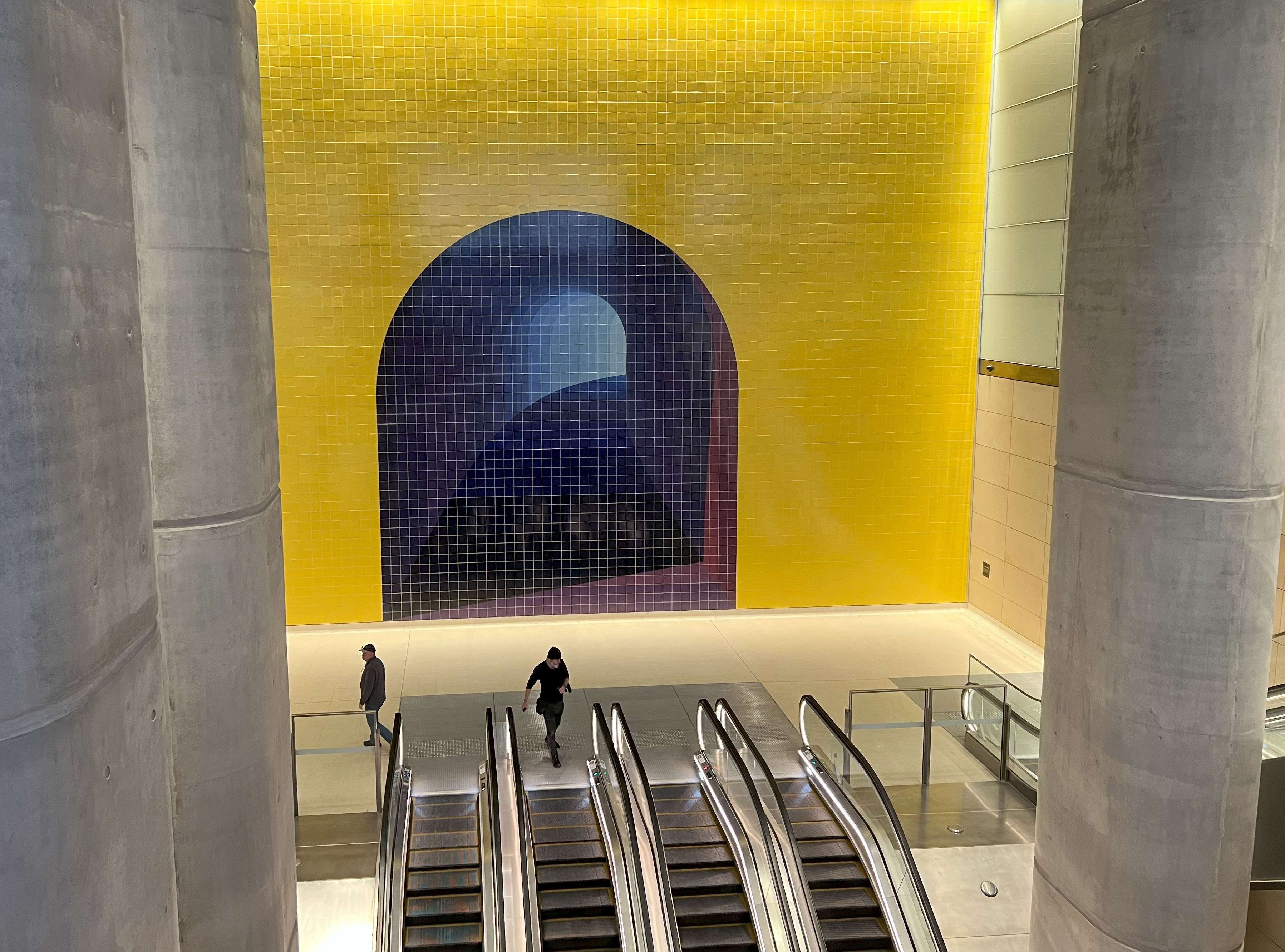
Gadigal Station entrance. Image: Alex Gooding
First, a quick recap. The first stage of what is now designated the Sydney Metro M1 Line from Tallawong in the northwest of Sydney through Epping to Chatswood opened in 2019. There was a lot of controversy about the development of this first stage, with many commentators (including me) saying the link should have been integrated with Sydney’s existing double-deck heavy rail suburban system instead of being constructed as a stand-alone, incompatible single-deck driverless metro.
Indeed, this line loosely followed the path of the Metropolitan Rail Expansion Program (MREP), an earlier proposal to construct a new heavy rail line servicing the growth centres of the northwest. This would have been linked via a harbour crossing continuing under the CBD to the existing heavy rail lines serving the growth areas to Sydney’s southwest.
This approach would have had the great advantage of providing flexibility in that the line could have been integrated with several existing lines both to the north and south of the harbour and CBD. However, the then recently-elected Liberal-National state government which had initially supported this approach later changed their minds and decided to pursue the stand-alone metro option.
As a result any existing rail line or lines would require conversion to metro standards to be linked to the metro. This occurred to a section of the existing line between Epping and Chatswood (which itself had opened as a suburban line only a few years earlier) which was incorporated into the first stage. The stage which opened yesterday was all newly built and did not require any conversions, but the final section which is due to open next year involves the conversion of the Bankstown line.
First impressions
The journey
Having travelled on the northwest section a few times in the past five years I had a sense of what to expect and venturing onto the Metro M1 line platforms at Central Station for the first time in the afternoon of the first day of service did not initially present any great surprises. This is mainly because the Central Metro concourse has been open since last year providing access for passengers between different parts of Central Station, and it has been possible to steal glimpses down the escalator shafts to the new Metro platforms.

Central Station Metro platform escalators. Image: Alex Gooding
The trains are also the same as those which have been in use in the northwest since 2019. By the time I took my first ride the mood of the other first-time passengers was quietly happy rather than celebratory, though there was also a sense of wonder both at the system’s performance and size and appearance of the new stations. Their responses closely resembled those of the passengers seen in footage who took the first trams across the Sydney Harbour Bridge after it opened in 1932.
Operationally the trains are the same as those on the Metro’s initial section, and the service is similarly frequent and fast. The lack of any transverse seating continues to be a disappointment but given the firm longitudinal seating of the metro trains the ride was reasonably smooth and generally no worse than on Sydney’s suburban trains.
However, I was surprised that despite running on brand new track the ride was a little choppy in places (but nowhere near as bad as some sections of the suburban network). There was also a bit of low-level squealing from the wheels on some of the tighter curves between Barangaroo and Martin Place but overall the trip was quick, quiet and comfortable.
The stations…
While the trains themselves and the Metro concourse at Central may have become familiar, a visit to the other underground stations in the new section is a revelation. They are much more diverse than the stations in the northwest section. This is particularly the case in the CBD, due in large part to significant pieces of public art installed in each station. In addition each station has been “dressed” differently, with different materials and finishes on the walls and ceilings.

Public art at Martin Place Metro Station. Image: Alex Gooding
Incidentally, I disagree with the criticisms of the high level of investment in public art at the new Metro stations. Somebody aptly described them on social media as “…testaments that our grandest places are not palaces, but gateways promising mobility for all”. I fully agree with this view – rail and metro stations should be the sites of substantial cultural investment in just the same way that other public buildings are.
However, the biggest element of surprise for me was how spacious the new stations seem, even compared to those in the northwest section which I described in my review five years ago.
In some cases the stations are actually of a similar size but layout changes, different designs and better lighting make them feel larger. For example, Victoria Cross has separate concourses at each end providing an atrium affect in between for the central platform below which gives it a very open feel. Even those stations where the area above the platform level is more enclosed there is plenty of space around the connecting escalator banks. This provides light and a sense of room down to the lower level, as well as sightlines from there back upwards, in some cases to the station entrance.

Victoria Cross Metro Station – view down to platforms. Image: Alex Gooding
All the stations also provide plenty of space at platform level. At most stations there is effectively a single but wide island platform with platform doors on both sides similar to the northwest stations, but at Gadigal station the tunnels run parallel a whole city block apart under Pitt and Castlereagh Streets. At Martin Place the tracks swing across so the station is similarly located across the block between Castlereagh and Elizabeth Streets.

Martin Place Metro Station – passageway between platforms. Image: Alex Gooding
At both stations a “binocular” approach has been used, with two distinct and widely-separated platforms linked by interconnecting corridors. Of the two, Gadigal is more utilitarian in appearance, with two separate entrances through ticket barriers directly from Park and Bathurst Streets. From each entrance banks of escalators and lifts run to platform level, where wide pedestrian tunnels branch off to connect to each platform. The effect is similar to some of the stations on London’s Elizabeth line.

Gadigal Metro Station passageways. Image: Alex Gooding
Martin Place is much grander, with the station entrances and multiple concourse levels involving food and retail outlets integrated into the office buildings above, a result of a successful unsolicited proposal to develop the over-station sites. The northern entrance can be accessed from Castlereagh, Hunter and Elizabeth Streets, while the southern end is accessed from Martin Place.
At the northern end of Martin Place natural light is brought all the way down to the central area at platform level via the cut outs for the escalators. This central area is effectively a 45-metre wide corridor, wider than the passageways at Gadigal. The walls on both sides of this space are interrupted by generous sized walkways connecting to the platforms.
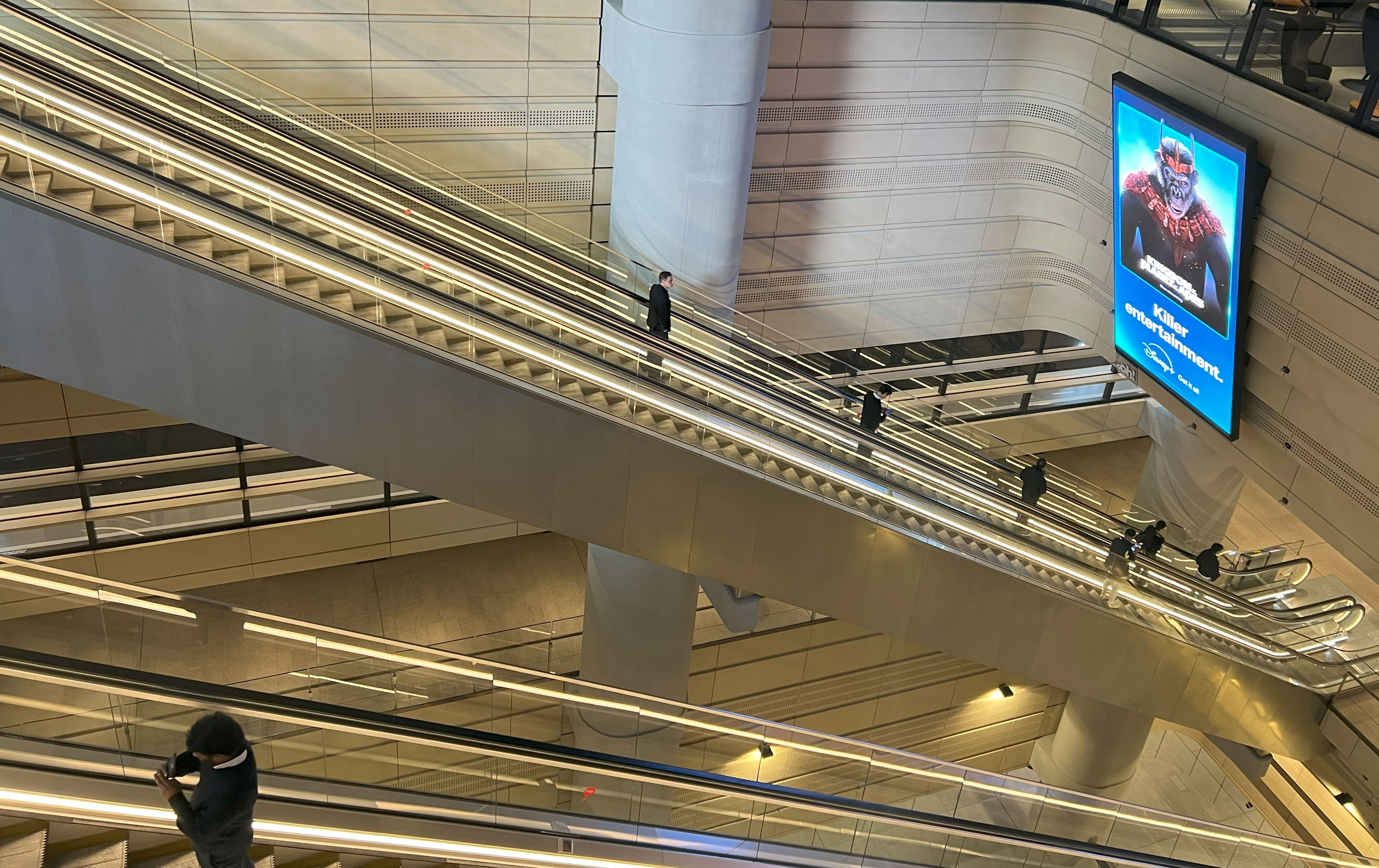
Martin Place Metro Station escalators. Image: Alex Gooding
All stations provide full disabled access with lifts from street level to the concourse and then to platform level and there are no gaps or steps between platforms and trains, though there has been some discussion on social media about the distances people with disabilities have to travel inside some stations. There are limited seats available at most stations, generally consisting of the “anti-homeless” variety, designed to stop people sleeping on them. Platform announcements are clear but sound mechanical. The screen doors not only considerably improve platform safety but also significantly reduce the sound of trains arriving and departing.
… and their locations
Many commentators, me included, have criticised the limited extent to which Sydney’s metro lines expand the footprint of the rail network in terms of coverage, particularly in Western Sydney. Several have been particularly critical of the way in which most of the stations in the new section of the M1 Metro are very close to existing railway stations, as shown in the table below.

The counter argument is that the Chatswood to Sydenham link is essentially an extension of the first stage of the metro which did greatly expand the rail coverage in Western Sydney by incorporating eight new stations. While employment containment within Western Sydney is to be encouraged, the reality is that roughly two-thirds of the region’s workforce is employed in eastern Sydney. Even with increased working from home arrangements post-pandemic, many of these workers will continue to travel to the CBD as well as to jobs in North Sydney and Macquarie Park.
The existing rail lines did not have the capacity to deal with the additional demand as population increases, so some form of additional connection from the northwest directly to these destinations and in particular the city centre was inevitable. While there was a lot of debate about how to do this, the metro as built involves a dedicated line from the northwest to the CBD broadly within the same corridor as the north shore rail line, but constructed underground with stations in different locations to the Sydney Trains ones.
Although I understand the logic, I can’t help but feel that a valuable opportunity was missed to bring the metro into the CBD via one of the many proposals for a completely new corridor, for example via Ryde, Gladesville and Drummoyne. This would have provided additional stations in areas not currently served by rail.
I am less concerned about the metro station locations and their proximity to existing stations in the city centre. Given the constrained size and shape of the Sydney CBD and the need for close integration with the existing rail network, it is logical that some would also be interchanges with suburban rail lines and inevitable that the remaining stations would be close to existing ones; Martin Place and Central were obvious choices for the interchange role.
Barangaroo station is the only CBD metro station to provide additional access to a part of the CBD not previously served by rail, but its location seems to be a compromise; ideally it could have been built further south but the design constraints of building the line from here to Martin Place seem to have prevented this. Similarly, making Gadigal a standalone station rather than an interchange with nearby Town Hall is logical given the capacity constraints on the latter. However, it could have been constructed a block or two further south to improve access from Haymarket.
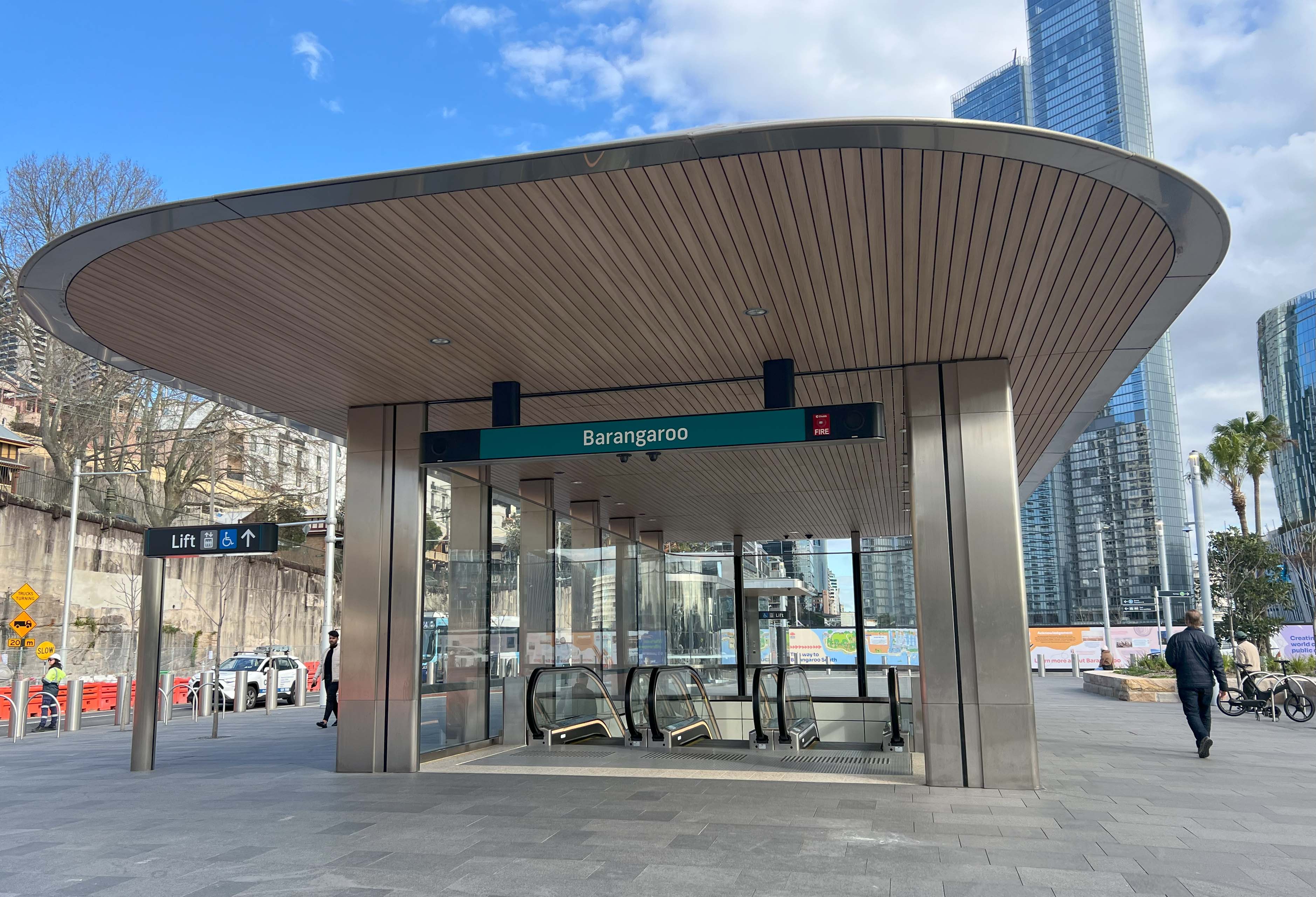
Baranagaroo Metro Station entrance. Image: Alex Gooding
The location of the remaining non-interchange stations outside the CBD is more problematic. On the north side, it is not entirely clear to me why Victoria Cross was not made either an interchange station with North Sydney station from which it is only 300m away, or conversely, why it wasn’t built further away from it to expand coverage. While Crows Nest is at least a reasonable distance from St Leonards railway station, it could have been closer to the Crows Nest shopping centre.

Crows Nest Metro Station. Image: Alex Gooding
However, the most unfortunate location selection in my view was the choice of Waterloo over the University of Sydney as the sole station location in the stretch between Central and Sydenham. This selection, driven by the desire of the previous state government to use the station as a catalyst to redevelop – and gentrify – the significant public housing in the Waterloo area means that the University and nearby Prince Alfred Hospital were bypassed, despite the tens of thousands of trips they generate.
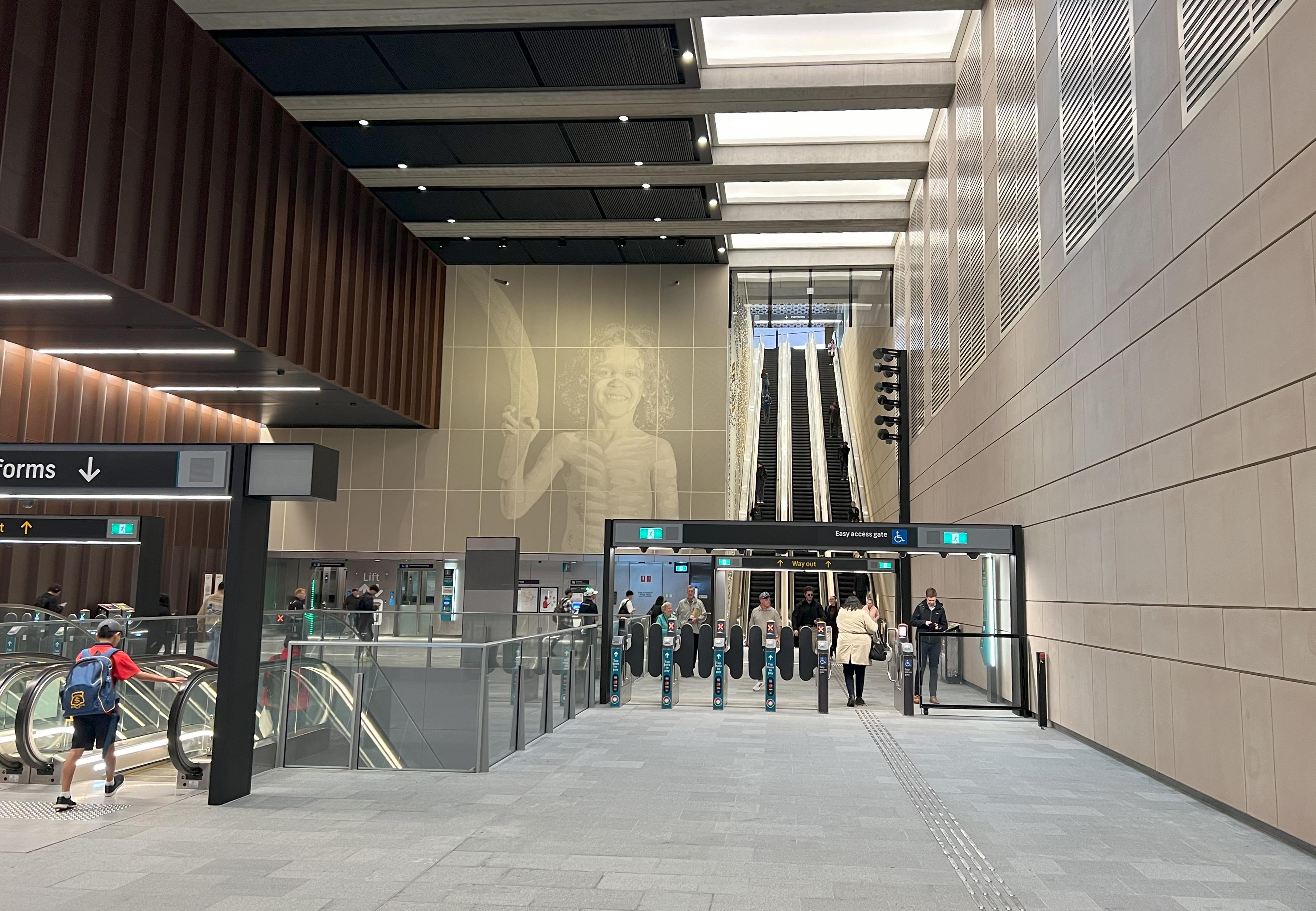
Waterloo Metro Station concourse. Image: Alex Gooding
This approach is in marked contrast to Melbourne’s metro project where Parkville Station will provide access to the University of Melbourne as well as two hospitals and other major health destinations. It’s unclear also why the University of Sydney and Waterloo options became a binary choice, when both locations could have been incorporated in the same way that the system’s designers were prepared to do to link Barangaroo and Martin Place.
Frequency and speed
The frequency of service is one of the Metro’s main selling points, with 15 trains an hour or every four minutes during peak times, 12 trains an hour or every five minutes in the inter-peak period on weekdays and six per hour or every 10 minutes at other times on weekdays and all day on weekends. This frequency provides a substantial increase in capacity but it also has to be said that most of the interchange stations served by the Metro were already receiving that frequency of service from the existing rail network as shown in the table below, albeit not always with such consistent spacing and sometimes involving different lines and platforms.
In most cases the Metro is time-competitive with Sydney Trains services, as also shown in the table. This compares both frequency of service and travel times between the same or comparable pairs of origin and destination stations for Sydney Trains and Metro services, and the extent of time saved (or in one case, lost) by taking the metro.

The most substantial saving is 11 minutes by using the metro from Epping to Gadigal Metro Station compared to the 40-minute trip on the T9 service to Town Hall Railway Station. On the other hand, Central Coast intercity expresses which stop at Epping take a minimum of 30 minutes to reach Town Hall even with a change to a suburban train, just one minute more than the metro. These trains are actually faster than the Metro from Epping to Central by 7 minutes due to their limited stopping pattern and the fact that the Metro route is slightly longer, but there are only four Central Coast trains on this route in the morning peak.
Generally the Metro has quicker station-to-station times than the suburban rail lines, though this is offset to some degree by the longer time it takes to access and exit most of the underground Metro stations and platforms. However, Metro travel times are likely to decrease in future when station dwell times are reduced and service frequencies increase, reducing waiting times.
Conclusion
There is no question that the Sydney Metro does what it was intended to do extremely well. It is easy to be seduced by the calm and unhurried way the trains turn up and depart at precise intervals without any drama, and the city centre stations in their scale and grandeur provide a marked contrast to their constrained century-old City Circle counterparts. As one journalist described her experience of walking through Gadigal Station, “[it] felt like being inside a futuristic movie, where the future is beautiful, sparkling and peaceful”.
There is also no question regarding the benefits that the eight new stations of the Metro’s first phase brought to north western Sydney, greatly expanding the rail network’s reach. There was also a compelling case for connecting this new line to the city in some way and in doing so increasing the rail system’s overall capacity.
However, there are questions about the strategic approach used to implement this critical task. The new extension has done little to further expand the rail system’s coverage beyond the current Sydney Trains’ North Shore to CBD corridor, and has added only one station to the south of the CBD. The conversion of the Bankstown Line due to be completed next year will undoubtedly add to the rail network’s overall capacity by taking trains out of the City Circle, but by itself will do nothing to increase the system’s coverage.
The overall $20.5 billion project cost (including the Bankstown line conversion) seems to be a very high price to pay for a relatively modest expansion in this coverage, even if the resulting increases in capacity translate to more frequent services across the network. Obviously, any questions about route selection or station location for the completed sections of the Sydney Metro are moot. The real question now is how the capacity created by the huge investment in this “beautiful, sparkling and peaceful” transport system can best be used to support substantial expansion of the rail network’s coverage in future, an issue I’ll look at in Part 2.
 StrategicMatters