
Kathleen Butler’s contribution to the construction of Sydney’s Harbour Bridge (and indirectly, her work on Sydney’s underground railway) was formally recognised with the unveiling of a Blue Plaque on the NSW Chief Secretary’s Building yesterday (Tuesday 6 August 2024).
The Blue Plaques program is a NSW Government initiative to connect people to the “hidden history and heritage of NSW”. Based on public nominations, the program shares the often little-known stories of the people and events who have been important in shaping the history of NSW. Butler’s nomination was made by Engineers of Australia Sydney branch based on the work of member Bill Phippen.
Butler’s recognition is long overdue, and I am pleased to have had some input to the increasing interest in her story. In 2018 I started researching a series of articles for this blog on John Bradfield who in the first decades of the 20th Century literally shaped the future of Sydney’s development through his work on developing Sydney’s underground railway, electrification of the suburban rail network and above all the construction of the Sydney Harbour Bridge.
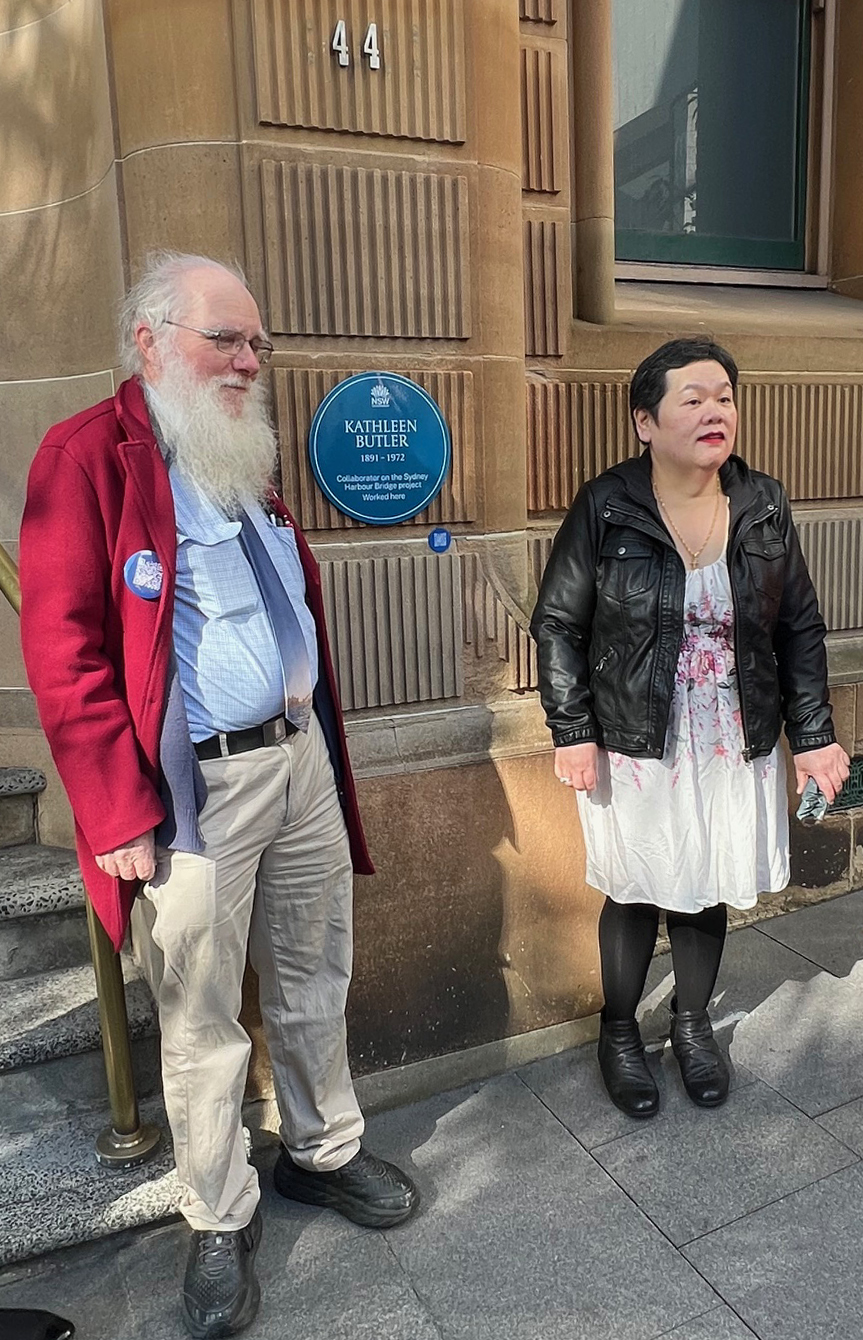
Unveiling of the the Blue Plaque commemorating Kathleen Butler’s work by Engineers of Australia member Bill Phippen and Engineers of Australia Sydney president Olivia Mirza. (Source: Alex Gooding)
In this series of articles I wanted to concentrate on Bradfield’s ideas and how they shaped the development of these projects, rather than on the projects themselves, drawing on his writing and in particular his thesis for the degree of Doctor of Science in Engineering which he was awarded by the University of Sydney in 1924. In doing so I was immediately struck by the praise he lavished in the preface to his thesis on “Miss K.M. Butler”, his confidential secretary, and decided to follow up her story.
This led me down an absorbing and very interesting rabbit hole. As I noted in the article I wrote about her in 2018, Butler seems to have largely slipped from public view, a fate she doesn’t deserve, “not only because of her substantial contribution to the building of the bridge, but also because her story provides a fascinating perspective on the lives of working women in the early 20th Century, with some lessons for us today”.
I won’t reiterate Butler’s life story but in brief she was born in February 1891 in Lithgow NSW and worked as a clerk/typist in the government testing office at the ironworks there until transferring to the NSW Department of Public Works in Sydney in 1910. In 1912 Bradfield selected her as the “first officer” of his new branch, which was a remarkable achievement for a 21-year-old woman without any formal technical training.
This was the start of her close professional relationship with Bradfield which was to last 15 years. Butler helped Bradfield’s develop the tender specifications for the Sydney Harbour Bridge and dealt with enquiries from tenderers all over the world while he travelled overseas in early 1922. In addition, she drafted the “clear and informative notes” that accompanied the final legislation authorising the bridge’s construction which “materially assisted the passage of the Bill” through the NSW Legislative Assembly.
Butler was the “only woman present” both for the opening of the Bridge tenders in January 1924 and the signing of the contract for its construction a few months later. She was also the chief publicist for the bridge’s construction, drawing from Bradfield’s notes to write dozens of articles for the Sydney press. Later in 1924 she travelled to London with three engineers to finalise design details, organise the contract and to review documentation with the successful tenderer.
However, while Butler would return to “enter in earnest on the six-years job of constructing the harbor bridge” in 1927 her career was over, as she “retired” to marry Maurice Hagarty, a grazier from Cunnamulla in Queensland. Of course, this was really a forced resignation; until the early 1960s women in the public service had no option but to resign if they married. At this point Butler virtually disappeared from public life until her death in 1972, though she did attend the bridge opening in 1932.
My article on Butler generated some interest in the media over the years (including a two-part podcast about her life made in 2022 by Michael Adams) but there was little in the way of formal recognition for her, except the naming in 2019 of a tunnel boring machine for the Sydney metro “Kathleen”. However, former Sydney engineer and now historian and writer Bill Phippen had also begun to research her story which formed the basis for the Engineering Blue Plaque nomination.
So yesterday the Blue Plaque was unveiled by Bill and Engineers of Australia Sydney President Olivia Mirza in front of a small gathering outside the 1870s Chief Secretary’s Building in central Sydney. This was where the tender opening and signing for the Bridge which Butler attended took place over a century ago, and we were lucky after the unveiling to have a guided tour of several rooms on the third floor which are virtually unchanged from the 1920s.. These include the Colonial Secretary’s office (once occupied by Sir Henry Parkes) and the Minister’s office where the tender opening and signing took place.
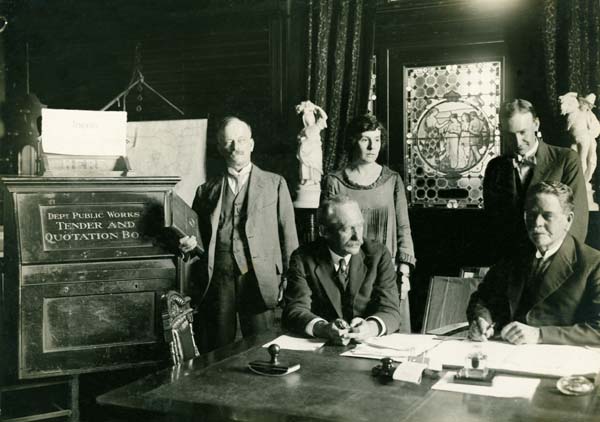
“The only woman present” – Kathleen Butler at the opening of tenders in the Minister’s office in January 1924 with John Bradfield (standing left) (source: NSW State Archives)
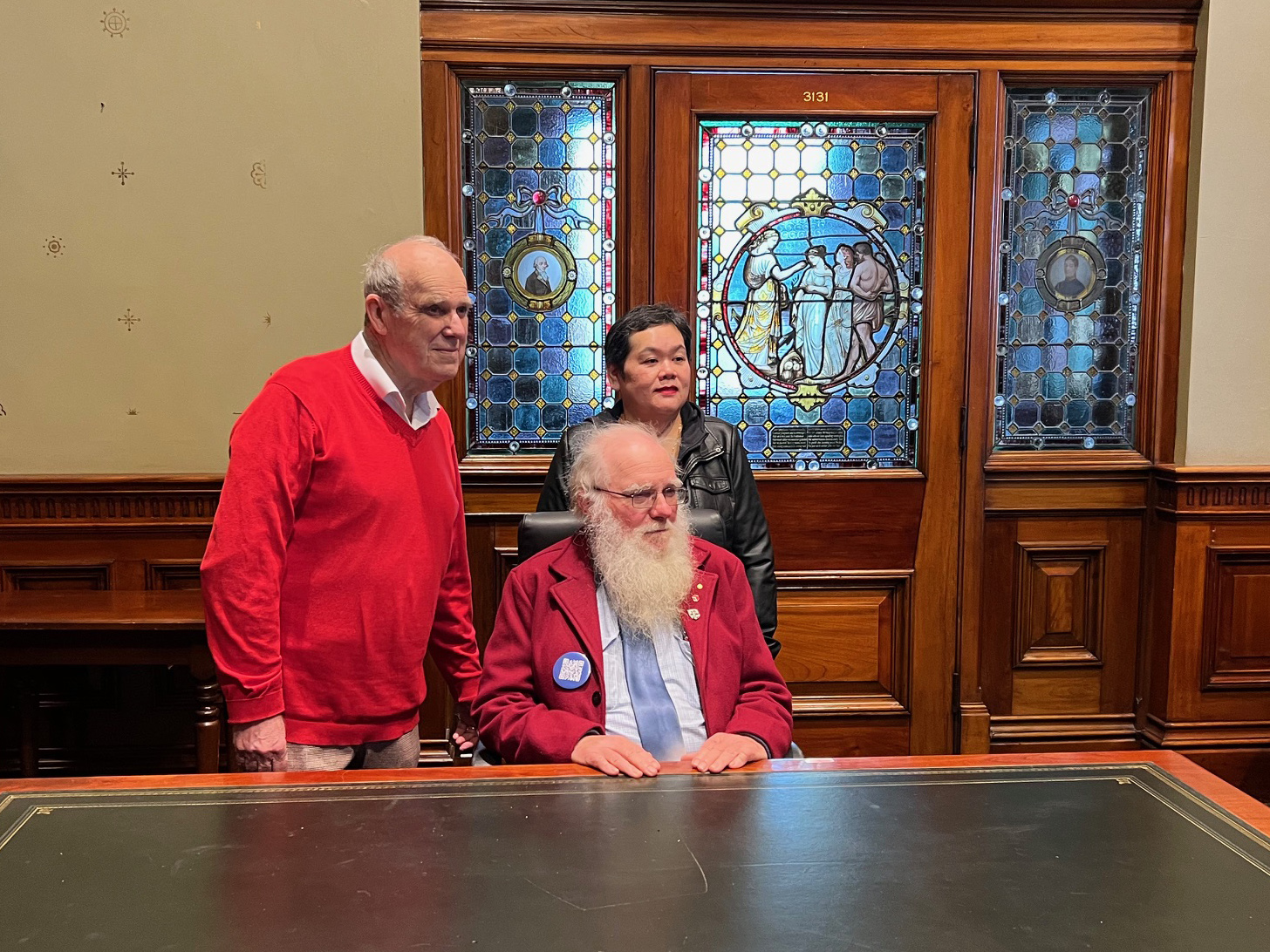
John Bradfield’s grandson Jim Bradfield, Bill Phippen and Olivia Mirza “reenact” the opening of the Bridge tenders a century later in the same room. Source: Alex Gooding
The unveiling finished with several speeches reflecting on Butler’s pioneering role, including contributions by Bill Phippen, Olivia Mirza and John Bradfield’s grandson Jim Bradfield, who commented on his pride at his grandfather’s recognition over a century ago of Butler’s ability and acceptance that as a woman she could play such an important role.
The unveiling has also rekindled my interest in Butler, her substantial contribution and above all how she managed to succeed in what was such an unusual career for a woman in early 20th century Australia. This is a story whose relevance echoes down the decades to modern Australia a century later, so I’m hoping to pursue it further.
 StrategicMatters